 Blaine Roofing
 Semiahmoo's Climate Is Rougher on Siding Than Most Homeowners Realize
Semiahmoo sits right where Whatcom County meets Semiahmoo Bay, and that waterfront position comes with a trade-off. The same view that makes these homes desirable also means near-constant exposure to salt-laden air, wind-driven rain off the water, and a wet, shaded moss season that can stretch for months. Siding here doesn't just get rained on — it gets rained on sideways, and it stays damp longer than siding a few miles inland because of shade, humidity, and slower drying winds near the water.
Over years, that combination is hard on almost every siding material except the ones specifically engineered for it. Wood-based products absorb moisture and swell. Vinyl can warp or crack in temperature swings and offers no real defense against moss and algae staining. Fasteners and trim corrode faster in salt air if they're not rated for it. None of this is exotic — it's just what happens when a building material spends decades a short distance from saltwater in the Pacific Northwest.
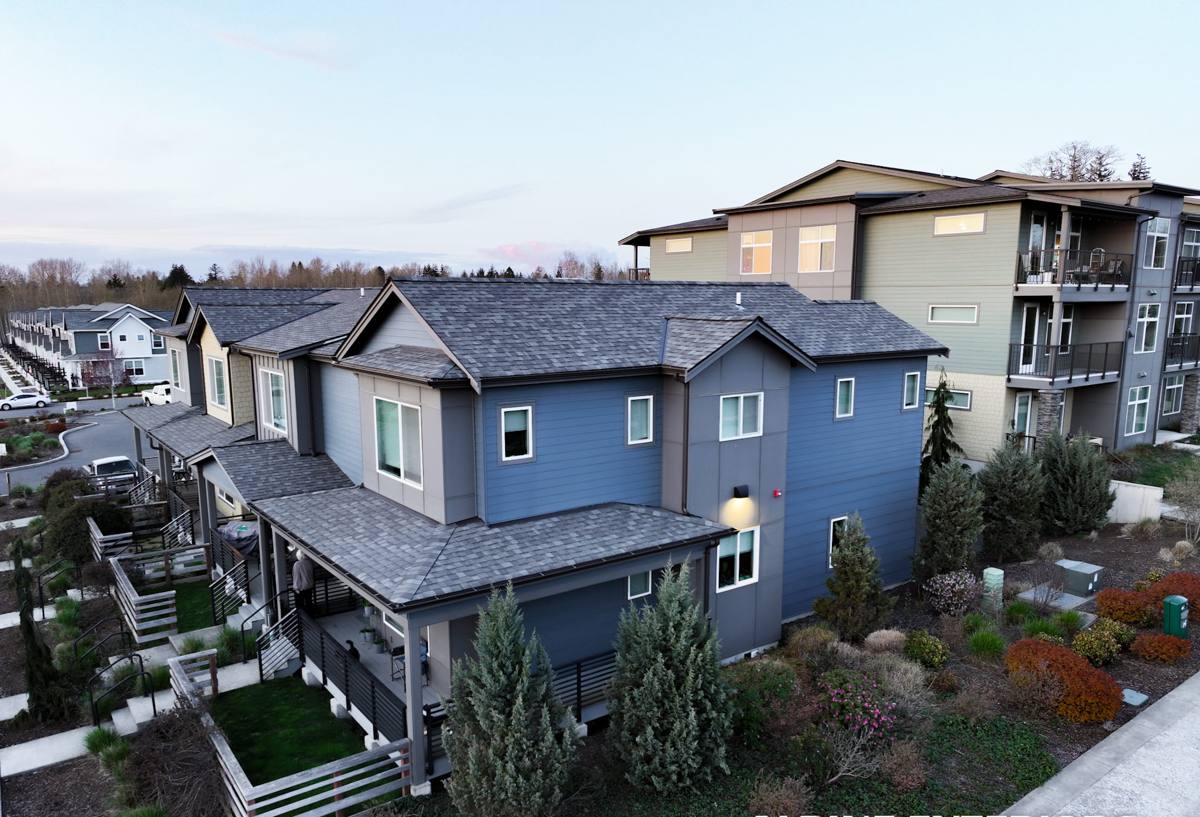
Why We Install Only James Hardie Fiber Cement
Blaine Roofing Co made a deliberate decision to install James Hardie siding exclusively — not LP SmartSide, not vinyl, not Cemplank, Allura, primed spruce, or cedar. That's not a marketing position, it's a maintenance and longevity call based on what actually holds up in this climate over time.
James Hardie fiber cement is non-combustible, doesn't absorb water the way wood-based siding does, and comes with a factory-applied ColorPlus finish that's baked on rather than field-painted. That matters directly for a place like Semiahmoo: less moisture absorption means less swelling and less of the freeze-thaw and wet-dry cycling that eventually pulls seams and paint apart. A factory finish also holds color more consistently against salt air and UV exposure than most field-applied paint jobs.
We're not saying other products can't be installed correctly — some can, under the right conditions. We're saying that after years of doing exterior work in this specific corner of Whatcom County, Hardie is the one we're willing to stand behind with our own labor and warranty.
The HZ5 Climate Engineering
James Hardie makes region-specific product formulations called HZ (Hardie Zone) products. The Pacific Northwest, including Blaine and Semiahmoo, falls into a wetter climate zone, and Hardie's HZ5 formulation is engineered with that in mind — different moisture and freeze-thaw performance targeting than the formulations sold in drier regions. Installing the wrong zone product, or installing the right product incorrectly, undercuts the whole point of choosing it.
What a Correct Installation Actually Involves
Fiber cement siding is only as good as the water management system behind it. Most siding failures we get called out to inspect — regardless of brand — trace back to installation shortcuts, not the material itself. On a Semiahmoo home, where wind-driven rain is a regular event rather than an occasional storm, these details matter more than they would somewhere drier.
- A continuous, correctly lapped weather-resistive barrier behind the siding, not just housewrap stapled up and left to it
- Proper flashing at every window, door, and roofline penetration, integrated with the barrier rather than caulked over gaps
- Correct fastener type and spacing — corrosion-resistant fasteners matter more here than in a drier inland zone
- Manufacturer-specified gaps and clearances at trim, corners, and ground level so the siding can drain and dry
- Factory-cut and field-cut edges properly sealed per Hardie's installation instructions
- Ventilation behind the cladding so damp wall assemblies actually get a chance to dry between weather events
Skip any one of these and you can still end up with moisture problems behind a product that's rated to resist them. That's the installation-sensitivity trade-off worth understanding: Hardie siding is an excellent material, but it doesn't install itself correctly, and a rushed crew can undercut a good product just as easily as a mediocre one.
Moss, Algae, and North-Facing Walls
Semiahmoo's tree cover, shade patterns, and long damp season create ideal conditions for moss and algae growth on exterior surfaces, particularly on north-facing walls and areas that stay shaded most of the day. This isn't a defect in any siding product — it's biology responding to moisture and lack of sun exposure.
What you can control is how the siding handles it. ColorPlus factory finishes resist staining better than field-applied paint because the finish is more uniformly cured and bonded to the fiber cement substrate. Correct installation clearances also help — siding installed too close to grade, decking, or landscaping traps moisture and gives moss more to hold onto. Combined with periodic gentle cleaning (never high-pressure washing directly into seams), this keeps a home looking maintained rather than neglected through the wet months.
Our Process on a Semiahmoo Job
| Step | What Happens |
|---|---|
| Site walk and moisture check | We inspect existing siding, sheathing, and trim for hidden water damage before quoting anything |
| Product and color selection | HZ5 panel or lap siding selection, ColorPlus finish choice, trim and accessory matching |
| Weather barrier and flashing | Full removal of old cladding where needed, new barrier installed and integrated with window and door flashing |
| Installation to spec | Correct fastener schedule, gapping, and clearances per James Hardie's published installation requirements |
| Final inspection and cleanup | Walkthrough with the homeowner, warranty paperwork registered |
We size crews and schedule around Whatcom County's weather windows rather than pushing installation during heavy rain, which protects both the substrate and the finished product during the vulnerable open-wall period of a re-side.
Comparing What's Actually Available
Homeowners in Semiahmoo often get quotes for several different siding products in the same bid round. Here's an honest look at the trade-offs, not a sales pitch against the alternatives.
| Product | Moisture Behavior | Finish Durability | Fire Resistance |
|---|---|---|---|
| James Hardie fiber cement | Engineered for wet climates (HZ5), low absorption | Factory ColorPlus finish, long fade resistance | Non-combustible |
| Vinyl siding | Doesn't absorb, but can warp/crack in temperature swings | Color molded in, can chalk and fade over time | Combustible, can melt/deform near heat |
| LP SmartSide / engineered wood | Wood-strand core, sensitive to sustained moisture exposure | Field or factory finish, seams need maintenance | Combustible |
| Cedar / primed spruce | Natural wood, absorbs moisture without diligent maintenance | Requires repainting/staining on a recurring cycle | Combustible |
Every product on that list can perform reasonably well somewhere. Our position is narrower: for a bay-front, high-moisture, moss-prone location like Semiahmoo, fiber cement engineered for this climate is the material we're willing to put our name behind.
Why Hiring a Crew That Already Works Semiahmoo Matters
Siding installation isn't just about following a manufacturer's manual in the abstract — it's about applying it to the specific conditions of a specific site. A crew that regularly works Blaine and the Semiahmoo area already understands things a visiting or out-of-area crew has to learn on the fly: how far wind-driven rain travels up a wall on an exposed elevation, which sides of a house need extra attention for moss and shade, and how salt air affects fastener and trim choices over time.
That familiarity shows up in small decisions — flashing details at a water-facing gable, drainage planning at grade, fastener corrosion resistance — that don't show up on a glossy brochure but do show up ten years later in how the siding is holding up.
What to Ask Any Siding Contractor Before Hiring
- Are you a certified or preferred James Hardie installer, and can you show it?
- What HZ product line and finish are you specifying for this specific home and elevation?
- Will you show me the flashing and weather-barrier detailing before it's covered up?
- What's your fastener spec, and is it corrosion-rated for a coastal/salt-air environment?
- What does the manufacturer's warranty cover, and what voids it?
- Can you walk me through your process for handling wet-weather scheduling during the install?
Warranty and Long-Term Care
James Hardie backs its fiber cement products with a strong, transferable material warranty when installed to spec, and ColorPlus finishes carry their own finish warranty covering fade and chipping. Both of those warranties depend on correct installation — improper fastening, missing clearances, or skipped flashing details can affect warranty coverage even though the product itself was sound.
Beyond the warranty paperwork, a little ongoing care goes a long way in this climate: periodic gentle rinsing to keep moss and algae from establishing, keeping gutters clear so overflow doesn't run down the siding face, and prompt attention to any caulking or trim that starts to separate. None of it is heavy maintenance — it's just paying attention to a house that lives close to the water.
If you're planning a re-side in Semiahmoo or anywhere else around Blaine, we're happy to walk the property, look at what's actually happening with your current siding, and put together a straightforward, no-pressure estimate using the form below.