 Blaine Roofing
 Birch Bay's Siding Problem Isn't Like Bellingham's
Birch Bay sits right on the water, and that changes what siding has to survive. A few miles inland in Whatcom County, siding mostly has to deal with rain and cool, damp winters. On the bay, you add salt-laden air blowing off the water, wind-driven rain that hits walls sideways instead of dripping straight down, and a moss-and-algae season that runs longer than almost anywhere else in the county because the air rarely dries out. Homes facing the water take the worst of it, but even homes a block or two back get enough salt spray on windy days to matter over the life of a siding job.
This isn't a reason to panic about siding — it's a reason to be specific about what product goes on the wall and how it's installed. We install James Hardie fiber cement siding exclusively, and Birch Bay is one of the clearer examples of why that standard exists. A product that isn't built for salt exposure and constant moisture cycling will show it here faster than in a drier part of the county.
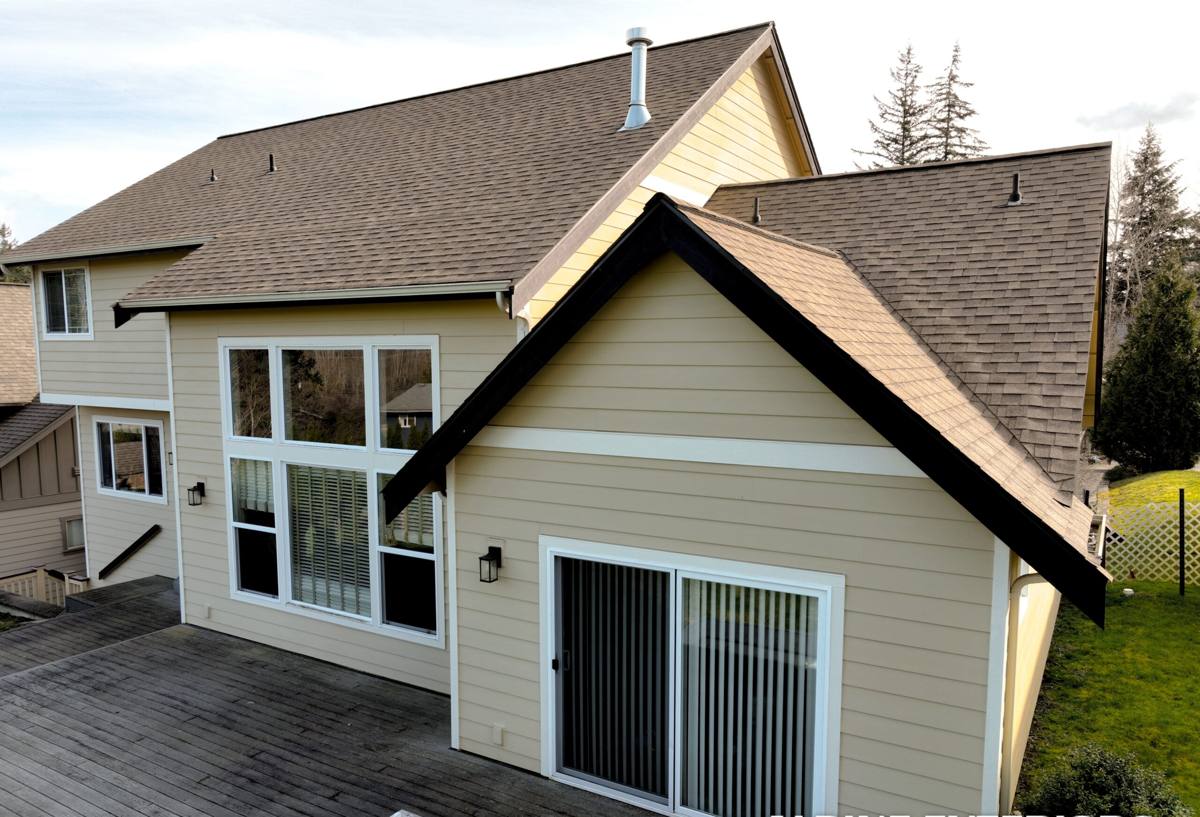
What Salt Air and Driving Rain Actually Do to Siding
Salt air doesn't rot siding directly, but it changes how everything else behaves. Salt residue holds moisture against a wall surface longer than plain rainwater would, which extends the time wood-based products and many coatings stay wet after a storm. That extra wet time is what feeds moss and algae growth, and it's also what accelerates fastener corrosion, paint failure, and — on products with wood or wood-composite cores — swelling and softening at joints and cut edges.
Wind-driven rain adds a second problem: water doesn't just run down the wall, it gets pushed sideways and upward into laps, seams, and any gap in flashing or caulking. A siding system that relies heavily on caulk and paint film to stay watertight is more exposed here than in a calmer inland location, because the wind is doing more of the work to find a way in.
Why This Matters More at Birch Bay Specifically
- Direct waterfront and near-waterfront homes get salt spray on windy days, sometimes several times a week in stormier months
- Marine air keeps humidity elevated even on days without rain, which is what feeds a long moss season
- Exposed, open-water-facing elevations take wind-driven rain at angles that shaded or inland walls rarely see
- Homes with limited roof overhangs get less natural protection at the top courses of siding
Why We Install Only James Hardie Fiber Cement Here
James Hardie siding is fiber cement — a mix of cement, sand, and cellulose fibers, not wood. That composition is the whole reason it holds up in a marine environment better than wood-based sidings. It doesn't have wood's grain structure to swell, split, or rot when it takes on moisture, and it's non-combustible, which matters in a region that also sees dry-season wildfire smoke and occasional burn bans.
James Hardie's ColorPlus factory finish is baked on under controlled conditions rather than field-applied, which gives it better adhesion and UV resistance than a job-site paint job — important on a coastline where sun, salt, and moisture are all working on the finish at once. Hardie also engineers regional product lines (HZ5 for our climate zone) specifically for moisture and freeze-thaw behavior, rather than selling one generic board everywhere.
We don't install LP SmartSide, vinyl, Cemplank, Allura, primed spruce, or cedar. Some of those are reasonable products in the right setting — this isn't about calling them bad. It's that we've standardized on one system we can install, flash, and warranty consistently, and for a coastal climate like Birch Bay's, fiber cement with a factory finish is the version of that system we trust most.
HZ5: The Product Line Built for This Climate
James Hardie makes climate-specific product lines rather than a one-size-fits-all board. Whatcom County, including Birch Bay, falls into Hardie's HZ5 zone, engineered for regions with sustained moisture exposure and freeze-thaw cycling. That's the line we spec for Birch Bay jobs by default — not a downgraded "budget" version, but the version matched to what this coastline actually does to a wall over a 30- or 40-year span.
| Feature | Why it matters at Birch Bay |
|---|---|
| Fiber cement core | Doesn't swell, rot, or delaminate the way wood-based siding can when repeatedly wetted by wind-driven rain and salt spray |
| HZ5 engineered formulation | Matched to sustained coastal moisture and freeze-thaw cycling rather than a generic national spec |
| ColorPlus factory finish | Baked-on finish resists salt and UV fading better than field-applied paint, and holds color longer between repaints |
| Non-combustible material | Reduces wildfire ember risk during dry-season burn bans, on top of the moisture performance |
| Manufacturer transferable warranty | Backed by product performance data, not just a contractor's word — matters if you sell the home |
What a Correct Installation Involves
Fiber cement siding's coastal performance depends almost entirely on installation quality — the product can only do its job if the details behind it are right. This is where a lot of siding problems actually originate, on any product, in any climate: not the material, but gaps in flashing, fastening, and clearances that let water in behind the surface.
Details we hold to on every Birch Bay job
- Correct water-resistive barrier and rainscreen or drainage gap behind the siding, so any moisture that gets past the surface can drain and dry instead of sitting against the wall
- Proper flashing at every window, door, deck ledger, and roof-to-wall transition — the places wind-driven rain actually finds a way in
- Manufacturer-specified fastener spacing and type, since incorrect fastening is one of the most common causes of early siding failure on any coastal home
- Correct clearance from the siding to grade, decks, and roof lines, so standing water and splash-back don't sit against the bottom course
- Sealed and caulked joints only where Hardie's install spec calls for them — not as a substitute for proper flashing
A crew that treats these as optional, or that installs Hardie the same way they'd install any siding product, is the most common reason a fiber cement job underperforms. The product is only as good as the water management behind it.
How We Approach a Birch Bay Job
Every Birch Bay project starts with a walk of the exterior, looking specifically at which elevations face the water and prevailing wind, where the existing siding or sheathing shows moisture damage, and what the flashing situation looks like at windows, decks, and rooflines. On homes with existing wood or composite siding, this is also where we find out how much moisture has already gotten behind the wall — something that isn't always obvious from the outside.
- On-site assessment of exposure, existing damage, and flashing condition
- Written estimate specifying HZ5 product, profile, and color, plus any sheathing or flashing repair needed before siding goes on
- Removal of old siding with a check of the water-resistive barrier and sheathing underneath
- Correction of any flashing, drainage gap, or sheathing issues found — not just covering them up
- Installation to Hardie's fastening and clearance spec, with attention to the specific elevations taking the worst wind and salt exposure
- Final walkthrough covering warranty registration and basic care
Why a Crew That Already Works Birch Bay Matters
Siding installation on a shoreline property isn't identical to installation three miles inland, even with the same product. A crew that regularly works Birch Bay has already seen how wind loads behave on open, water-facing elevations, where salt buildup tends to concentrate, and which flashing details actually hold up here versus which ones look fine on installation day and fail in year three. That's not something you get from a spec sheet — it comes from doing the work on this specific stretch of coastline repeatedly.
We're based in Blaine and work this part of Whatcom County regularly, which means Birch Bay jobs aren't a special trip or an unfamiliar environment — it's where we already are.
Ongoing Care for Birch Bay Homes
James Hardie siding is low-maintenance compared to wood, but "low-maintenance" isn't "zero-maintenance," especially this close to the water. A little regular attention keeps both the siding and the finish performing for the long haul.
- Rinse salt residue off the exterior a few times a year, especially on water-facing walls, using a garden hose — no pressure washer directly at seams or joints
- Keep gutters and downspouts clear so runoff doesn't sheet down the siding face
- Trim back vegetation and keep mulch or soil from piling up against the bottom courses
- Watch for moss or algae starting at shaded, low-airflow areas and address it early rather than letting it establish
- Check caulking at trim and penetrations annually and have any cracked or missing caulk redone promptly
- Have flashing and butt joints checked periodically, particularly after major windstorms
What Drives the Cost of a Birch Bay Siding Job
| Factor | Why it affects your project |
|---|---|
| Home size and elevation exposure | Water-facing walls often need more flashing detail work than sheltered ones |
| Condition of existing sheathing | Hidden moisture damage found during tear-off adds repair scope before siding can go on |
| Siding profile and trim complexity | Lap width, panel vs. plank profiles, and trim detailing all affect labor and material |
| Color selection | Factory ColorPlus finishes carry different pricing than field-painted primed board |
| Access and site conditions | Waterfront lots, retaining walls, and limited staging area can affect labor time |
We won't quote a number without seeing the house, but we're upfront about what we find during the walk-through and won't pad a bid with work that isn't needed.
If you're planning a siding project on a Birch Bay home, we're happy to take a look and walk you through what your home specifically needs — no pressure, no obligation. Use the form below to request a free estimate.