 Blaine Roofing
 Deck Building in Sandy Point: A Waterfront Job, Not a Standard One
Sandy Point sits right on the water on the edge of Whatcom County, close enough to the Strait of Georgia and Semiahmoo Bay that a deck out here lives in a different environment than one built ten miles inland. It's a community built around beach access and water views, which means most decks are also the most exposed structure on the property — out past the roofline, catching wind and spray straight off the water with nothing to break it up. We work throughout Blaine and the surrounding coastline, and Sandy Point is regular territory for our crew, enough that we've watched the same mistakes show up on the same style of deck, year after year, when the build didn't account for where it sits.
A deck built to a generic spec — the kind that would hold up fine in a sheltered inland yard — tends to show problems early in a place like this. Loose railings, corroded fasteners, soft boards near the ledger, a slick green film underfoot for half the year. None of that is inevitable. It's the predictable result of building the same way everywhere instead of accounting for salt air, driving rain, and a moss season that runs longer here than it does even a short distance inland.
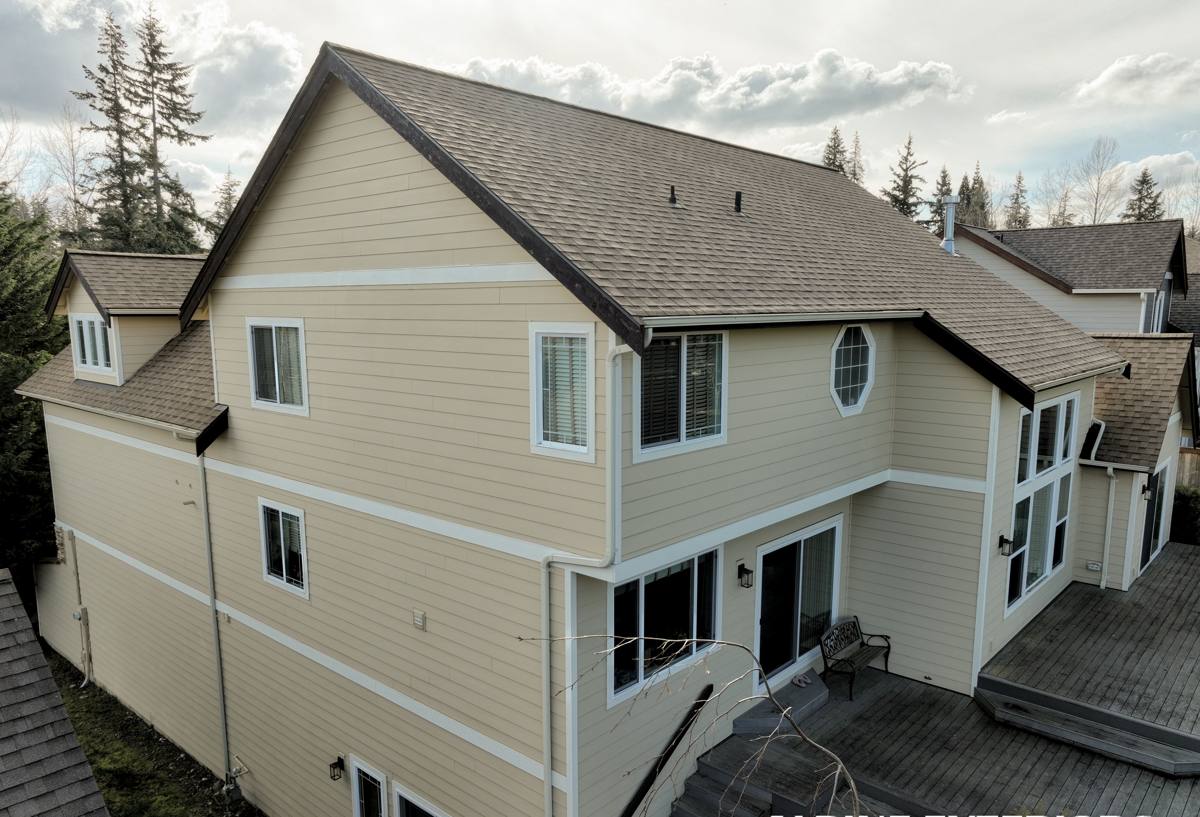
What Sandy Point's Climate Does to a Deck
Salt Air, Close to the Water
Airborne salt off the water is a constant, low-level presence on any property near the beach, and it's harder on exposed exterior structures than most homeowners expect. It accelerates corrosion on fasteners, hardware, and any exposed metal connector, and it wears down lower-grade coatings and finishes faster than they'd wear in a dry inland climate. On a deck, that shows up first in the fasteners and hardware — the parts holding the whole structure together — long before it's visible in the decking boards themselves.
Driving Rain Off the Water
Storms coming off the water don't fall straight down. Wind drives rain sideways, into railing posts, ledger connections, and any joint where two pieces of framing or decking meet. That sideways load finds gaps a careless build would leave behind, and it's a harder test on flashing and fastening details than the same total rainfall would be in a calmer, more sheltered spot. Sandy Point's open exposure to the water means this pattern shows up more often, and with more force, than it does on a deck tucked into a more protected yard.
A Long Moss Season
Mild temperatures and near-constant moisture add up to a moss and algae season that can run most of the year on shaded decks or ones that don't get much direct sun through the winter. Moss doesn't just look bad — it holds moisture against the decking surface and makes boards slick and genuinely dangerous underfoot, especially on stairs. Any decking material with surface porosity becomes a growth surface over time, which is a real factor in choosing what to build with out here.
Choosing a Decking Material for a Waterfront Property
There's no single "correct" decking material for every budget and every homeowner, but out here the trade-offs are sharper than they'd be inland. Some materials handle salt air, standing moisture, and moss pressure better than others, and the gap between a good choice and a poor one shows up faster on a waterfront lot than it would further from the coast.
| Material | How It Handles Salt Air & Moisture | Moss & Maintenance | Typical Lifespan |
|---|---|---|---|
| Pressure-treated wood | Holds up reasonably well if fasteners and hardware are corrosion-resistant; the wood itself needs ongoing protection | Needs regular cleaning, sealing, and moss treatment to stay ahead of a coastal moss season | 10–15 years with consistent upkeep |
| Cedar | Naturally more rot-resistant than most softwoods, but still an organic material exposed to constant moisture | Grays and can host moss without regular cleaning and periodic sealing | 15–20 years with upkeep |
| Composite decking | Doesn't absorb moisture the way wood does; performs consistently in salt-air, high-moisture conditions | Lower maintenance, but still needs periodic cleaning — surface texture affects how easily moss and algae take hold | 25–30 years, backed by manufacturer warranty |
| PVC decking | Fully synthetic, no wood fiber content to absorb moisture or feed rot | Lowest maintenance of common options; smooth-surface boards resist moss better than textured ones | 25–30+ years, backed by manufacturer warranty |
We'll build with any of these depending on a homeowner's budget and preference, but we're honest about the trade-offs up front. Wood costs less at the outset and has a natural look many people prefer, but it asks for real, ongoing maintenance to perform well this close to the water. Composite and PVC cost more initially but ask much less of the homeowner over the life of the deck — a trade-off that matters more on an exposed waterfront lot than it would on a sheltered inland patio.
What a Correctly Built Deck Involves Here
The visible decking boards are the smallest part of what makes a deck perform well over time. Most of what determines whether a Sandy Point deck lasts is buried in the framing, fasteners, and flashing details that never get a second look once the boards are down.
- Footings sized and set for the soil and exposure: Waterfront and near-beach soils vary, and footings need to be sized and set to actually hold the structure through wind and moisture cycling, not just meet a bare minimum.
- Ledger board flashing done correctly: Where a deck attaches to the house is one of the most common failure points on any deck, and it's a bigger risk here — proper flashing keeps wind-driven rain from working its way behind the ledger and into the house framing.
- Joist tape or capping on framing lumber: A strip of protective tape over the tops of joists keeps standing moisture from sitting directly on cut lumber, which matters in a climate where things rarely get a chance to fully dry out.
- Corrosion-resistant fasteners and hardware throughout: Stainless steel or coated fasteners rated for coastal exposure, used consistently rather than just on the visible top surface.
- Proper board spacing and airflow underneath: Decking needs room to shed water and dry between rain events; tight spacing and poor under-deck airflow are a big part of why moss and rot take hold faster than they should.
- Stair and railing connections built to hold under wind load: Railings on an exposed waterfront lot take more direct wind than a sheltered deck would, and loose railing posts are one of the most common complaints we hear about decks built by crews unfamiliar with the area.
None of this is exotic work. It's the difference between following code as a minimum and building to actually perform in the conditions the deck will sit in for the next two or three decades.
Fasteners, Railings, and Hardware Near Salt Water
If there's one detail that separates a deck that holds up on Sandy Point from one that doesn't, it's the hardware. Salt air is relentless on exposed metal, and a deck is full of exposed metal — structural screws, joist hangers, post bases, railing brackets, and stair hardware all live outdoors, unprotected, for the life of the structure.
We use stainless steel or coastal-rated coated fasteners and connectors throughout, not just where they're visible. A hidden joist hanger that starts corroding a few years in is just as much a structural problem as a rusted railing bolt someone can see and feel — it's just a problem that shows up later, and usually as a surprise. On railings specifically, we pay close attention to post connections and cap details, since a loose or corroded railing post is both a maintenance headache and a real safety issue on a deck that's likely getting used for viewing the water.
Our Deck Building Process
- On-site assessment: We walk the property, look at sun exposure, prevailing wind direction, existing drainage, and how close the build sits to the water, before talking about materials or layout.
- Design and material selection: We go over decking material options honestly, including the maintenance trade-offs above, and design the layout, railing style, and any stairs around how the space will actually get used.
- Permitting: Deck projects generally require a permit, and we handle that process rather than leaving it to the homeowner.
- Demolition, if replacing an existing deck: Old decking, framing, and footings get removed and inspected — this step often reveals hidden moisture damage that shapes the rest of the build.
- Framing and structural work: Footings, posts, beams, and joists go in first, with flashing, joist tape, and corrosion-resistant hardware built in from the start rather than added as an afterthought.
- Decking, railings, and finish work: Boards, railings, and stairs go in last, with attention to spacing and drainage throughout.
- Final walkthrough: We go over the finished deck with the homeowner, including what maintenance the chosen material will actually need going forward.
What a Sandy Point Deck Needs From the Homeowner Afterward
No decking material is fully maintenance-free in this climate, even the low-upkeep synthetic options. What changes by material is how much work that maintenance actually takes.
- Sweep debris and standing leaves off the deck surface regularly, especially in shaded areas where moss takes hold fastest
- Clean the deck surface at least once or twice a year to stay ahead of moss and algae growth before it becomes established
- Check railing posts and stair connections periodically for looseness, especially after major windstorms off the water
- For wood decks, plan on resealing or restaining on a regular cycle rather than waiting until the wood already looks worn
- Keep gutters and downspouts near the deck clear so runoff isn't draining directly onto or under the structure
- Address any soft or spongy boards immediately — that's usually a sign of trapped moisture, not something that improves on its own
Cost Factors for a Sandy Point Deck
| Factor | What Drives the Cost | Coastal Consideration |
|---|---|---|
| Size and footprint | Square footage, number of levels, stairs | Larger decks mean more exposed fastener and railing connections to build correctly |
| Decking material | Wood vs. composite vs. PVC | Lower-maintenance materials cost more upfront but less over the deck's lifespan out here |
| Framing and footings | Height off grade, soil conditions, local code requirements | Footings need to account for wind exposure on an open waterfront lot |
| Railings and hardware | Railing style, cable vs. baluster, glass panels | Corrosion-resistant hardware throughout, not just on visible surfaces |
| Ledger and flashing detail | Complexity of the house attachment point | Correct flashing here is one of the most important places not to cut cost |
These are general cost drivers, not a quote. Every lot near the water sits a little differently — sun exposure, wind direction, existing drainage, and soil all vary from property to property, so we walk the site before putting a real number on the work.
Why a Local Crew Matters in Sandy Point
A crew that builds decks across Whatcom County's coastline regularly sees how salt air, driving rain, and moss actually behave on real waterfront decks over a full year, not just how a product performs on a spec sheet. That experience shapes practical decisions on build day: where extra flashing attention pays off, which sides of a deck stay wet the longest, and which fastener and hardware choices are worth the added cost so a homeowner isn't dealing with a loose railing or a soft board a few years in. Sandy Point's exposed position on the water isn't the same as a sheltered inland yard, and a deck built by a crew that knows the difference performs accordingly instead of following a generic, one-size-fits-all approach.
If you're planning a new deck or replacing an aging one in Sandy Point, we're glad to walk the property and give you a straightforward, honest assessment of what it needs. Reach out using the form below for a free, no-pressure estimate.