 Blaine Roofing
 Roofing Built for Where You Actually Live
A new roof in Lynden has to do more than keep rain out. It has to hold up to a specific combination of conditions that Whatcom County throws at it year after year: salt-laden air drifting in off the Strait of Georgia and Semiahmoo Bay, long stretches of driving rain that comes in sideways more often than straight down, and a moss season that can run nine months out of twelve on a shaded, north-facing slope. None of these things are dramatic on their own. Together, over ten or fifteen years, they're what separates a roof that ages gracefully from one that starts failing early.
When we install a new roof for a homeowner in the Lynden area, we're not just matching what's on the house next door. We're building the system underneath the shingles, metal, or shakes to handle salt exposure, wind-driven moisture, and moss pressure specifically — because that's the environment the roof actually has to survive, not a generic Pacific Northwest average.
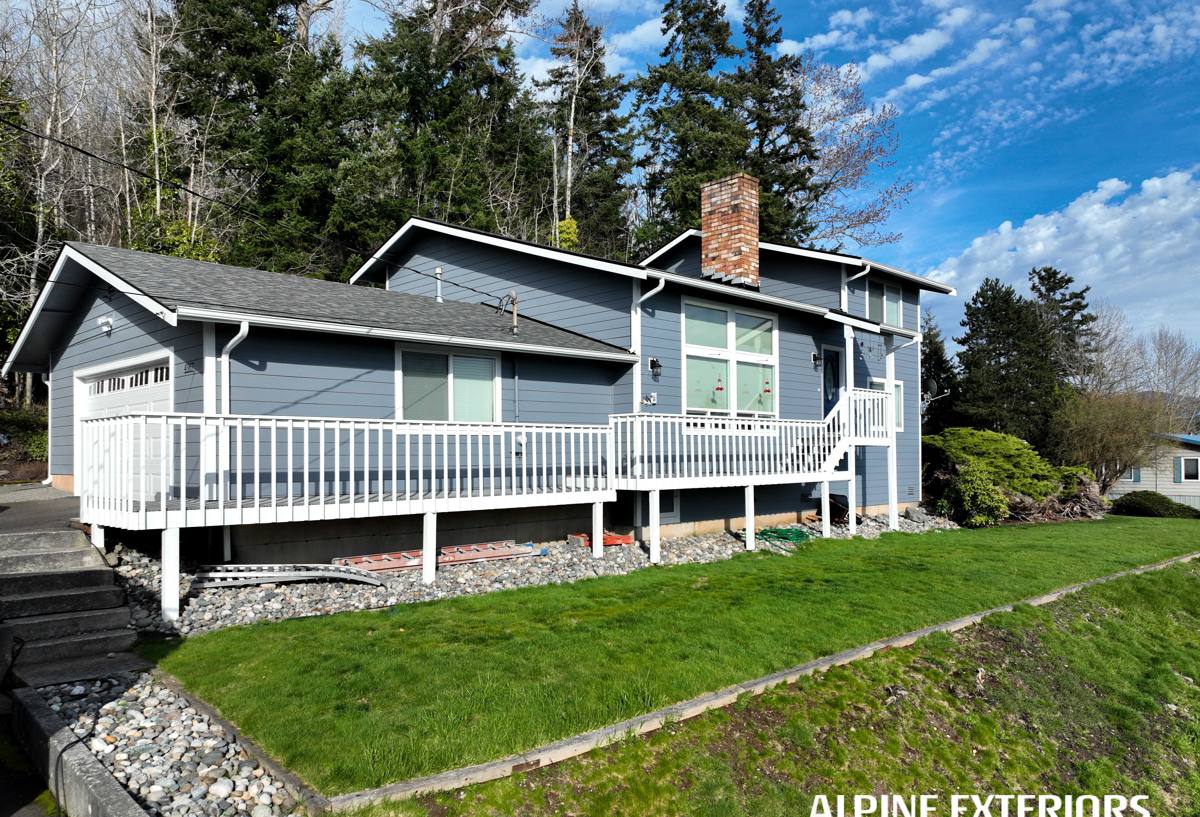
What Lynden's Climate Actually Does to a Roof
Salt Air
Proximity to the water means airborne salt settles on roofing surfaces and, more importantly, on exposed metal — flashing, fasteners, vents, and gutter hardware. Standard fasteners and lower-grade flashing corrode faster here than they would twenty or thirty miles inland. It's a slow process, but it's constant, and it's one of the most common reasons we see premature flashing failure on roofs that are otherwise in decent shape.
Driving Rain
Rain that comes in at an angle behaves differently than rain that falls straight down. It gets pushed up under shingle tabs, into open laps, and around fasteners that a calmer climate would never test. That means underlayment quality, shingle nailing pattern, and flashing detail at every penetration and edge matter more here than they would in a drier or calmer region. A roof that's "good enough" somewhere else can leak in Lynden.
Moss
Moss thrives on moisture and shade, and a lot of Lynden-area properties have mature trees and roof slopes that stay damp for days after a storm passes. Moss isn't just cosmetic — it holds water against the roofing surface, lifts shingle edges as it grows, and works its way under laps and flashing over time. A roof that isn't designed with moss resistance in mind will need more aggressive, more frequent maintenance to avoid real damage.
What a Correct Installation Actually Involves
A new roof is a system, not a single product. Getting it right in this climate means paying attention to every layer, not just the one you can see from the street.
- Tear-off and deck inspection: Full removal of the old roofing so the deck can be inspected for soft spots, rot, and prior leak damage — problems that get sealed in permanently if you roof over them.
- Deck repair: Any damaged sheathing gets replaced before anything new goes down. This is not an area to shortcut.
- Ice-and-water or self-adhering membrane at vulnerable areas: Eaves, valleys, and any low-slope transitions get extra protection against wind-driven rain and ice damming.
- Synthetic underlayment across the full deck: A continuous water-resistant barrier underneath the roofing material, sized and lapped correctly for our rain patterns.
- Flashing at every penetration: Chimneys, skylights, vents, and wall transitions — corrosion-resistant materials chosen with salt air in mind.
- Balanced ventilation: Intake at the eaves and exhaust at the ridge, sized to the attic, so moisture doesn't get trapped and shorten the life of the deck or the roofing material from underneath.
- Correct fastening and exposure: Manufacturer nailing patterns followed exactly, especially important in a wind-and-rain climate where under-fastened roofing fails first.
Skip any one of these and the roof might still look fine for a few years. The failures we get called out to fix almost always trace back to one of these steps being rushed or skipped, not to the shingle brand itself.
Choosing a Roofing Material for This Climate
There isn't one "best" roofing material for Lynden — there's a best fit for your home's slope, shade exposure, budget, and how long you plan to stay in the house. Here's how the common options actually compare in a salt-air, high-rain, moss-prone environment.
| Material | Moss Resistance | Salt Air Durability | Typical Lifespan Here | Maintenance Burden |
|---|---|---|---|---|
| Architectural asphalt shingle | Moderate (better with algae-resistant granules) | Good, with corrosion-resistant flashing/fasteners | 20-30 years | Moderate — periodic moss and debris removal |
| Standing seam metal | High — sheds moisture, little for moss to grip | Depends on coating and fastener grade | 40-60 years | Low |
| Cedar shake | Low without diligent upkeep | Moderate | 20-30 years with maintenance | High — regular treatment and inspection needed |
| Composite/synthetic shake or slate | High | Good | 40-50 years | Low to moderate |
We won't push cedar shake as a low-maintenance option here, and we're upfront about that. It can look excellent and last a long time, but only with consistent upkeep — moss and moisture are exactly what it struggles against in this specific climate. If you love the look, composite shake products give you a similar appearance with far less long-term maintenance, and we'll walk you through that trade-off honestly rather than just selling what's easiest to install.
Ventilation and Moisture Control — the Half of the Job Nobody Sees
Most roof problems that homeowners blame on "bad shingles" actually start underneath the shingles, in the attic. A roof deck that can't breathe traps moisture from everyday household humidity and from small amounts of condensation that build up over a damp Whatcom County winter. Over time, that trapped moisture softens sheathing, promotes rot, and shortens the life of the roofing material from below — even while the top surface still looks fine.
Correct ventilation means balanced intake (usually at the soffit or eave) and exhaust (usually at the ridge), sized to the square footage of the attic space. When we install a new roof, we check and correct ventilation as part of the job — not as an upsell, but because installing a new roofing surface over an unventilated deck just resets the clock on the same problem.
Our Installation Process, Step by Step
1. On-Site Assessment
We walk the roof and attic, check the deck condition, note slope and shade exposure, and talk through what your home actually needs — not a generic package.
2. Written Scope and Material Selection
You get a clear, itemized scope: tear-off, deck repair allowance, underlayment type, flashing plan, ventilation work, and the roofing material itself. No vague line items.
3. Permitting
Whatcom County and local building code requirements are handled as part of the job, not left for you to sort out.
4. Tear-Off and Deck Repair
Old roofing comes off, the deck is inspected in daylight, and any damaged sheathing is replaced before we move forward.
5. Underlayment, Flashing, and Ventilation
The protective layers go in first and get inspected before the finish material is installed — this is the stage that determines whether the roof actually performs in our weather.
6. Roofing Material Installation
Installed to manufacturer specification, with attention to nailing pattern, exposure, and detail work at valleys, edges, and penetrations.
7. Final Walkthrough and Cleanup
We walk the finished roof with you, confirm everything meets the agreed scope, and do a thorough magnetic sweep and debris cleanup of the property.
What Happens After Installation
A correctly installed roof still needs some basic upkeep to hit its full lifespan in this climate. This isn't about babying it — it's a short list of things that actually matter.
- Clear debris and needles from valleys and behind chimneys once or twice a year, especially under mature trees.
- Keep gutters clear so water isn't backing up under the roof edge during heavy rain events.
- Treat visible moss growth early, using methods appropriate to your specific roofing material — not every treatment is safe for every surface.
- Have flashing and fasteners visually checked every few years, given the corrosion pressure from salt air.
- Address attic ventilation if you notice condensation, musty smells, or ice damming in winter — these are early signs, not just cosmetic issues.
Cost Factors Worth Understanding
Roofing costs vary by square footage, roof pitch, number of penetrations, deck condition, and material choice, so we don't quote generic numbers without seeing the roof. What we can tell you is what tends to move the price in either direction on a Lynden-area home:
| Factor | Effect on Cost |
|---|---|
| Steep or complex roofline (multiple valleys, dormers) | Increases labor and material waste |
| Deck damage found during tear-off | Adds repair cost — budget a contingency |
| Upgraded underlayment or ice-and-water coverage | Modest increase, meaningful protection here |
| Material choice (asphalt vs. metal vs. composite) | Largest single variable in total cost |
| Ventilation corrections | Usually minor relative to overall project |
We'd rather flag a likely deck repair or ventilation issue during the estimate than surprise you mid-project. If your roof has known problem areas, tell us up front and we'll account for it in the scope.
Why It Matters That We Already Work in This Area
A crew that regularly works roofs in and around Blaine and Lynden already knows which flashing grades hold up to the salt air here, which slopes in the area tend to hold moss longest, and how local permitting and inspection actually run — not in theory, but from doing it repeatedly. That familiarity shows up in small decisions during the job: which fastener to use, how much ice-and-water membrane a particular valley needs, where ventilation tends to be undersized on homes of a certain age. Those are the details that separate a roof that performs for its full expected life from one that needs early repairs.
If you're planning a new roof for a home in the Lynden area, we're happy to take a look and give you a straightforward, no-pressure estimate — what your roof actually needs, what it will cost, and why. Use the form below to get started.