 Blaine Roofing
 Storm Damage Is Different From Ordinary Wear in Everson
Everson sits inland from Blaine but still gets the full brunt of Whatcom County's winter weather pattern: fast-moving frontal systems that bring driving, wind-blown rain, gusts strong enough to lift shingle edges, and long stretches of gray, damp weather that never quite lets a roof dry out. That combination is different from ordinary wear and tear, and it needs to be treated differently. Ordinary aging happens slowly and evenly. Storm damage happens in minutes, in specific spots, and it often looks minor from the ground while doing real harm underneath.
A single windstorm can lift a row of shingles just enough to break their seal without tearing them off. A hard, sideways rain can drive water up under a ridge cap or around a chimney flashing that's held fine for years. None of that shows up as an obvious hole. It shows up weeks later as a stain on a ceiling, or not at all until the decking underneath has already started to soften. That's the pattern we see most often on storm calls in this part of Whatcom County, and it's why we treat storm damage repair as its own service rather than a generic patch job.
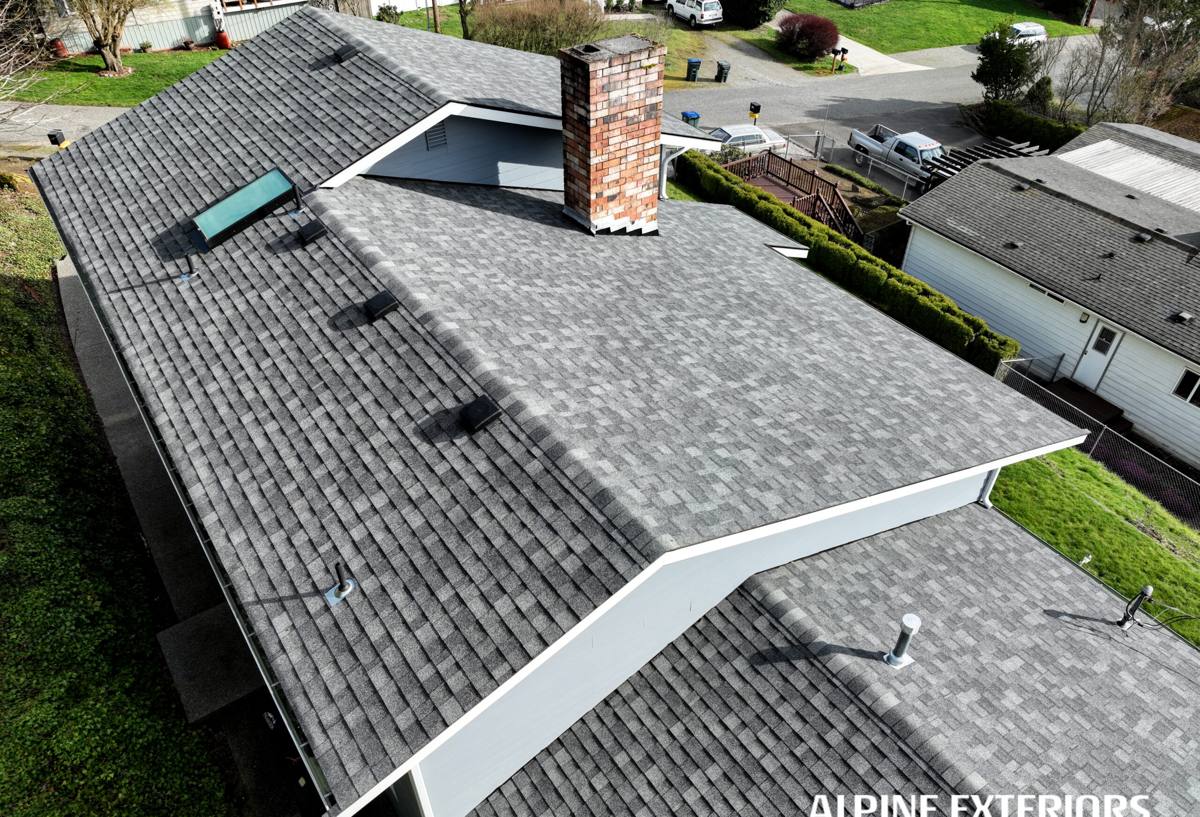
What Whatcom County Weather Does to a Roof Over Time
Three things define roofing conditions in this region, and Everson gets all three:
- Driving rain: wind-driven rain doesn't just fall on a roof, it pushes sideways and upward under laps, flashing edges, and fastener heads that a straight-down rain would never reach.
- Wind gusts during frontal passages: the storms that move through Whatcom County in fall and winter often carry gusts strong enough to work at shingle tabs, ridge caps, and loose flashing until something gives.
- A long moss season: the region's mild, wet stretch from fall through spring gives moss and algae months to establish themselves on north-facing slopes and shaded valleys, holding moisture against the roofing material and, over time, lifting shingle edges from underneath.
Coastal areas near Blaine also deal with salt-laden air that accelerates corrosion on exposed metal — fasteners, flashing, and gutter hardware in particular. Everson is far enough inland that salt exposure is a smaller factor than it is right on the water, but the same driving rain and moss pressure apply here, and a roof already weakened by storm impact is far more vulnerable to moss establishing itself in the damaged area afterward. Storm damage and moss damage often show up together for exactly that reason.
Signs Your Everson Roof May Have Storm Damage
Most storm damage isn't visible from the driveway. Here's what we tell homeowners to actually check for, or ask us to check for them, after a significant wind or rain event:
- Shingles that look slightly out of alignment, cupped, or raised at the edges compared to the rest of the slope
- Granules collecting in gutters or at downspout outlets after a storm — a sign the shingle surface has been abraded
- Any new ceiling stain, even a faint one, especially near a chimney, skylight, or roof valley
- Bent, creased, or missing flashing around vents, chimneys, or where a lower roof meets a wall
- Soft or spongy spots when walking the roof (we check this, not something to test yourself)
- Debris — branches, moss clumps, gravel-like granules — concentrated in one area of the roof after wind
Any one of these on its own might be nothing. Several together, or any sign paired with an interior stain, is worth a prompt look before the next rain event finds the opening.
What a Correct Storm Damage Repair Actually Involves
A rushed storm repair patches the visible symptom and leaves the underlying cause untouched. A correct one works backward from the water's actual path. That means:
Full slope inspection, not just the damaged spot
Wind and rain damage rarely stays confined to one shingle. We check the whole slope the damage occurred on, plus adjacent slopes and valleys, because wind uplift typically loosens a cluster of shingles even if only a few show obvious displacement.
Decking check, not just surface repair
If water has been getting under the roofing material for any length of time, the plywood or OSB decking underneath may have already started to soften. Replacing shingles over compromised decking doesn't fix anything — it just re-covers the problem. We check decking condition at every repair, not only when it's visibly obvious.
Flashing and underlayment, not just shingles
Most storm leaks trace back to flashing — around chimneys, vent pipes, skylights, and roof-to-wall transitions — or to underlayment that's torn or displaced, not to the shingles themselves. A repair that replaces shingles but ignores flashing condition is likely to leak again in the next storm.
Matching materials correctly
Shingle color and profile change over the life of a roof as products are updated. We match as closely as current manufacturing allows and are upfront when an exact match isn't possible, rather than leaving a homeowner surprised by a visible patch.
Our Storm Damage Repair Process
- Assessment. We inspect the affected area, the full slope, and adjacent vulnerable points — valleys, penetrations, and edges — and check the attic or ceiling below for signs of water intrusion.
- Written scope. You get a clear explanation of what's damaged, what's causing it, and what repair options exist, in plain language before any work starts.
- Temporary protection if needed. If there's an active leak or exposed decking, we can install temporary weatherproofing to stop further water intrusion while a full repair is scheduled.
- Repair. Damaged shingles, underlayment, and flashing are removed and replaced with matched materials, decking is repaired or replaced as needed, and all work is sealed and fastened to current standards.
- Final check. We walk the repair with you, confirm the area is watertight, and note anything else on the roof worth keeping an eye on.
Repair vs. Replace: How We Help You Decide
Not every storm-damaged roof needs full replacement, and not every roof is a good candidate for another round of patching. The right call depends on a few honest factors:
| Factor | Favors Repair | Favors Replacement |
|---|---|---|
| Roof age | Under roughly two-thirds of expected service life | Already near or past expected service life |
| Extent of damage | Localized to one area or slope | Spread across multiple slopes or recurring in the same spots |
| Decking condition | Solid, no soft spots found | Soft or delaminated decking found during inspection |
| Moss/algae history | Minimal, easily treated | Established growth that's already lifted shingle edges |
| Prior repair history | First significant repair | Multiple past patches, especially in different spots |
We'll always give you our honest read on which side of that table your roof falls on. If a repair is the sound, cost-effective answer, that's what we'll recommend — a storm repair company that pushes full replacement on every call isn't doing you any favors.
Insurance Claims and Storm Damage
Many storm repairs in this area are covered, at least in part, by homeowners insurance, since wind and storm-caused damage is typically distinct from gradual wear. If you're planning to file a claim, a few things help:
- Get an inspection soon after the storm — insurers often want documentation close to the event date
- Ask for a written scope and photos of the damage before repairs begin
- Avoid rushing into a repair with a "storm chasing" crew that shows up unsolicited after a weather event and pressures a same-day signature — a legitimate local contractor will document the damage and let you take that information to your adjuster
We're happy to provide documentation you can use in a claim. We don't handle the claim itself or promise a specific payout — that's between you and your insurer — but a clear, honest assessment makes that conversation easier.
Why a Crew That Already Works Everson Matters
Storm damage repair rewards local knowledge. A crew that regularly works Whatcom County roofs already knows which flashing details tend to fail first under sideways rain, how fast moss re-establishes on a shaded north slope after a repair, and what a normal amount of granule loss looks like versus storm-caused abrasion. That experience shortens the time between "something looks off" and "here's exactly what's wrong and what it'll take to fix it."
It also means faster response. Storm damage doesn't wait for a convenient week, and a contractor already working in and around Blaine and the surrounding county can get eyes on a damaged roof — and temporary protection up, if needed — well before a distant crew could even schedule a look.
Reducing Storm Damage Risk Going Forward
After a repair, a few habits go a long way toward keeping the next storm from causing a repeat problem:
- Keep gutters and downspouts clear so wind-driven rain has somewhere to go instead of backing up under roof edges
- Trim back tree limbs that overhang the roof — both for direct impact risk and because overhanging branches keep shaded areas damp longer, feeding moss growth
- Have moss and algae treated before it establishes rather than after shingle edges have already started lifting
- Schedule a roof check after any major wind event, even if nothing looks obviously wrong from the ground
- Address small flashing or seal issues promptly — they're inexpensive to fix early and expensive to ignore
If a recent storm has you wondering about your roof, or you've noticed any of the warning signs above, we're glad to take a look. We offer free, no-pressure estimates for storm damage repair in Everson and the surrounding Whatcom County area — just fill out the form below and we'll get in touch.