 Blaine Roofing
 Board and batten has a particular pull for homes in Birch Bay. The vertical lines read as classic beach-cottage and farmhouse at the same time, which fits a shoreline community where houses range from older cabins to newer builds trying to capture that same relaxed, coastal look. It's a siding profile people choose on purpose, not by default — and in a place like Birch Bay, sitting right on the water at the edge of Whatcom County, that choice comes with a climate that will find every weak point in the installation within a few winters if the details aren't handled correctly.
We install board and batten siding in Birch Bay regularly, and we install it in one material: James Hardie fiber cement. That's not a brand preference we picked at random. It's a professional standard we settled on after seeing how differently board and batten in other materials ages on a shoreline lot compared to a sheltered, inland one.
Why Birch Bay's Climate Is Hard on Board & Batten Siding
Board and batten has more vertical seams than a standard lap profile, and every one of those seams is a place water can try to get behind the cladding if the assembly underneath isn't built right. That makes the profile more climate-sensitive than lap siding, and Birch Bay's conditions are exactly the kind that expose a shortcut.
Salt Air Off the Water
Birch Bay is named for the water it sits on, and homes here — especially anywhere close to the beach — take a steadier dose of salt-laden air than towns set further inland. Salt accelerates corrosion on fasteners, staples, and any exposed metal flashing, and it breaks down lower-grade paint and field-applied coatings faster than a dry climate would. On a vertical profile with a batten strip nailed over every panel seam, the fastener count is higher than on lap siding, so corrosion-resistant hardware isn't optional here — it's the difference between battens that stay tight and ones that start bleeding rust streaks within a few years.
Driving Rain and Open Exposure
A beachfront or near-beach community like Birch Bay doesn't get much of a windbreak. Storms coming off the water push rain sideways into wall assemblies rather than letting it fall straight down, and that wind-driven moisture load is harder on a wall than the same rainfall total would be somewhere more sheltered. Vertical siding profiles depend on their water-resistive barrier and drainage plane to manage that sideways water, since the battens themselves are decorative and structural, not the primary waterproofing.
A Long Moss Season
Mild, consistently damp weather in this part of Whatcom County keeps moss and mildew active on shaded and north-facing walls for much of the year. Board and batten's vertical battens create small ledges and shadow lines that hold moisture a little longer than a flat lap profile does, particularly on tree-shaded lots set back from the beach. A material with any surface porosity becomes a growth surface in conditions like these faster than most homeowners expect.
What Board & Batten Actually Involves
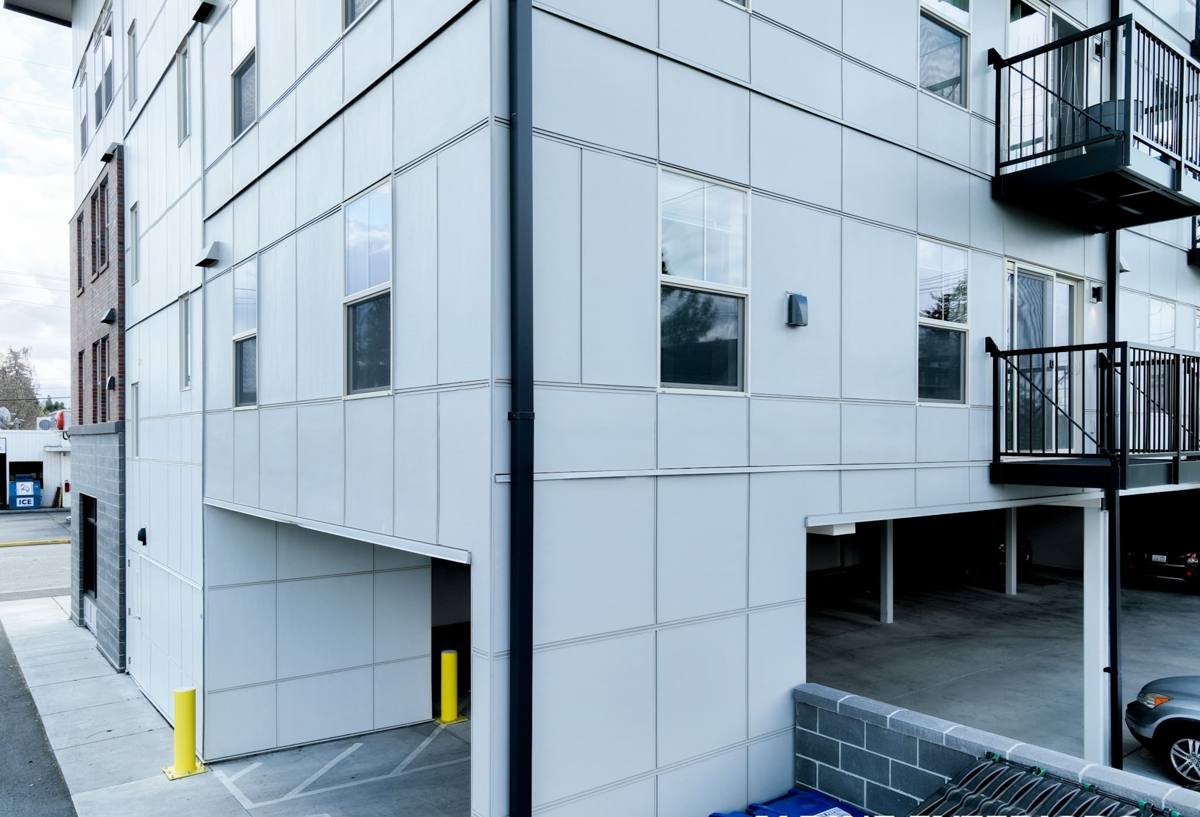
Board and batten construction uses wide, flat panels as the base layer, with narrower vertical strips — the battens — installed over the seams between panels. Historically this was solid wood, and it's still sold that way, but the modern version most people are choosing today is a fiber cement panel system with matching fiber cement or composite trim battens. The visual result is the same vertical-line look; the performance is not, because the water management happens in the layers homeowners never see rather than in the boards themselves.
The panels and battens are only the visible surface. Behind them, a correctly built assembly has a weather-resistive barrier, properly lapped and taped seams, and — in most coastal and high-moisture applications — a drainage gap that lets any moisture that does get past the cladding find its way back out instead of sitting against the wall sheathing. Skip any of those layers and the vertical seam count of a board and batten profile works against the house instead of just being a style choice.
Why We Only Install This in James Hardie Fiber Cement
We used to offer a wider range of siding materials, board and batten included. We narrowed to one system after watching how tear-offs and service calls in coastal, high-moisture towns like Birch Bay played out over time — not because of a supplier arrangement.
- Non-combustible core: Fiber cement doesn't feed a fire the way wood-based or wood-composite siding products can, which matters for both safety and insurance considerations.
- Factory-applied ColorPlus finish: The color is baked on under controlled factory conditions instead of brushed or sprayed on site, so it holds up longer against fading, chalking, and salt exposure than a field-applied coating.
- Climate-engineered HZ formulation: Hardie's HZ5 product line is built for regions with sustained moisture and freeze-thaw cycling, which describes shoreline Whatcom County well.
- Dimensional stability: Fiber cement doesn't swell, cup, or warp at cut edges and panel seams the way engineered wood products can after repeated wetting near the beach.
- Strong transferable warranty: Hardie backs the product with one of the stronger warranty structures in the industry, provided installation follows their published spec.
We don't install vinyl board and batten, LP SmartSide, Cemplank, Allura, primed spruce, or solid cedar board and batten. Vinyl board and batten looks the part from the curb but is a thin extruded product that can warp or fade under direct sun and salt exposure, and its battens are typically snap-fit rather than truly sealed, which limits how much water management they actually contribute. Real wood and cedar board and batten need ongoing refinishing to keep ahead of moisture, and any lapse in that maintenance shows up as rot at the battens first, since that's where end grain and fastener penetrations concentrate. Engineered wood products carry real moisture sensitivity at cut panel edges. Each of those materials has a place in the market and homeowners who are satisfied with them — we've simply made a professional call to install one system we can fully stand behind in a climate this demanding, rather than offer something that quietly shifts maintenance risk onto the homeowner.
What Correct Installation Involves
Board and batten performs the way it's supposed to only when the assembly behind it is built right, and in an exposed beach community like Birch Bay, these details matter more than they would inland. Points we don't skip:
- A continuous, properly lapped weather-resistive barrier behind the panels, with all seams and penetrations sealed before any siding goes up
- A drainage gap or furring strips behind the panels so any moisture that gets past the cladding can drain and dry rather than sitting against the sheathing
- Corrosion-resistant, manufacturer-spec fasteners set at the correct pattern and depth — critical on a profile with this many nailing points
- Battens fastened directly over panel seams with the correct reveal and gap, not just decoratively placed
- Proper flashing and sealant at every window, door, and roof-to-wall intersection, since these transitions are where vertical siding most often fails first
- Correct clearance at the foundation and any grade-level trim, so splash-back and standing water don't sit against the bottom course
Cost Factors for a Birch Bay Board & Batten Project
| Factor | Why It Matters |
|---|---|
| Condition of existing siding and sheathing | Rot or hidden moisture damage found during tear-off adds repair work before the new assembly goes up |
| House height and roofline complexity | Multiple stories, dormers, and cut-up rooflines add labor time and scaffolding needs beyond a simple rectangular wall |
| Trim and batten detailing | Board and batten typically runs somewhat higher than standard lap siding because of the extra batten material and the added fastening labor |
| Drainage plane requirements | A proper rainscreen gap adds material and labor but is the single biggest factor in how the assembly performs long-term this close to the water |
| Exposure of the specific wall | Beach-facing and unsheltered walls warrant a more robust weather-resistive barrier and flashing detail than a sheltered side wall |
Our Process for Birch Bay Projects
We start with an on-site look at the existing siding and, where it's accessible, the condition of the sheathing behind it — that tells us whether this is a straightforward re-side or whether there's moisture damage to address first. From there we walk through panel and batten layout, reveal spacing, and color with the homeowner, since board and batten's vertical lines make those choices more visible than they'd be on a lap profile. Once the scope is set, tear-off and any needed sheathing repair come first, followed by the weather-resistive barrier, drainage layer, panels, battens, and trim, with flashing details checked at every transition as we go rather than caulked over at the end. We walk the finished job with the homeowner before calling it done.
Why Hiring a Crew That Already Works Birch Bay Matters
Manufacturer installation guides are written for average conditions, and Birch Bay's beachfront exposure isn't average — it's closer to the upper end of what a wall assembly in this county has to handle. A crew that has actually installed board and batten on homes sitting directly on the water here knows which parts of the spec are non-negotiable in this exposure and where extra attention to the drainage plane or flashing is worth the added time even when a sheltered inland job wouldn't need it. That judgment doesn't show up in a sales conversation — it shows up in whether the siding is still performing cleanly in fifteen years or showing rot at the battens in five.
If you're considering board and batten for a home in Birch Bay, it's worth having someone look at the specific walls and exposure before you settle on a scope. We offer free, no-pressure estimates for board and batten siding projects in Birch Bay and the surrounding Blaine area — use the form below to get a time on the schedule.