 Blaine Roofing
 Why Siding Repair on Semiahmoo Isn't a One-Size-Fits-All Job
Semiahmoo sits out on a narrow spit between Semiahmoo Bay and Drayton Harbor, right at the edge of Blaine near the Canadian border. It's one of the more exposed residential settings in Whatcom County — water on more than one side, open wind with little to break it, and a marine climate that stays wet and mild for most of the year. Siding out here takes a harder hit than siding just a few miles inland, and it shows up as damage sooner: failed caulk joints, corroded fasteners, moss holding moisture against shaded walls, and water finding its way behind panels that were never detailed for this level of exposure.
That's the reason a siding repair on a Semiahmoo home isn't the same job as a siding repair on a sheltered inland lot. The damage patterns are different, the moisture load behind the wall is heavier, and a repair that only addresses what's visible from the yard often misses what's actually driving the problem. This page is about repair specifically — what it takes to fix damaged siding correctly on a property like this, not replace it wholesale, and how to tell which one you actually need.
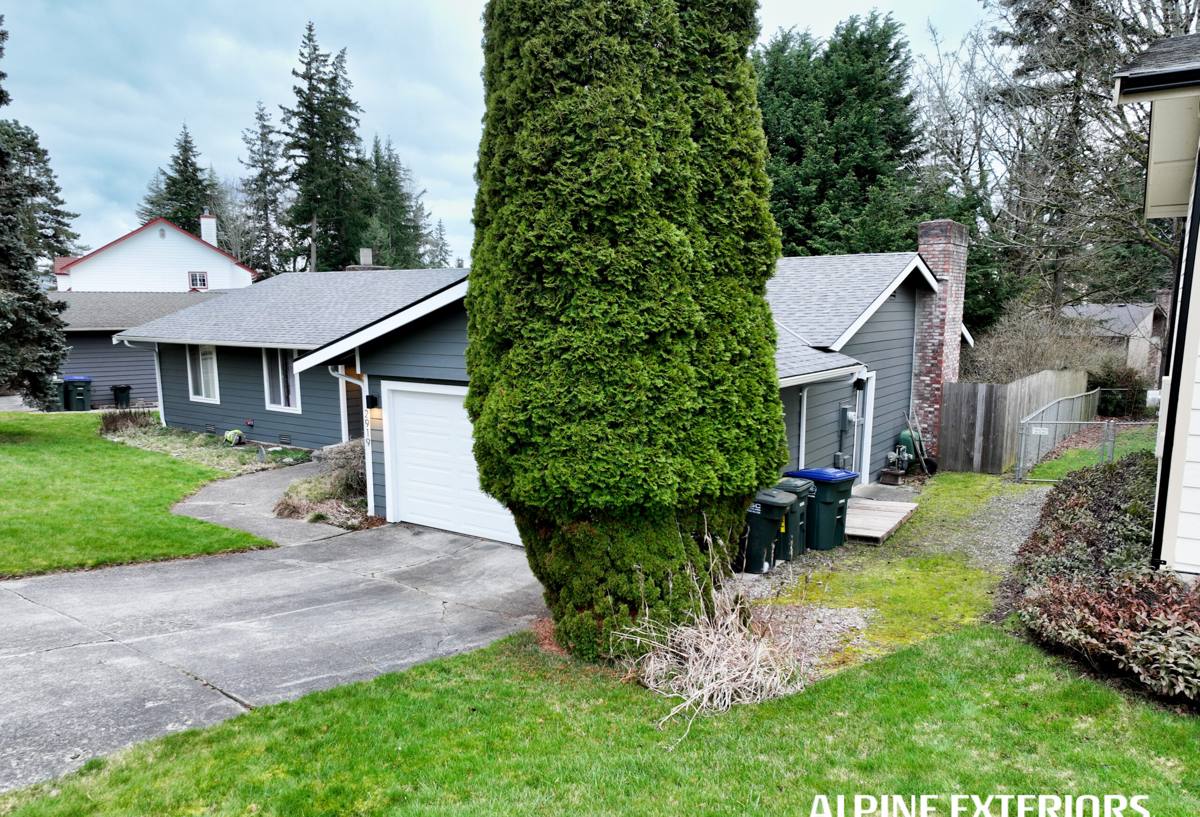
What Salt Air, Driving Rain, and Moss Season Do to Siding Here
Salt Air From More Than One Direction
Because Semiahmoo has water on more than one side, salt-laden air reaches homes from multiple directions instead of a single prevailing exposure. Salt accelerates corrosion in fasteners, flashing, and trim, and it breaks down lower-grade caulk and paint faster than a drier site would. A lot of the repairs we get called out for start as a corroded fastener or a failed caulk joint that let water in long before anyone noticed a visible problem.
Driving Rain, Not Just Rainfall
With almost no windbreak, rain on the spit gets pushed sideways into wall assemblies rather than falling straight down. That's a heavier load on laps, seams, and trim than the region's rainfall totals alone would suggest. A joint or seam that would hold up fine on a sheltered inland wall can still fail here because it was never tested against water hitting it at an angle with real force behind it.
A Moss Season That Doesn't Really End
Mild temperatures and near-constant humidity keep moss and mildew active across most of the year, and shaded, north-facing walls on Semiahmoo see it worst. Moss doesn't just look bad — it holds moisture against the siding surface far longer than it would otherwise sit there, which extends every wet cycle the material goes through underneath it.
Signs Your Siding Needs Repair
What You Can See From the Ground
- Cracked, buckled, or visibly gapped siding panels or seams
- Bubbling, peeling, or chalking paint, especially on wood-based or engineered wood products
- Rust streaking running down from nail heads or metal trim
- Caulk that's cracked, shrunk, or pulled away at corners, trim, and window and door edges
- Moss or algae staining that keeps coming back on the same section of wall
What Often Doesn't Show Up Until Later
Some of the most costly siding problems don't announce themselves on the exterior at all. Soft spots when you press on the siding, a section that feels spongy or swollen, or a musty smell near an exterior wall inside the house are all signs that moisture has already gotten past the surface. By the time interior signs like peeling paint or soft drywall show up, the damage has usually been developing for a while. That's part of why we check both sides of a wall during an inspection rather than judging the whole assembly from what's visible outside.
What a Correct Siding Repair Actually Involves
A repair that just patches the visible damage and caulks over it tends to fail again within a season or two on an exposed property like this, because it doesn't address why the damage happened in the first place. A repair done right starts with figuring out the water path — where it's getting in, not just where it ended up — and then addresses that path along with the visible damage itself.
- Diagnosing the actual entry point, which is often a different location than where the damage is visible
- Checking the water-resistive barrier and flashing behind the damaged section, not just the siding surface
- Removing and replacing any sheathing or framing that's already been compromised by trapped moisture
- Matching replacement material correctly so the repair doesn't create a mismatched or premature-failure section next to the original siding
- Correct fastener type, spacing, and sealed cut edges on any new material
- Re-caulking and sealing to current standards, not just matching what was there before if that original detailing was part of the problem
Skipping straight to cosmetic patchwork is the single most common reason a siding repair has to be done twice.
Repair vs. Full Replacement: How We Decide
Not every damaged section needs a full re-side, and not every repair is worth doing instead of replacing the siding outright. We walk through a handful of factors on-site before recommending either one.
| Factor | Repair Usually Makes Sense | Replacement Usually Makes More Sense |
|---|---|---|
| Extent of damage | Isolated to one or a few sections | Widespread across multiple walls or elevations |
| Age and condition of existing siding | Siding is otherwise sound and reasonably current | Siding is near or past its practical service life |
| Moisture behind the wall | Limited to the damaged area, sheathing intact | Sheathing or framing compromised over a larger area |
| Material match | Replacement material can match cleanly | Original product is discontinued or won't match without patchwork appearance |
| Cost over time | Targeted repair addresses the actual cause | Repeated repairs are starting to add up to replacement cost anyway |
Why We Repair Exclusively With James Hardie Fiber Cement
We install and repair one siding system: James Hardie fiber cement. We don't install or patch with LP SmartSide, vinyl, Cemplank, Allura, primed spruce, or cedar, and that includes repair work on homes that currently have one of those products. Fiber cement is dimensionally stable — it doesn't swell, cup, or warp with repeated wetting the way wood-based products can, and its factory-applied ColorPlus finish holds color and resists moisture far longer than a field-applied paint job. Hardie's HZ5 formulation is engineered specifically for regions with heavy moisture exposure, which fits waterfront Whatcom County well, and the product carries a strong transferable warranty when installed to spec.
If a Semiahmoo home currently has a different siding product and needs repair, we'll say so plainly rather than pretend we can patch it seamlessly with material we don't stock or stand behind. In many cases the honest answer is that the damaged section gets transitioned to Hardie even if the rest of the wall stays as-is for now — we'll walk through what that looks like and what it costs before any work starts.
Why Installation Quality Matters as Much as the Material
Fiber cement only performs the way it's engineered to when it's installed to Hardie's published specifications — correct fastener type and spacing, proper clearance from grade and roof lines, and cut edges primed and sealed before they're exposed to weather. A Hardie repair installed loosely will still develop the same moisture problems as any other material in a climate like Semiahmoo's. The material gives you a better margin for error than wood-based alternatives; it doesn't remove the need for correct installation.
Our Siding Repair Process
- On-site inspection: We look at the damaged area and the surrounding wall, checking both the visible surface and, where warranted, moisture levels behind it.
- Diagnosis: We identify the actual water path and any underlying sheathing or framing damage before scoping the repair.
- Written scope and estimate: You get a clear breakdown of what's being repaired, what material is being used, and what it costs before anything is scheduled.
- Repair work: Damaged material and any compromised sheathing get removed, the water-resistive barrier and flashing get corrected where needed, and new Hardie material goes in to spec.
- Final check and cleanup: We confirm the repair matches surrounding siding as closely as possible and leave the site clean.
Common Trouble Spots on Semiahmoo Homes
Water-Facing Walls
Walls facing the bay or open water take the most direct wind-driven rain and salt exposure. These are usually the first place we find failed caulk joints, corroded fasteners, and siding that's absorbed more moisture than the rest of the house.
Shaded and Ground-Level Areas
North-facing walls, areas under overhangs, and siding close to grade or landscaping tend to stay damp longer and are where moss and mildew take hold first. Ground-level sections also see more splash-back moisture during heavy rain than siding higher up the wall.
Trim, Corners, and Penetrations
Anywhere the siding is interrupted — corner trim, window and door casings, hose bibs, vents, and light fixtures — is a seam that has to be sealed correctly to stay watertight. These transition points fail more often than open field siding because they depend on caulk and flashing detail rather than the material itself.
A Simple Checklist Between Inspections
- Walk the exterior after major windstorms and check for loose, cracked, or missing sections of siding
- Look at caulk joints at corners, trim, and window and door edges for cracking or gaps
- Check for moss or algae patches that keep returning in the same spot
- Press gently on any section that looks discolored or swollen to check for softness
- Note any musty smell or new staining on interior walls near the exterior
- Have siding professionally inspected periodically, not just when damage is already visible
Why a Crew That Already Works Semiahmoo Matters
A contractor who regularly repairs siding on this specific stretch of coastline already knows how salt air, open wind, and prolonged moisture behave differently here than they do a few miles inland in Blaine proper. That experience shows up in the small decisions — where to expect hidden damage, which fastener grade to use, how much clearance to leave at grade — and those details are what determine whether a repair holds up for years or fails again by the next wet season. It also means a straighter answer about whether a section actually needs repair or is better off replaced, instead of a default answer built for an easier, more sheltered property.
If you're seeing damage on Semiahmoo siding, or just want an honest read on whether it needs repair or replacement, we're happy to take a look. Reach out below for a free, no-pressure estimate.