 Blaine Roofing
 Birch Bay's Coastal Climate Is Hard on Roofs
Birch Bay sits right on the water, and that location cuts both ways. The views are part of why people live there, but the same conditions that make the bay beautiful also shorten the life of an ordinary roof. Salt-laden air moves in off the water and settles on shingles, flashing, and fasteners day after day, accelerating corrosion on anything that isn't built to handle it. Add in the driving rain that comes through this part of Whatcom County during fall and winter storms — often blowing sideways instead of falling straight down — and you get wind-driven water finding its way into laps, valleys, and edges that would stay dry in a calmer climate.
Then there's moss. Between the marine humidity, the tree cover common on many Birch Bay lots, and a long stretch of cool, wet months, moss has a lot of time and moisture to work with. Left alone, it holds water against the roof surface, lifts shingle edges, and works its way under laps over a few seasons. None of this means a roof in Birch Bay is doomed — it means the roof needs to be built and detailed with these specific conditions in mind, not installed the same generic way you'd install one twenty miles inland.
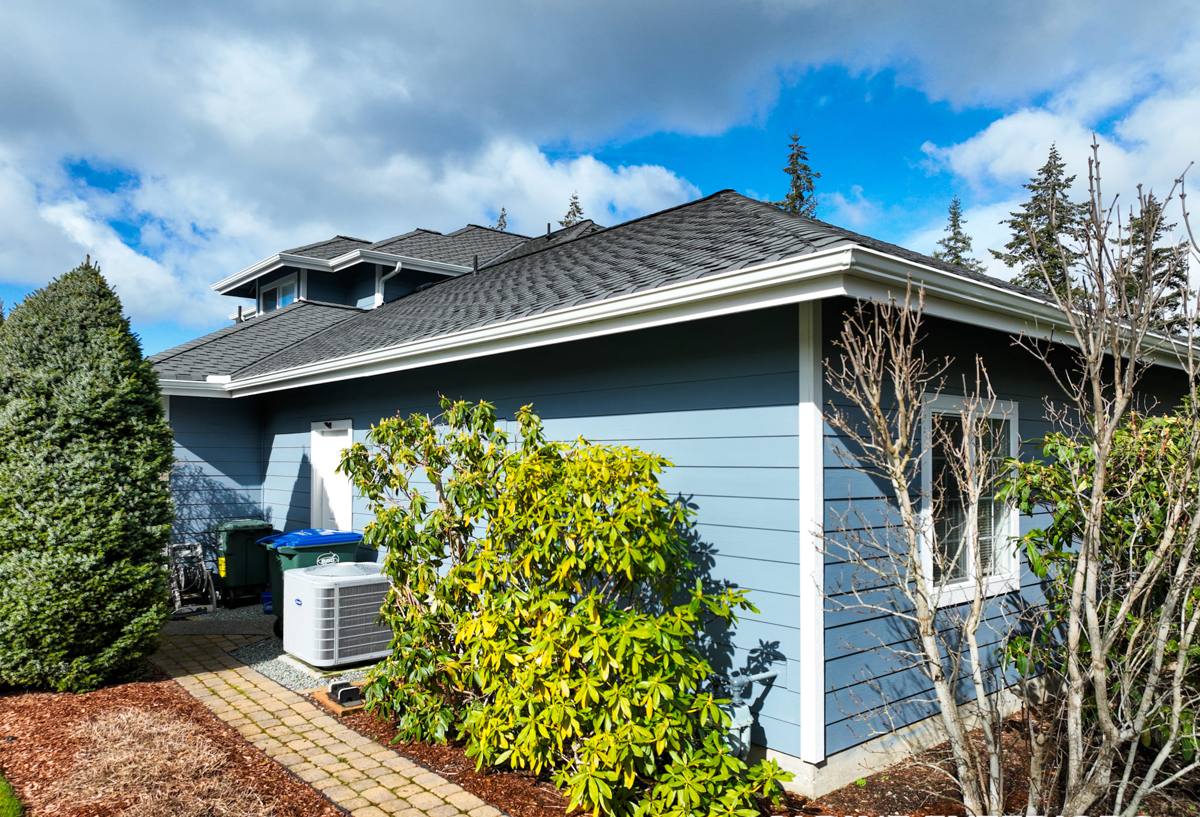
Signs Your Birch Bay Roof Is Due for Replacement
Roofs rarely fail all at once. They give warnings first, and in a salt-air, high-moss environment those warnings can show up earlier than the shingle manufacturer's age chart suggests. Worth checking for, or having a roofer check for:
- Granule loss showing up in gutters or at downspout splash points — a sign the shingle surface is wearing thin
- Moss mats or dark streaking concentrated on north-facing or shaded slopes
- Curling, cupping, or cracked shingles, especially on slopes that catch the most wind-driven rain
- Rusted or corroded flashing around chimneys, vents, and skylights
- Soft spots in the decking felt underfoot, or sagging visible from the ground
- Water stains on interior ceilings or in the attic, particularly near valleys or wall intersections
- Daylight visible through the roof deck from inside the attic
- A roof that's simply reaching the end of its expected service life for its material and exposure
One or two of these on their own might mean a repair. Several together, especially on an older roof, usually mean it's time to talk about replacement before a small problem becomes a ceiling repair too.
Roofing Materials That Hold Up on the Water
There's no single "best" roofing material for every home — pitch, budget, HOA rules (common in some Birch Bay developments), and the look you want all factor in. But in a salt-air, high-moisture setting, some choices perform more predictably than others. Here's how the common options compare for this specific environment:
| Material | Salt air / corrosion behavior | Moss resistance | Typical lifespan here |
|---|---|---|---|
| Architectural asphalt shingle | Good when fasteners and flashing are corrosion-resistant; the shingle itself isn't affected by salt | Moderate — benefits from algae/moss-resistant granules and good airflow underneath | 20-30 years with proper ventilation and upkeep |
| Standing seam metal | Very good with the right coating and fastener spec; smooth surface sheds salt spray and rinses clean in rain | Strong — steep pitch and slick surface give moss little to hold onto | 40-50+ years |
| Composite / synthetic shake | Good; engineered to resist moisture absorption better than natural wood | Moderate to strong depending on product line | 30-50 years |
| Cedar shake (natural wood) | Requires diligent maintenance in this climate; absorbs and holds moisture | Weak without regular treatment and cleaning | Highly maintenance-dependent |
We'll walk you through the real trade-offs for your roof — appearance, weight, budget, and how much upkeep you actually want to do — rather than pushing one product because it's easier for us to install. What matters most is that whatever material you choose is installed with fasteners, flashing, and ventilation specified for a marine environment, not generic inland hardware.
A Note on Cost
Exact pricing depends on your roof's size, pitch, number of layers to remove, decking condition, and material choice, so we won't quote a number without seeing the roof. What we can tell you honestly: cutting corners on underlayment, flashing, or ventilation to save money up front tends to cost more later in this climate, because those are exactly the components that fail first under salt and moisture exposure. A correct install costs more than a rushed one — but a rushed one in Birch Bay often needs attention again well before it should.
What a Correct Roof Replacement Includes
Tear-Off and Deck Inspection
We remove the old roofing down to the deck rather than layering over it. That's the only way to actually see what's underneath — soft or delaminated plywood, rot around penetrations, or damage that's been hidden for years. Any compromised decking gets replaced before anything new goes down; installing a new roof over a weak deck just moves the problem forward a few years.
Underlayment and Ice & Water Barrier
In a region that sees sustained wind-driven rain, the underlayment is doing more work than people realize. We use a synthetic underlayment built for wet, marine climates, with self-adhered ice-and-water membrane at the eaves, valleys, and around penetrations — the spots where wind can drive rain uphill under the shingles instead of letting it run off normally.
Flashing and Penetrations
Chimneys, vent pipes, skylights, and wall intersections are where roofs actually leak, far more often than the open field of shingles. We use corrosion-resistant flashing sized and formed for each penetration, sealed correctly rather than just caulked over — caulk is a maintenance item, not a permanent flashing solution.
Ventilation
Balanced intake and exhaust ventilation keeps the attic close to outdoor temperature and moisture levels. That matters twice over here: it prevents condensation from building up under the deck during our cool, wet winters, and it keeps the roof surface drying out properly between rain events instead of staying damp — which is exactly the condition moss needs to take hold.
Moss and Moisture Control Built Into the Job
Moss prevention isn't a separate add-on — it's a byproduct of doing the roof correctly. Proper ventilation lets the roof dry between storms. Correct shingle exposure and nailing prevent the small lifts and gaps where moss spores settle in first. On shaded or heavily tree-covered slopes, we'll talk with you about options like zinc or copper strips near the ridge, which release trace metal ions with the rain to inhibit moss growth over time — a passive, low-maintenance step that suits homes where regular roof cleaning isn't practical.
We're straightforward about what these measures can and can't do. No product stops moss forever in a climate this wet and mild — the goal is to significantly slow regrowth and make periodic gentle cleaning far more effective than it would be otherwise.
Our Process, Start to Finish
- On-site inspection. We walk the roof and attic, check the decking, flashing, and ventilation, and take photos of anything worth showing you directly.
- Written estimate. A clear scope of work and pricing — what's being torn off, what's going on, and why — with no vague line items.
- Material selection. We go over the options that fit your home, budget, and how much maintenance you want to take on long-term.
- Scheduling around the weather. Coastal storm windows matter here; we plan tear-off and dry-in to minimize any time your roof deck is exposed.
- Installation. Tear-off, deck repair as needed, underlayment, flashing, and the finish material, installed to manufacturer spec.
- Cleanup and walkthrough. Magnetic nail sweep of the yard and driveway, debris hauled off, and a final walkthrough so you know exactly what was done.
Why a Crew That Already Works Birch Bay Matters
A roofer who mostly works inland, in drier or more sheltered conditions, can still frame and shingle a roof competently — but they may not default to marine-grade fasteners, won't necessarily think about wind direction off the bay when planning drip edge and starter courses, and may not flag moss risk on a shaded north slope until it's already a problem. None of that is incompetence; it's just a different set of habits built for a different climate.
Working roofs in and around Blaine and Birch Bay regularly means we're not guessing at how salt air, coastal wind, and moss season actually behave here — we're building for it as a matter of course, not as an afterthought. That includes knowing which details tend to fail first on homes exposed to the water, and building those details right the first time.
After the Roof Goes On: Keeping It That Way
A correctly installed roof still benefits from basic upkeep in this climate. A simple annual routine goes a long way:
- Clear gutters and downspouts each fall so wind-driven rain has somewhere to go
- Trim back overhanging branches to cut down shade and debris buildup on moss-prone slopes
- Do a visual check after major windstorms for lifted shingles or displaced flashing
- Have a light moss treatment or gentle cleaning done every couple of years if growth returns
- Keep an eye on attic ventilation — blocked soffit vents undo a lot of the protection a good install provides
None of this requires climbing on the roof yourself, and a few minutes of attention a couple of times a year is usually enough to protect the investment you just made.
If your Birch Bay roof is showing its age, or you just want an honest read on how much life it has left, we're happy to take a look. The estimate is free, there's no pressure attached to it, and you'll get a straight answer about what your roof actually needs — use the form below to get started.