 Blaine Roofing
 Why Sumas Decks Take a Different Kind of Beating
A deck in Sumas doesn't fail the way a deck in a dry climate fails. It doesn't crack from sun exposure or dry out and split. It fails from the inside out — moisture that gets trapped where it shouldn't, wood that never fully dries between rain events, and hardware that corrodes years before the boards on top of it show any wear. Whatcom County sits in a marine-influenced weather pattern: the same damp Pacific air that moves across Blaine and the Salish Sea carries salt and moisture well inland, and Sumas gets its share of it, especially during the long stretch from October through April when the region sees weeks of low cloud, steady rain, and short windows of drying sun.
Add in moss season — which in this part of Whatcom County can run eight months or more — and you have a climate that's genuinely hard on outdoor structures. Moss doesn't just look bad on a deck. It holds water against the surface, keeps boards from drying, and accelerates rot in wood and delamination in lower-grade composite. A deck built without that in mind will need real repair work inside five to seven years. One built correctly for this climate can go decades with nothing more than routine cleaning.
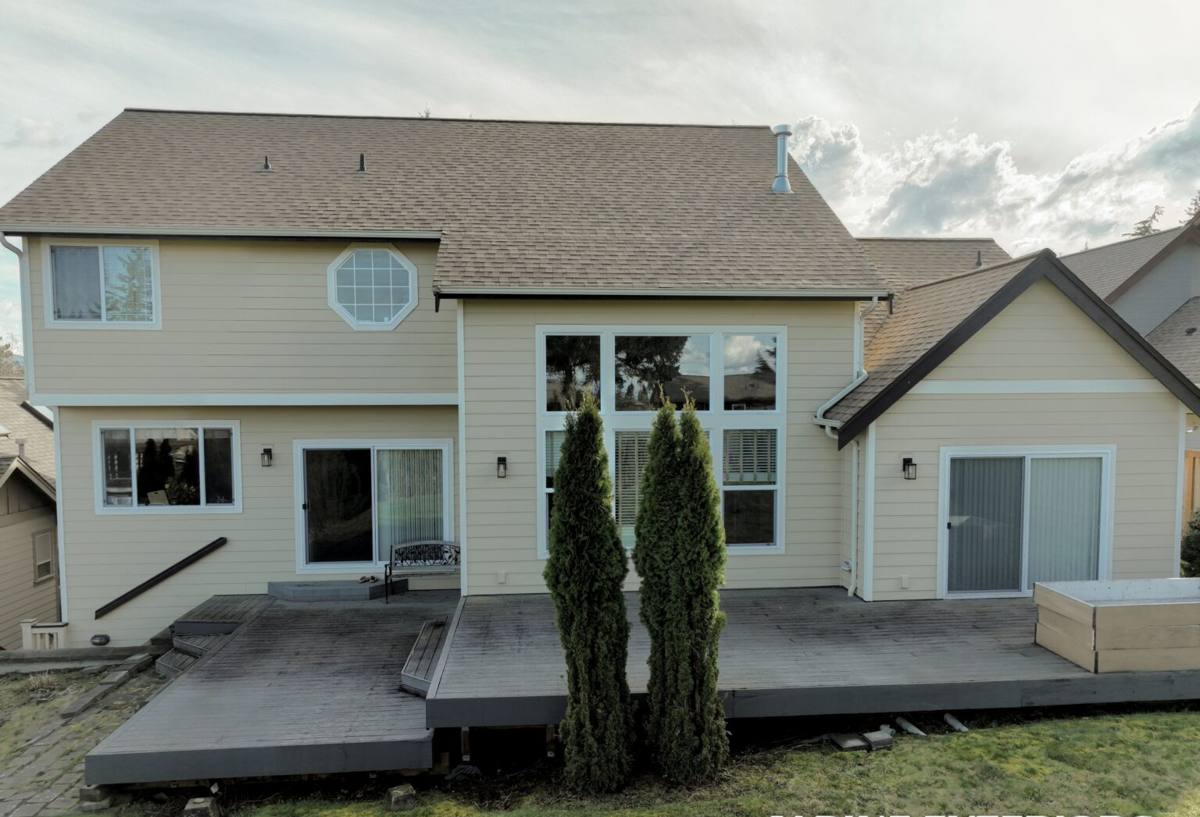
What a Correctly Built Deck Involves Here
"Correct" isn't about fancy materials. It's about a handful of details that are easy to skip and expensive to fix later. These are the things we treat as non-negotiable on every deck we build in the Sumas area, regardless of budget or design.
Ledger Board Attachment and Flashing
The ledger board — where the deck attaches to the house — is the single most common failure point on decks in wet climates, and it's almost always a flashing problem, not a framing problem. Water runs down the siding, hits the ledger, and if it isn't diverted with proper flashing and a drainage gap behind the board, it works its way into the house's rim joist. We flash every ledger connection with a code-compliant water-resistive barrier and metal flashing, and we never fasten a ledger directly against siding without that gap and drainage path in place.
Framing and Fastener Choice
Pressure-treated framing lumber is standard, but the fasteners holding it together matter just as much as the lumber grade. In a climate with this much sustained moisture, we use hot-dip galvanized or stainless structural screws and joist hardware rated for ground-contact and treated-lumber compatibility. Cheaper electroplated fasteners can corrode within a few wet seasons, and a corroded structural connector is a problem you can't see until something moves.
Choosing Decking Material for This Climate
There's no single "best" decking material — there's a best fit for how much maintenance you want to do and how the material behaves under constant damp and moss exposure. Here's how the common options actually compare in a Sumas-area setting.
| Material | Moisture & Moss Behavior | Maintenance | Typical Lifespan Here |
|---|---|---|---|
| Pressure-treated cedar or fir | Absorbs moisture, needs airflow and regular sealing to resist rot and moss growth | Annual cleaning and re-sealing recommended | 10–15 years with upkeep |
| Western red cedar | Naturally rot-resistant but still holds moisture on the surface; moss will grow if not cleaned | Periodic cleaning and oil/stain every 1–2 years | 15–20 years with upkeep |
| Capped composite | Sheds water well, resists moss staining much better than wood, doesn't absorb moisture into the core | Occasional washing, no sealing or staining | 25+ years |
| Uncapped/lower-grade composite | Can absorb moisture at the surface and is more prone to mold and moss staining over time | Regular cleaning to prevent staining | Varies widely by product |
We install real wood decks when that's what a homeowner wants — there's nothing wrong with cedar done right — but for most Sumas projects we steer people toward capped composite because it holds up to the moss-and-moisture cycle with the least amount of upkeep. We don't install the lowest-tier uncapped composite products as a standard offering; the moisture behavior of the core material just isn't a good match for eight months of damp weather a year, and we'd rather set that expectation up front than have a homeowner dealing with staining a few years in.
What Board Spacing Has to Do With Moss
Gap spacing between boards isn't just cosmetic. Too tight, and debris and moisture sit in the gaps and never dry out — that's where moss and algae get a foothold first. We space boards to allow airflow and drainage while still giving a clean, finished look, and we account for the specific expansion and contraction behavior of whatever material we're installing.
Substructure and Drainage — The Part You Don't See
Most of what determines how long a deck lasts in this climate is underneath it, not on top of it. A few things we always address:
Ground Clearance and Airflow
Framing that sits too close to grade traps moisture and gives moss and mildew a place to establish year-round. We build in adequate clearance and, where the site allows it, ventilation paths so air can move under the deck instead of sitting stagnant through the wet months.
Joist Protection
Every joist top gets a protective tape or coating before decking goes down. This is a small material cost that prevents water from pooling in fastener holes and wicking into the joist — one of the most common causes of hidden rot on decks that otherwise look fine from above.
Footings Rated for Local Soil and Frost
Whatcom County's soil conditions and occasional hard freezes mean footings need to be set below frost depth and sized correctly for the load. We pull permits and follow the local building department's footing requirements rather than guessing at what "should" hold — this is one area where cutting corners doesn't show up until a footing heaves or settles years later.
Railings and Hardware That Won't Corrode
Railings take direct weather exposure on every side, and hardware — screws, brackets, post bases — is usually the first thing to show corrosion in a wet coastal-influenced climate. We use fasteners and structural hardware rated for exterior and treated-lumber use throughout, not just at the framing level. On metal or cable railing systems, we also pay attention to how the manufacturer specifies coastal or high-moisture installations, since some systems have different hardware requirements for marine-influenced climates than they do for drier regions.
Our Process, Start to Finish
- On-site assessment. We look at drainage, sun exposure, existing structure (if it's a rebuild), and how the deck will actually be used before we talk materials.
- Design and material selection. We walk through the material comparison honestly, including maintenance trade-offs, so the decision fits your budget and how much upkeep you actually want to do.
- Permitting. We handle the local permit and inspection process — footings, framing, and railings all get inspected per code.
- Construction. Ledger flashing, framing, joist protection, decking, and railing installed in sequence, with each stage built to hold up through the wet season, not just look right on install day.
- Final walkthrough. We go over the finished deck and what maintenance schedule makes sense for the material you chose.
Maintenance in a Long Moss Season
Every deck in this climate needs some level of upkeep — the difference between materials is how much. Here's a basic seasonal checklist we give homeowners regardless of what we install:
- Sweep debris off the deck regularly through fall — wet leaves left sitting are one of the fastest ways to start moss growth and surface staining
- Rinse or wash the surface at least once or twice a year to remove early moss and algae before it takes hold
- Check fastener heads and railing hardware annually for early signs of corrosion or loosening
- Keep gutters and downspouts near the deck clear so runoff isn't draining directly onto or under the structure
- For wood decks, plan on re-sealing or re-staining on the schedule appropriate to the species — skipping a cycle in this climate shows up fast
- Trim back overhanging vegetation to let sunlight and airflow reach the deck surface, which is one of the simplest ways to slow moss regrowth
Why Hire a Crew That Already Works Sumas
Deck-building fundamentals don't change from town to town, but the specifics of building for this exact climate do. A crew that's used to building in a dry inland region will often under-detail flashing, skip joist protection, or spec hardware that's fine in a mild climate but starts corroding here within a few years. Working regularly in and around Blaine and the rest of Whatcom County means we're building for this rain pattern and this moss season as the default, not as an afterthought — the flashing details, fastener grades, and material recommendations described above are our standard approach, not an upgrade.
It also means we're familiar with the local permitting process and inspection expectations, which keeps a project moving instead of stalling on paperwork or a failed inspection over a detail that's easy to get right the first time.
Getting Started
If you're planning a new deck or replacing one that's showing its age, we're happy to come take a look and talk through what makes sense for your home, your budget, and how you actually want to use the space. There's no pressure and no obligation — just a straightforward estimate and an honest read on your options. Use the form below to request your free estimate.