 Blaine Roofing
 Why Birch Point's Waterfront Position Changes the Roofing Equation
Birch Point sits close enough to the water that the roof over your head is doing a different job than a roof ten miles inland in Whatcom County. Salt-laden air moves off the Strait almost constantly, wind-driven rain hits siding and roof edges at an angle instead of falling straight down, and the tree cover that gives the area its character also means shade, damp ground, and a long moss season. None of that is a problem metal roofing can't handle — but it does mean the material choice, the fastener hardware, and the detailing at edges and penetrations all need to be selected with this specific environment in mind, not treated the same as a roof going on in a drier part of the county.
We've done enough roofs in and around Blaine to know that "metal roofing" isn't one product. A panel system, coating, and fastener package that performs well forty minutes inland can underperform right on the water. This page is about what actually holds up at Birch Point, and what a correct installation looks like when salt air and moss are working against the roof from day one.
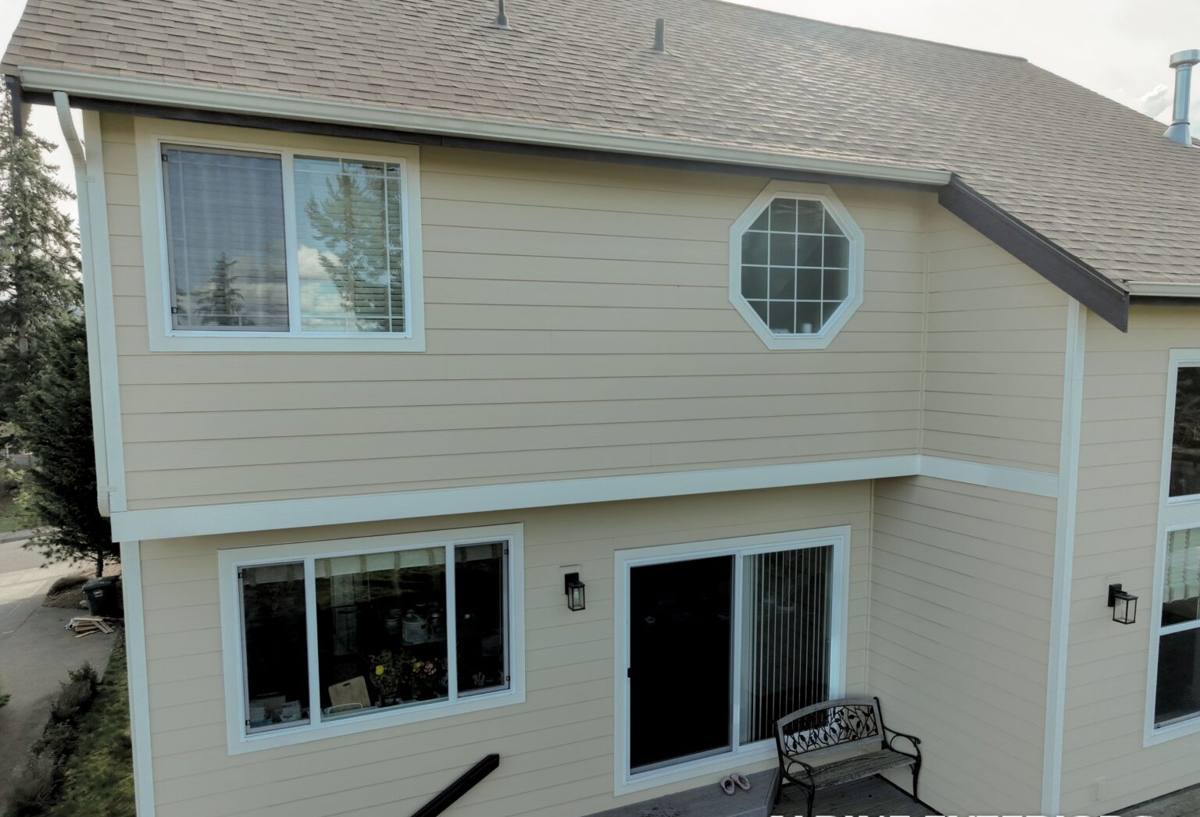
What Salt Air, Driving Rain, and Moss Actually Do to a Roof
Salt Air and Corrosion
Airborne salt accelerates corrosion on any metal it settles on — fasteners, flashing, and the cut edges of panels are the most vulnerable spots because that's where bare metal is most likely to be exposed. Over years, untreated or mismatched hardware near the water can develop rust streaks well before the roof itself is due for replacement. The fix isn't complicated, but it has to be built in at installation: correct alloy choices, correct coatings, and correct fastener metallurgy so you're not mixing metals that corrode each other.
Wind-Driven, Angled Rain
Rain that comes in sideways off the water finds every weak seam, lap, and flashing detail a straight-down rain never would. Roofs at Birch Point need underlayment and flashing details built for wind-driven moisture, not just gravity drainage. This matters most at ridges, valleys, and anywhere the roof meets a wall or chimney.
Moss and Shade
A long, wet moss season plus tree-shaded roof sections means organic growth gets a real foothold if a roof doesn't shed water and dry out efficiently. Moss holds moisture against roofing material, and on the wrong substrate that trapped moisture is what causes long-term deterioration — not the moss itself, but what it keeps damp underneath it. Metal roofing's smooth, non-porous surface gives moss far less to grip than a shingle roof, which is one of the biggest practical reasons it makes sense here.
Choosing the Right Metal Roofing System for Birch Point
Not every metal roofing style is the same fit for a waterfront property. Here's how the common options stack up for a home in this specific environment:
| System | How It Handles Salt Air | How It Handles Driving Rain | Moss Resistance |
|---|---|---|---|
| Standing seam (concealed fastener) | Best — no exposed fastener heads for corrosion to start at | Best — raised seams shed wind-driven rain effectively | Excellent — smooth vertical panels, minimal debris capture |
| Exposed-fastener metal panel | Fair — depends entirely on fastener quality and washer seal life | Good, if installed with correct lap and sealant details | Good |
| Stone-coated steel | Good — coating protects the steel, but cut edges need attention | Good | Good, though textured surface can trap more debris than smooth panel |
For most Birch Point homes, we lean toward standing seam because it minimizes the number of exposed fasteners and puts the water-shedding job on the panel geometry itself rather than on caulk or washers that will eventually age. That's not a knock on exposed-fastener systems — they're a legitimate, more budget-friendly option — it's just a maintenance and longevity trade-off worth understanding before you choose.
Coatings and Finish
Whatever panel style you choose, the paint or coating system matters as much as the base metal in a salt-air environment. A quality baked-on finish resists chalking and fading from UV and salt exposure far longer than a lower-grade coating, and it's the coating — not just the steel or aluminum underneath — that determines how the roof looks after fifteen or twenty years on this stretch of coastline.
What a Correct Installation Involves
Underlayment
A synthetic, water-resistant underlayment goes down as the roof's backup layer, with extra attention to sealing around every penetration — vents, pipe boots, and anywhere a fixture breaks the roof plane. In a driving-rain environment, this layer is what protects the deck if wind ever pushes water past the panel seams.
Fasteners and Flashing
This is the detail most often shortcut, and it's the one that matters most at Birch Point. Fasteners and flashing metal should be matched to the panel material to avoid galvanic corrosion — mixing incompatible metals (say, the wrong-grade steel screw into an aluminum panel) sets up a slow electrochemical reaction that eats away at the panel from the fastener point outward. Stainless or coated fasteners rated for coastal exposure are worth the modest upcharge over standard hardware.
Ventilation
Proper attic and roof-deck ventilation keeps moisture from condensing on the underside of the panels, which matters in a climate where the air itself carries a lot of humidity. A well-ventilated roof also dries out faster after storms, which helps limit the conditions moss needs to establish.
Edge and Valley Detailing
Drip edges, valley metal, and ridge caps are where wind-driven rain is most likely to find a way in. These get extra-wide overlaps and mechanically fastened seams rather than relying on sealant alone, since sealant is the first thing to fail under years of UV and salt exposure.
Our Process for a Birch Point Metal Roof
- On-site inspection: We look at your existing roof, deck condition, ventilation, and how exposed the home is to wind and salt air off the water before recommending a system.
- Honest system recommendation: We'll walk you through panel and coating options with real trade-offs — cost, longevity, and maintenance — instead of pushing one product for every home.
- Deck prep and underlayment: Any soft or damaged decking gets addressed before anything goes back over it. Underlayment goes down with full attention to penetrations and edges.
- Panel installation: Panels, fasteners, and flashing are installed as a matched system so nothing corrodes against anything else.
- Final walk-through: We review the finished roof with you, including what maintenance to expect given your specific tree cover and sun exposure.
Maintaining a Metal Roof in This Climate
Metal roofing is low-maintenance compared to shingles, but "low" isn't "none," especially with moss pressure and salt air working on it year-round. A simple annual routine goes a long way:
- Clear overhanging branches and debris that hold moisture against the roof surface
- Rinse off accumulated organic debris and salt residue in gutters and valleys
- Check that gutters and downspouts are flowing freely, especially after fall leaf drop
- Look for any early rust streaking at fasteners or cut edges and address it before it spreads
- Confirm attic ventilation isn't blocked by insulation or debris
- Have a professional check sealant at penetrations every few years, since sealant ages faster than the metal itself
Cost Factors for Metal Roofing at Birch Point
Metal roofing costs more upfront than asphalt shingles, and pricing on any given home depends on roof complexity, panel style, and access. Broadly, homeowners should expect metal roofing to run meaningfully higher per square than a standard shingle roof, with standing seam typically priced above exposed-fastener panel systems. The variables that move the number most:
| Factor | Why It Affects Cost |
|---|---|
| Panel system (standing seam vs. exposed fastener) | Concealed-fastener systems require more labor and material per square foot |
| Roof complexity | Valleys, dormers, and multiple roof planes all add cutting, flashing, and labor time |
| Coating grade | Higher-grade finishes cost more but resist salt-air fading and chalking longer |
| Fastener and flashing hardware | Coastal-rated hardware costs more than standard-grade but avoids early corrosion |
| Existing deck condition | Repairs or replacement of damaged decking add to the project before panels ever go on |
We'll give you a specific number after we've actually looked at your roof — broad ranges without seeing the home don't tell you much, and we'd rather give you an accurate figure than a low one that changes later.
Why Local Experience at Birch Point Matters
A contractor who's worked this specific stretch of Whatcom County coastline already knows how the wind behaves off the water, how long moss season actually runs here, and which fastener and coating combinations hold up versus which ones start showing rust streaks in a few years. That's knowledge you can't get from a spec sheet — it comes from having installed and later inspected roofs in this exact environment. It also means we're not guessing at ventilation needs or underlayment choices; we're applying what we've already seen work on homes with the same salt exposure and tree cover as yours.
If you're weighing metal roofing for a home at Birch Point, we're happy to take a look and talk through what makes sense for your specific roof and budget. There's a free, no-pressure estimate form below — reach out and we'll get you a straight answer.