 Blaine Roofing
 When Replacement Is the Right Call in Bellingham
There's a difference between patching a few damaged boards and replacing a home's siding outright, and in Bellingham that decision usually gets made for you by the climate rather than by preference. Salt-tinged marine air off the bay, wind-driven rain that hits walls sideways instead of falling straight down, and a moss season that can run most of the year on shaded surfaces all put steady, cumulative pressure on exterior materials. A siding system that's reached the end of its useful life here rarely fails in one obvious spot. It fails broadly, quietly, and usually behind the surface first, which is exactly why full replacement, not another round of patching, ends up being the right call for a lot of Bellingham homes.
This page is specifically about full siding replacement for homes in and around Bellingham — tearing off failing or outdated siding and installing new James Hardie fiber cement in its place, done to the standard this climate actually requires. It's not about spot repair or new construction; it's about what happens when a home's existing siding has reached the point where replacing it is the more honest answer than continuing to patch it.
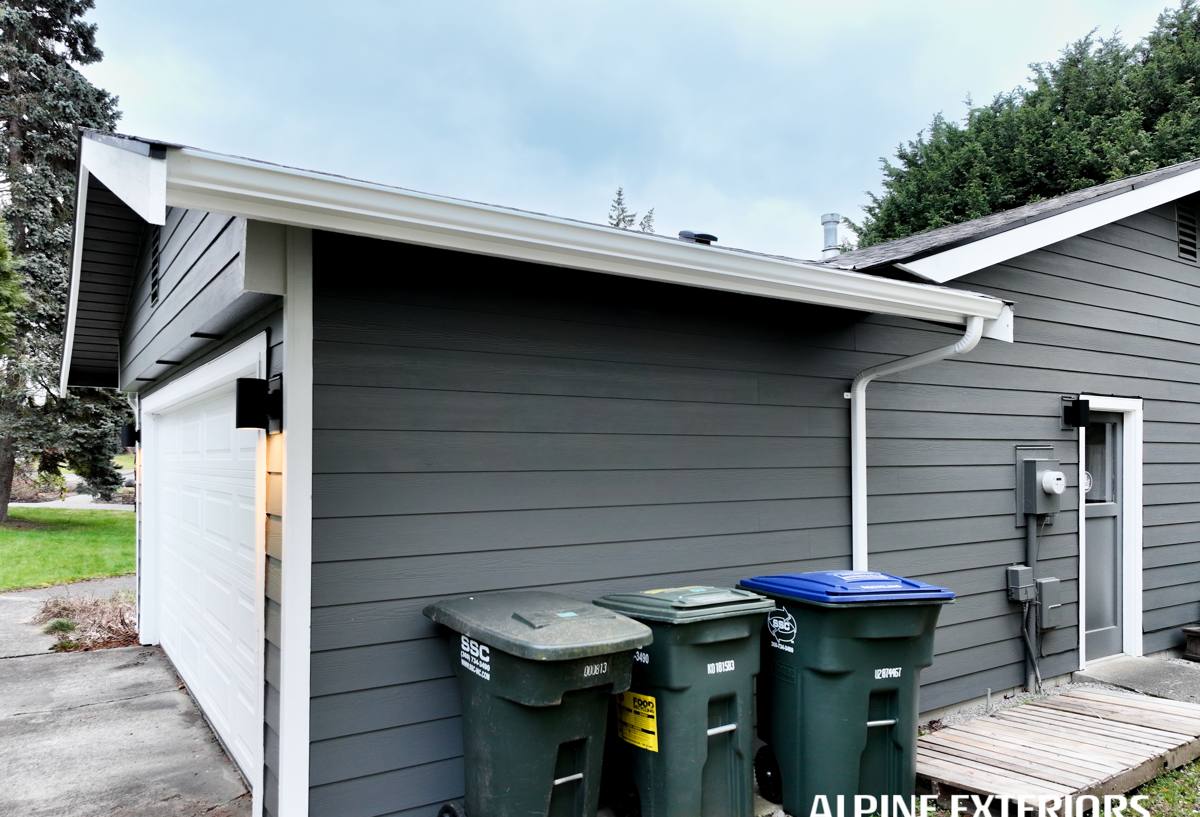
What Bellingham's Climate Does to Aging Siding
Salt Air and Corrosion Near the End of a Siding's Life
Bellingham's proximity to the bay means a steady flow of salt-laden air moving through most neighborhoods, not just the ones with a water view. Over the lifespan of a siding system, that salt exposure works on fasteners, flashing, and any exposed metal trim, and it tends to accelerate right at the point when a siding system is already aging — corroded fasteners loosen panels, degraded flashing stops shedding water the way it should, and problems that were minor a few years earlier compound quickly.
Driving Rain Finding the Gaps Older Siding Develops
Rain in this part of Whatcom County rarely falls straight down. Wind pushes it sideways into lap joints, trim seams, and wall penetrations, and a siding system that's shifted, cracked, or lost its seal over time gives that wind-driven rain far more opportunity to get behind the wall than it had when the siding was new. This is part of why aging siding in Bellingham tends to fail faster once it starts failing — the same driving rain that the material shed for years starts finding its way in once the material's condition slips.
A Moss Season That Outlasts Old Siding's Defenses
Mild temperatures and near-constant dampness give moss and mildew a long growing season on north-facing and shade-covered walls. New siding with an intact factory finish resists that growth reasonably well. Aging siding, especially anything with a chalking or degraded paint surface, gives moss and mildew far more to hold onto, and once organic growth is established on a wall it tends to accelerate whatever surface breakdown is already underway.
Signs It's Time to Replace Rather Than Repair
Not every siding problem calls for full replacement — some are legitimately fixable with a repair. But certain signs point toward replacement being the more honest answer, especially on an older home that hasn't been reclad in decades:
- Damage or soft spots spread across multiple walls rather than isolated to one section
- Siding material that's discontinued or hard to match, making spot repairs visually inconsistent
- Repeated moisture problems in the same areas despite prior repairs
- Widespread warping, cracking, or fastener failure rather than a handful of isolated boards
- Visible or suspected rot in the sheathing behind the siding, found during a repair estimate
- A siding material — cedar, primed spruce, older vinyl, or aging engineered wood — that's simply reached the end of what it can reasonably be expected to do in this climate
- A desire to correct underlying installation issues (missing rainscreen, poor flashing) that no amount of patching will fix
If what you're dealing with is one damaged board or a single area of impact damage, a repair is usually the right scope. If it's several of the items above at once, replacement tends to be the more cost-effective path over the long run, because it addresses the wall assembly as a whole rather than chasing the same underlying problem section by section.
What a Correct Full Replacement Involves
Tear-Off and What's Underneath
Full replacement starts with removing the existing siding down to the sheathing, which is also the point where problems that were invisible from the outside — water staining, soft sheathing, gaps in the old weather barrier — finally become visible. This is the single biggest advantage a full replacement has over patch repair: it's the only time anyone actually sees the condition of the wall behind the siding.
Sheathing and Structural Assessment
Any soft, delaminated, or water-damaged sheathing found during tear-off needs to be addressed before new siding goes up. Installing new siding over compromised sheathing just buries the same problem under new material, and in a climate that sees as much sustained moisture as Bellingham does, that's a problem that will resurface.
New Water-Resistive Barrier and Drainage
A full replacement is the opportunity to install a correctly lapped and taped weather-resistive barrier and, where appropriate, a drainage gap or rainscreen behind the new siding. That drainage plane is what lets any moisture that does get past the surface dry out instead of sitting against the wall, and it matters more in Bellingham's wet, marine climate than it would somewhere drier.
Installing to James Hardie's Spec for This Region
Fastener type, spacing, clearances at grade and trim, and flashing details all follow James Hardie's published installation requirements for this climate zone, not a generic national standard. That's what keeps the manufacturer's warranty intact and what determines whether the new siding performs for decades rather than years.
Why We Replace With James Hardie, Not Something Cheaper
We install James Hardie fiber cement exclusively for replacement projects, and we don't offer LP SmartSide, vinyl, Cemplank, Allura, primed spruce, or cedar as alternatives. Those are legitimate products and other contractors install them competently. Our reasoning is specific to what a full replacement is actually for: putting something on the wall that won't need replacing again in fifteen years because the climate wore it out.
| Material | Behavior in Bellingham's Climate | Ongoing Maintenance | Realistic Lifespan |
|---|---|---|---|
| James Hardie fiber cement | Dimensionally stable; resists salt, moisture, and moss with a factory finish | Low; occasional cleaning, no repainting cycle | 30+ years with correct install |
| LP SmartSide (engineered wood) | More sensitive to moisture at cut edges and fastener penetrations | Moderate; edge sealing and touch-up needed | 15-25 years, climate-dependent |
| Vinyl | Can warp in sun, crack in cold, and trap moisture behind panels | Low visible upkeep, but hidden issues are hard to catch | 20-30 years, variable |
| Cedar / primed spruce | Absorbs moisture readily without regular sealing or repainting | High; recurring paint or seal cycle | 15-25 years with consistent upkeep |
The factory-applied ColorPlus finish is a meaningful part of this decision for a replacement project specifically. Because the color coat is cured under controlled conditions before the boards ever reach the site, the only field-painting we're responsible for is priming the occasional cut edge — unlike a field-painted material, where the entire wall's finish depends on paint quality holding up against Bellingham's rain and salt air for years afterward.
Our Replacement Process for a Bellingham Home
Walkthrough and Assessment
We start by looking at the whole exterior — which walls face the weather directly, which stay shaded and slow to dry, and what condition the existing siding and trim are actually in. This is also where we talk through whether full replacement or targeted repair is the right scope for your specific situation, honestly, before any contract is signed.
Tear-Off and Discovery
Old siding comes off down to the sheathing. If we find rot, soft spots, or prior water damage, we'll show you what we found and what it takes to address before new siding goes up — no surprises added to the invoice without a conversation first.
Installation to Manufacturer Spec
New weather-resistive barrier, drainage detailing where called for, and James Hardie siding installed to the fastening, clearance, and flashing spec this climate requires. We plan corner details, trim transitions, and window and door flashing before crews start cutting material, rather than working it out in the field as we go.
Final Walkthrough
We walk the finished job with you, cover what little maintenance James Hardie siding actually needs, and make sure you know what a healthy wall looks like going forward.
Timing a Replacement Around Bellingham's Wet Season
Siding replacement can happen at most points in the year here, but scheduling around Bellingham's wettest stretches reduces the number of days a wall sits open between tear-off and new siding going up. We plan projects with weather in mind and sequence the work — tear-off, sheathing repair, barrier installation, siding install — so the wall assembly isn't left exposed longer than necessary. This matters more in a marine climate with this much sustained rainfall than it would somewhere drier, where a delayed step is a minor inconvenience rather than a moisture risk.
Cost Factors for Full Siding Replacement
Full replacement costs more up front than a repair, but it resets the clock on the entire wall assembly rather than extending the life of a system that's already declining. A few things move the price on a given Bellingham home:
| Factor | Why It Matters |
|---|---|
| Total square footage and wall complexity | More corners, dormers, and roof transitions mean more cuts and flashing detail |
| Sheathing condition found at tear-off | Rot or water damage needs repair before new siding goes up, which affects scope |
| Existing siding material | Some materials come off faster and cleaner than others, affecting labor time |
| Trim, window, and door detailing | More openings mean more flashing and finish work around each one |
| Access and site conditions | Steep lots, tight setbacks, or limited access can add labor time |
| Siding profile chosen | Lap, shingle, and board and batten profiles differ in material and labor cost |
We'll walk your specific home and give you real numbers rather than a rough per-square-foot estimate — two Bellingham homes with similar square footage can land at very different price points depending on sheathing condition and how many of these factors are actually in play.
Why Hire a Crew That Already Works Bellingham
Full siding replacement is not a project you want to learn on. A crew that's replaced siding across Bellingham through multiple wet seasons already knows which orientations need extra drainage attention because of shade and tree cover, what condition to expect from sheathing on homes of a given age, and where corners tend to get cut on a rushed tear-off. That judgment doesn't show up on an estimate sheet, but it's the difference between a replacement that performs for thirty years and one that starts showing the same problems the old siding had within a decade.
If you're weighing a full siding replacement for a home in Bellingham, we're happy to walk the property, give you an honest read on whether replacement or repair fits your situation, and provide a straightforward, no-pressure estimate. There's a form below — reach out and we'll set up a time to take a look.