 Blaine Roofing
 Sandy Point's Shoreline Setting Puts Extra Demand on Siding
Sandy Point sits close enough to the water that its homes deal with a different set of pressures than a house ten miles inland in Whatcom County. Salt-laden air moves off the water and settles on exterior surfaces day after day. Wind-driven rain doesn't just fall straight down here — it gets pushed sideways into wall assemblies, seams, and trim joints that a calmer climate would never test. And because this part of Blaine stays cool, damp, and shaded for long stretches of the year, moss and algae get a head start on siding that other regions simply don't deal with to the same degree.
None of that means siding is doomed to fail. It means the material and the installation both have to be chosen with this specific environment in mind. A siding job that would hold up fine in a dry, inland neighborhood can start showing problems within a few years on a shoreline lot like the ones in Sandy Point. The fixes aren't exotic — they're about picking the right product and getting the details right the first time.
What "Correct" Siding Installation Means in a Marine Environment
Water needs somewhere to go
Every siding installation, no matter the material, is really a water management system with a finished appearance on top. In a driving-rain climate like this one, that system gets tested constantly. Water that gets behind the siding needs a clear path back out — it can't be trapped against sheathing where it will sit and slowly rot framing or feed mold growth. That means a properly lapped weather-resistive barrier, correctly flashed windows and doors, and drainage details at the bottom of every wall that actually let moisture escape instead of pooling.
Flashing and trim details carry more weight here than inland
Any spot where two building materials meet — a window head, a deck ledger, a roof-to-wall intersection, a hose bib penetration — is a place water can find its way in. Inland, a small gap or under-lapped flashing might go unnoticed for years. On a lot exposed to salt air and sideways rain, the same shortcut shows up much sooner as staining, soft trim, or paint failure. This is the part of the job that doesn't show up in photos of finished siding, but it's the part that determines whether the installation actually lasts.
Why We Only Install James Hardie Fiber Cement Siding in Sandy Point
We made a deliberate decision to install one siding system — James Hardie fiber cement — and nothing else. We don't offer vinyl, LP SmartSide, Cemplank, Allura, primed spruce, or cedar, not because those products don't have their place, but because we don't think they hold up to this specific climate as well as Hardie does, and we'd rather stand fully behind one product we trust than split our attention across several.
Built for this climate zone specifically
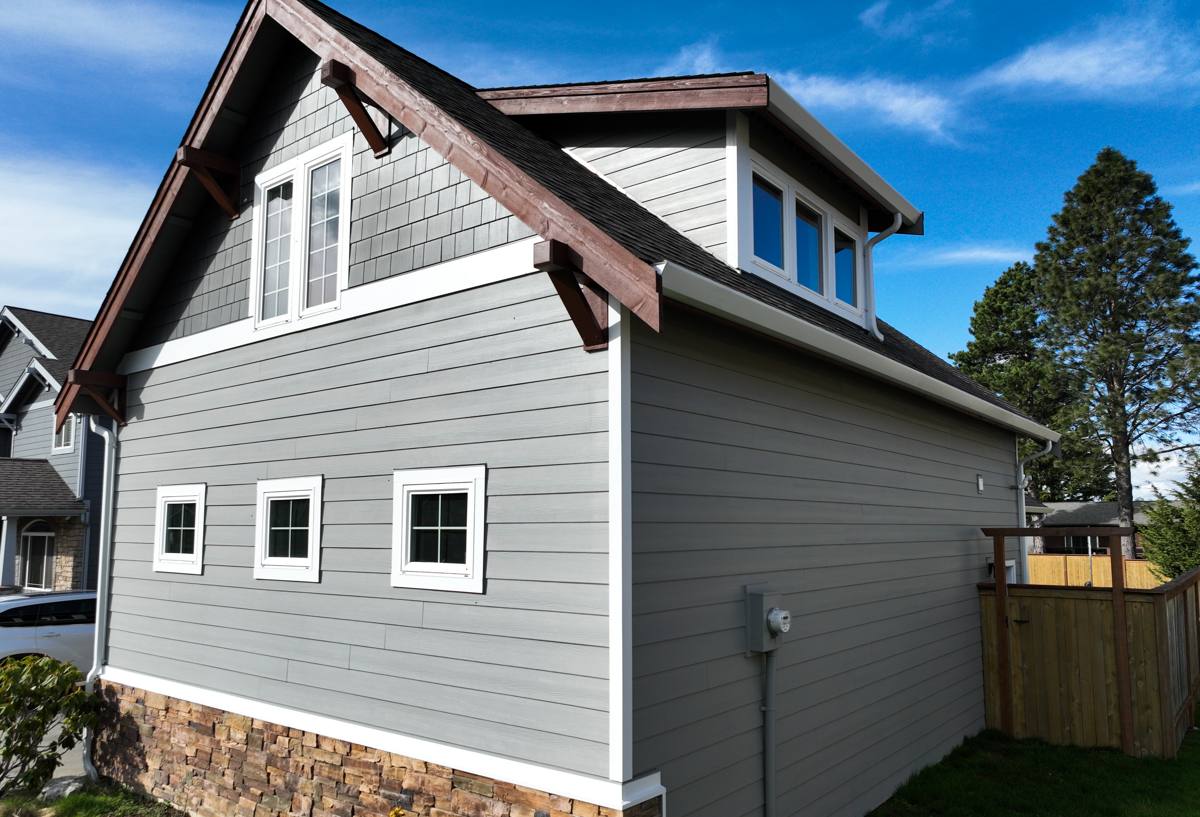
James Hardie engineers its siding in climate-specific formulations, and the HZ5 line is built for regions like the Pacific Northwest that see sustained moisture, cooler temperatures, and salt-air exposure. Fiber cement itself doesn't rot, doesn't attract wood-boring insects, and won't absorb water the way wood-based products can. That matters directly in a place where damp conditions and moss growth are a near-constant reality rather than an occasional problem.
A factory finish that doesn't depend on homeowner upkeep
Hardie's ColorPlus finish is baked on at the factory under controlled conditions, rather than field-applied paint that has to cure properly on-site and gets re-applied every few years. That finish is formulated to resist fading and holds up against the kind of grime and salt residue that shoreline air leaves behind. It's also backed by a long, non-prorated, transferable limited warranty — which matters to a homeowner who wants confidence the product will still be performing a couple of decades from now, and it matters when that home eventually sells.
How Siding Materials Compare for Coastal Whatcom County Homes
Homeowners researching siding options often ask us to explain, honestly, how the common choices stack up in an environment like Sandy Point's. Here's how we see it, based on the material properties themselves rather than brand claims:
| Factor | Vinyl | Cedar / Wood | LP SmartSide | James Hardie Fiber Cement |
|---|---|---|---|---|
| Salt air / moisture resistance | Doesn't absorb water, but can warp or become brittle over time | Absorbs moisture; needs consistent sealing to resist rot | Engineered wood core; vulnerable at cut edges and gaps if moisture gets in | Cement-based; does not rot or absorb water like wood |
| Moss / algae resistance | Can trap moisture behind panels in shaded, damp spots | Prone to moss and mildew without regular treatment | Needs intact factory coating to resist organic growth | Dense, non-organic material; factory finish resists staining |
| Maintenance burden | Low, but repainting isn't really possible if it fades | High — regular staining, sealing, and moss treatment | Moderate — coating integrity has to be maintained | Low — no re-staining or sealing required with ColorPlus finish |
| Fire resistance | Can soften or deform under heat | Combustible | Wood-based, combustible | Non-combustible cement composition |
| Warranty structure | Varies widely by manufacturer | Typically none beyond installer workmanship | Manufacturer-specific, coating-dependent | Long, non-prorated, transferable limited warranty |
Every one of these products has a legitimate use case somewhere. We simply concluded that for the moisture, salt exposure, and moss pressure this area sees, fiber cement gives homeowners the best combination of durability and low upkeep — which is why it's the only siding we put on a house.
What a Full Siding Installation Job Actually Involves
Tear-off versus installing over existing siding
In most cases, we recommend removing existing siding down to the sheathing rather than installing new material over it. That exposes the wall assembly so we can check for hidden moisture damage, deteriorated sheathing, or old flashing that's failed — issues that are common on older shoreline homes and that don't go away just because new siding covers them up. Covering over a problem locks it in place; it doesn't fix it.
The weather-resistive barrier and drainage gap
Once the wall is exposed, we install a continuous weather-resistive barrier, properly lapped from the bottom up so water sheds outward instead of working its way behind it. On many homes in a climate this wet, we also build in a rainscreen gap — a small drainage and ventilation space between the barrier and the siding — which gives any moisture that does get past the cladding a way to drain and dry instead of sitting against the wall.
Trim, flashing, and penetrations
Every window, door, and wall penetration gets flashed and integrated with the weather barrier before trim goes on. Seams and butt joints are treated with the fasteners and sealants Hardie specifies for its product — not generic caulk applied as an afterthought. This is where a rushed installation shows up first, and it's the part of the job most likely to fail early if it's cut short.
Our Process, Start to Finish
- A walkthrough of the home to assess current siding condition, trim, flashing, and any signs of existing moisture intrusion.
- A written estimate that spells out material, prep work, and what tear-off will reveal versus what we already expect to find.
- Removal of old siding and an inspection of the sheathing and framing underneath before anything new goes up.
- Installation of the weather-resistive barrier, drainage detailing, and flashing at every window, door, and penetration.
- Installation of James Hardie panels or lap siding per manufacturer fastening and clearance specifications.
- Trim, caulking, and a final walkthrough with the homeowner before we consider the job done.
Warning Signs Sandy Point Homeowners Shouldn't Ignore
Because of the climate here, siding problems tend to show up in specific, recognizable ways before they become structural. Worth checking for:
- Green or black growth concentrated on shaded or north-facing wall sections
- Paint or coating that's peeling or bubbling faster than it should
- Soft, spongy, or visibly swollen spots, especially near the bottom of walls or around trim
- Staining or streaking below butt joints, window heads, or where siding meets trim
- Gaps opening up at corners, trim boards, or panel seams
- A musty smell inside near exterior walls, which can indicate moisture already trapped behind the siding
Any one of these on its own isn't necessarily an emergency, but they're worth having looked at rather than waiting on, especially heading into another wet season.
Maintenance After Installation
Part of what makes fiber cement a good fit here is how little ongoing maintenance it asks for. There's no re-staining schedule and no sealing routine. A periodic rinse to clear salt residue and organic buildup, along with keeping gutters and downspouts clear so water isn't dumping directly onto siding or foundation areas, covers most of what a homeowner needs to do. We also recommend a visual check after major storms — not because failures are expected, but because catching a lifted piece of trim or a failed sealant joint early is a lot cheaper than dealing with hidden water damage later.
Why Hiring a Crew That Already Works in Sandy Point Matters
Siding installation isn't one-size-fits-all, and a crew that mostly works dry, inland jobs may not think about drainage gaps, flashing sequencing, or moss-prone shade patterns the same way a crew that works this specific stretch of Whatcom County coastline does every season. We've seen what driving rain and salt air do to shortcuts over time, and we build every installation around avoiding those specific failure points rather than treating this like a generic siding job that happens to be near the water.
If you're weighing siding options for a home in Sandy Point, we're happy to come take a look, walk you through what we're seeing on your specific walls, and put together a straightforward, no-pressure estimate. There's no obligation — just a clear picture of where your home stands and what a correct fix looks like.