 Blaine Roofing
 Why Decks in Bellingham Wear Out Differently
A deck in Bellingham is fighting three things at once, and they rarely get equal attention. There's salt-tinged marine air moving in off Bellingham Bay and the Salish Sea, which is quietly harder on fasteners and metal hardware than most homeowners assume. There's driving rain that doesn't fall straight down but gets pushed sideways by wind, working its way into ledger connections and end grain that a calmer climate would never test. And there's a moss and algae season that can run eight or nine months of the year on shaded, north-facing decks, holding moisture against the wood or composite surface far longer than a dry-climate deck ever experiences.
None of that means every deck in Bellingham is failing. But it does mean decks here age on a different timeline than the same structure would inland, and the failure usually starts where you can't see it: the ledger board, the joists, the fasteners, and the footings, well before the surface boards look obviously bad. We work this stretch of Whatcom County out of Blaine, and the pattern shows up on tear-out after tear-out.
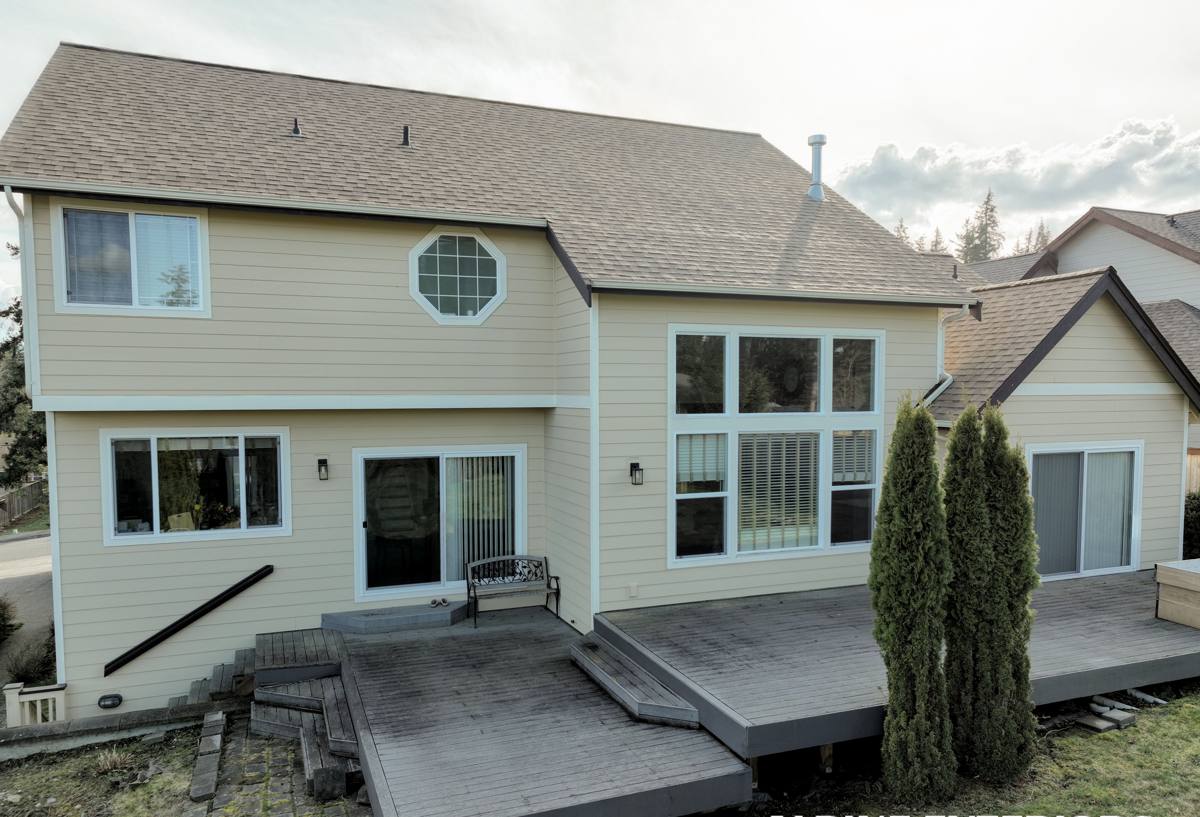
Signs a Deck Has Reached Replacement, Not Repair
Repair makes sense when the problem is isolated. Replacement makes sense when the structure itself, not just a few boards, has been compromised. Here's what tends to separate the two:
- Boards that feel soft, spongy, or give slightly underfoot, especially near the house or stair landing
- Rust streaks bleeding out around fastener heads or hardware, a sign the metal itself is corroding, not just staining
- A ledger board that's pulling away from the house, or a rim joist behind it that feels soft when probed
- Stair stringers with visible cracks, or stairs that flex noticeably under weight
- Railings that move or flex when leaned on, rather than staying rigid
- Moss or algae staining that returns within weeks of cleaning, suggesting the wood underneath is staying wet longer than it should
- A deck built more than 15 to 20 years ago to an older code cycle, particularly around railing height and footing depth
If what you're seeing is limited to a couple of worn boards on an otherwise sound frame, repair is often the honest answer and we'll say so. Replacement earns its cost when the framing, ledger, or footings are the actual problem.
Choosing a Decking Material for This Climate
The surface material matters, but it's not the part of the deck that fails first here. Still, it's worth choosing with the local climate in mind rather than by looks alone.
| Material | Moisture Behavior | Maintenance | Typical Lifespan Here |
|---|---|---|---|
| Pressure-treated lumber | Absorbs and releases moisture readily; prone to checking and warping through repeated wet-season cycles | Regular staining or sealing to keep performing | 10-15 years before boards need attention or replacement |
| Cedar | Naturally moisture-resistant heartwood, but sapwood and cut ends still take on water | Periodic sealing to hold color and resist cupping | 15-20 years with upkeep |
| Composite (capped) | Sheds surface moisture well; uncapped edges and older composite formulations can still absorb water | Low; occasional cleaning to slow algae growth | 25-30 years |
| PVC / cellular vinyl | Essentially non-absorbent; performs consistently in sustained wet exposure | Low; periodic cleaning | 25-30+ years |
Composite and PVC decking cost more up front, but in a climate where a deck spends much of the year damp, the lower long-term maintenance burden is a real trade-off worth weighing, not just a marketing point. Wood options aren't wrong, they just come with a maintenance schedule that has to actually get followed, and in our experience it often doesn't.
What a Correct Deck Replacement Involves
Footings and Framing
Footings need to sit below the local frost depth and bear on solid, undisturbed soil, not just be poured wherever the old ones happened to be. We check whether the existing footing layout and joist spans actually meet current span tables for the decking and loads involved, rather than assuming the old frame was sized correctly in the first place.
Ledger Board and Flashing
The ledger, where the deck attaches to the house, is the single most common failure point we find on tear-outs. It needs correct structural fasteners (not deck screws), proper flashing that directs water away from the house rather than behind the siding, and a gap or flashing detail that keeps water from sitting between the ledger and the wall. Get this wrong and the damage happens inside the wall assembly, out of sight, for years before it shows.
Fasteners and Hardware
In a marine-air environment, fastener choice isn't cosmetic. We use hot-dip galvanized or stainless hardware rated for ground contact and exterior exposure, matched to the decking material's manufacturer specifications, since dissimilar metals and undersized coatings are exactly what produces the rust staining and hardware failure we see on older decks.
Joist Protection and Drainage
Self-adhering flashing tape over the top of each joist keeps water from soaking into end grain and fastener holes, which is one of the more overlooked details on budget deck builds. Framing should also carry a slight slope away from the house, so water sheds off rather than pooling against the ledger.
Permits and Code Basics in Whatcom County
Depending on your address, a deck replacement in Bellingham falls under the City of Bellingham's building department or Whatcom County's if the property is outside city limits, and either way most decks attached to the house or elevated above a certain height require a permit and inspection. Guardrails on elevated decks generally need to meet a minimum height with baluster spacing tight enough to prevent a small child from passing through, and stair rise and run need to stay consistent step to step. Framing spans also have to account for the region's snow load requirements, which are modest here but not zero. We pull permits as part of the job rather than treating them as optional, because an uninspected deck can become a real problem at resale or after a structural failure.
Designing Out Moss and Standing Water
A deck built with maintenance in mind fights the local moss season instead of feeding it. That means board spacing wide enough to let water drain through rather than sit on the surface, skirting with enough ventilation to keep the space underneath from staying damp and dark, and gutters or downspouts routed away from the deck's footings instead of dumping straight onto them. None of this eliminates cleaning entirely, moss will still find shaded, north-facing surfaces in this climate no matter what you build, but it meaningfully slows how fast it comes back after a wash.
Railings, Stairs, and Everyday Safety
Railings and stairs get more daily use and abuse than the deck surface itself, and they're where a cut corner shows up as an actual safety problem rather than a cosmetic one. We build railings that meet current code height and baluster spacing rather than matching whatever height the old deck happened to have, since older decks were often built to a looser standard. On stairs, consistent rise and run matters more than most homeowners realize, an uneven step is one of the more common trip hazards on a deck, and it's an easy thing to get right during a full rebuild that's much harder to fix after the fact. For surfaces that see shade and moss growth, a grooved or lightly textured board profile also helps with footing when the surface is damp.
Our Deck Replacement Process
We treat a deck replacement as a structural project first and a finish-carpentry project second, because that order is what actually determines how long the deck lasts.
- On-site assessment of the ledger, framing, footings, and fasteners, not just the visible decking, since surface boards can look fine over a compromised frame
- Tear-out and disposal of the old structure, with a closer look at the ledger connection and any hidden moisture damage once it's exposed
- Correction of any undersized footings, framing, or ledger flashing found during tear-out, discussed with you before we proceed
- Installation of framing, joist protection tape, and code-compliant ledger flashing
- Decking, railing, and stair installation using fasteners and hardware matched to the material and this climate
- Final walkthrough covering maintenance expectations specific to the material you chose
Working out of Blaine, we're already familiar with how Whatcom County's permitting works and how this specific stretch of coastline treats a deck over time. That's less guesswork for you, and fewer surprises once the old boards come up.
What Affects the Cost of a Deck Replacement
| Factor | Why It Moves the Price |
|---|---|
| Deck size and layout | More square footage and multiple levels mean more material, framing, and labor |
| Decking material | Pressure-treated costs less upfront; composite and PVC cost more but need far less upkeep over time |
| Extent of structural repair needed | Rot found at the ledger, rim joist, or footings during tear-out adds real cost, but skipping it isn't a safe option |
| Stairs and railings | Multiple stair runs, custom railing designs, or added guardrail length add labor beyond a simple rectangular deck |
| Permit and inspection requirements | Part of doing the job correctly, and it protects you at resale |
| Site access | Decks over difficult terrain, on a slope, or with limited equipment access take longer to build |
We'd rather walk your specific deck and give you a number based on what we actually find than quote off a size chart, since the structural condition underneath is usually what separates a straightforward job from a more involved one.
If your deck in Bellingham is showing any of the signs above, or you're just not sure whether repair or full replacement makes sense, we're happy to take a look. The estimate is free, there's no pressure attached to it, and you'll get a straight answer about what your deck actually needs.