 Blaine Roofing
 Why Sandy Point's Location Is Tough on Exterior Siding
Sandy Point sits right up against the water, and that proximity is the whole story when it comes to siding performance. Homes here take a steady dose of salt-laden air, wind-driven rain that doesn't fall so much as get pushed sideways into wall assemblies, and a long, damp moss season that keeps north-facing walls and shaded elevations wet for weeks at a stretch. None of that is unusual for Whatcom County's coastline, but Sandy Point gets a concentrated version of it because there's little to break the wind before it reaches the house.
That combination punishes siding in three specific ways: it corrodes fasteners and trim that aren't rated for coastal exposure, it drives moisture past face-sealed joints that would hold up fine a few miles inland, and it feeds moss and algae growth that traps damp against the wall surface long after a storm has passed. A siding product and installation method that isn't built with those three failure points in mind will show problems earlier here than almost anywhere else in the county.
Why We Only Install James Hardie Fiber Cement
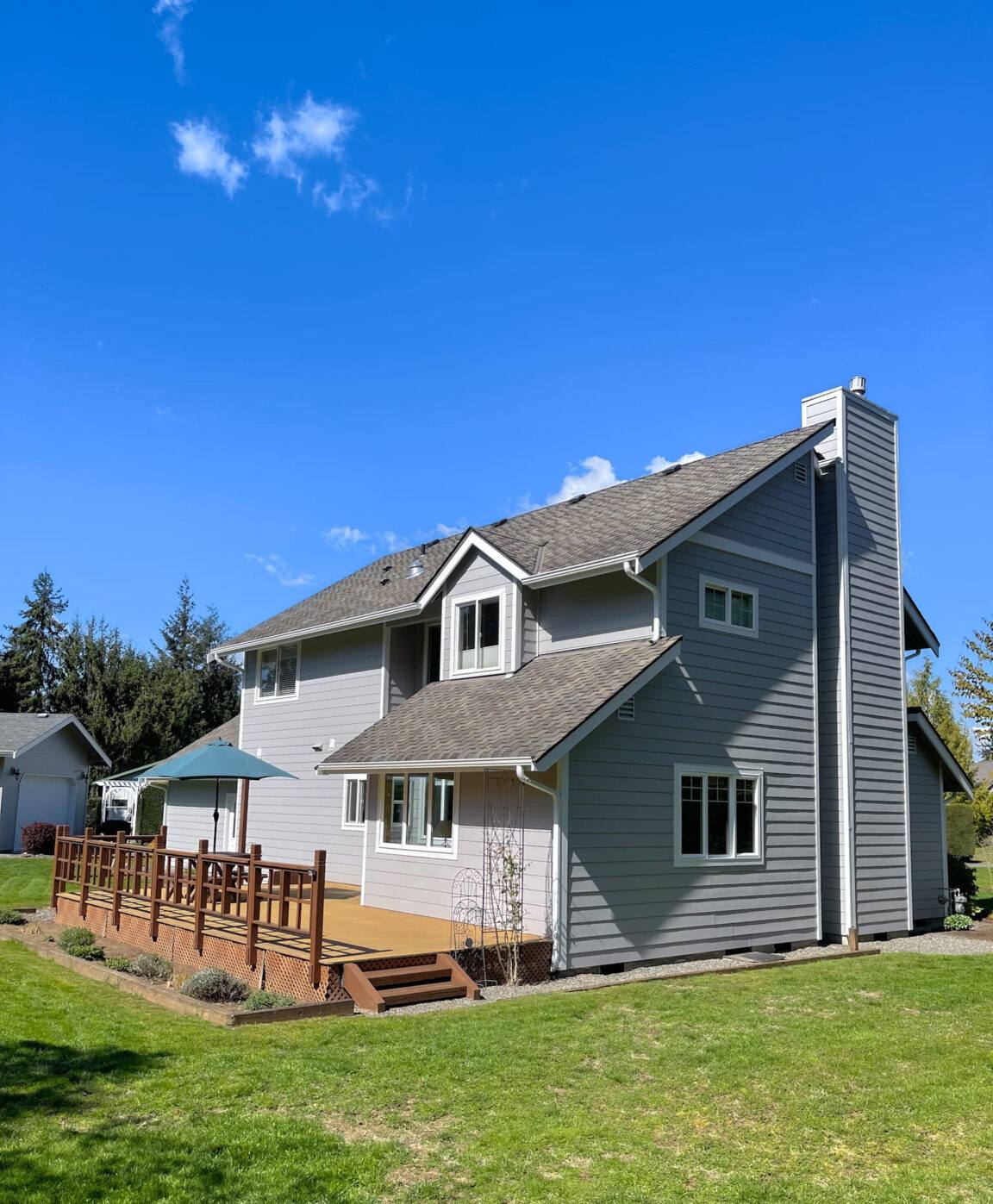
We standardized on James Hardie siding and don't install vinyl, LP SmartSide, Cemplank, Allura, primed spruce, or cedar. That's not a marketing position — it's a decision based on what actually holds up under Sandy Point conditions over decades, not just the first few years. Fiber cement is non-combustible, dimensionally stable when it gets wet, and doesn't rely on a paint film alone to keep water out the way wood-based and some engineered-wood products do.
The HZ5 Product Line and What "Climate-Engineered" Means
James Hardie makes region-specific formulations, and the HZ5 line is engineered for the wetter, colder climate zones the Pacific Northwest falls into. It's manufactured to resist moisture absorption and freeze-thaw stress better than a generic one-size-fits-all fiber cement product. For a home in Sandy Point, that engineering isn't a nice-to-have — it's the baseline requirement, because the product is rarely given a break between weather events to fully dry out.
ColorPlus Factory Finish vs. Field Paint
James Hardie's ColorPlus finish is baked on at the factory under controlled conditions, which gives it better adhesion and UV resistance than siding painted on-site after installation. In a salt-air environment, a weak paint bond fails faster — salt crystals work into any crack in the finish and accelerate peeling. ColorPlus siding also carries its own finish warranty separate from the substrate warranty, which matters more here than in a drier inland location because coastal exposure is exactly the kind of stress that separates a good finish from a mediocre one.
What a Correct James Hardie Installation Involves
The product is only half the equation. A huge share of the siding failures we get called out to inspect aren't a materials problem — they're an installation shortcut that a coastal climate exposed within a few years instead of a few decades.
Rainscreen and Moisture Management
James Hardie's own installation instructions call for a drainage plane behind the siding, and in a high-exposure location like Sandy Point we treat a proper rainscreen gap as non-negotiable rather than optional. That gap lets any moisture that does get past the siding face drain and dry instead of sitting against the sheathing. Skipping it is one of the most common corners cut on budget siding jobs, and it's invisible once the siding goes up — which is exactly why it's worth asking about before work starts.
Fasteners, Flashing, and Clearances
Coastal air corrodes the wrong fastener fast. We use fasteners rated for the exposure, flash every window, door, and penetration so water sheds outward instead of behind the cladding, and hold the siding to the manufacturer's minimum clearance above roofs, decks, and grade. That clearance keeps splash-back and standing moisture from wicking into the bottom edge of the panels, which is one of the first places coastal siding starts to fail.
Joints, Caulking, and Trim
Butt joints and trim transitions are where a lot of water intrusion actually starts. We follow Hardie's specified joint treatment rather than relying on caulk alone to do the job long-term, because caulk is a maintenance item, not a permanent seal — and in driving rain, a joint that depends entirely on caulk staying intact is a joint that will eventually leak.
Our Process for a Sandy Point Siding Project
- Site assessment: we walk the exterior, check current siding and sheathing condition, and note wind exposure and drainage patterns specific to the lot.
- Prep and moisture check: old siding comes off, sheathing is inspected for hidden rot or moisture damage before anything new goes on — covering up a wet wall assembly is how small problems become expensive ones.
- Weather barrier and rainscreen: a code-compliant water-resistive barrier goes on first, followed by the drainage gap.
- Installation: James Hardie panels or lap siding installed to manufacturer spec — correct fastener pattern, flashing, and clearances at every transition.
- Trim and joint detailing: corners, joints, and penetrations finished per Hardie's installation guidelines, not shortcuts.
- Final walkthrough: we go over the finished work with the homeowner before calling the job done.
Why Local Experience in Sandy Point Matters
A crew that hasn't worked this stretch of coastline doesn't have a feel for how hard the wind actually hits certain elevations, or how much moss buildup to expect on shaded north walls by the second winter. Working in Sandy Point regularly means we already know to pay extra attention to fastener corrosion resistance, to size flashing details for driving rain rather than average rain, and to plan installation timing around the wetter stretches of the year when possible. That local pattern recognition is the difference between a siding job that looks right on day one and one that's still performing correctly ten years in.
It also matters for permitting and code compliance — Whatcom County and local jurisdictions have specific requirements for exterior work, and a crew that pulls permits in this area regularly moves through that process without it becoming the homeowner's problem to manage.
Cost Factors for a Sandy Point Siding Project
Every home is different, but the variables that move a siding project's cost up or down are consistent. Rather than quote a number that doesn't mean much without seeing the house, here's what actually drives the estimate:
| Factor | Why It Matters |
|---|---|
| Home size and wall area | More square footage means more material and labor hours |
| Existing siding removal | Tear-off, disposal, and any sheathing repair add time before new siding goes up |
| Sheathing/moisture damage | Rot found during removal has to be repaired before siding can go on correctly |
| Trim and architectural detail | Corners, dormers, and multiple rooflines take more time per square foot than a simple rectangular wall |
| Siding profile chosen | Lap, panel, and shingle-style profiles differ in material and installation time |
| Wind/exposure rating needed | High-exposure sites like Sandy Point may call for additional fastening or flashing detail |
| Access and site conditions | Scaffolding needs, landscaping, and lot layout affect labor time |
What to Check Before Hiring a Siding Contractor
Whoever you hire, these are the things worth confirming before work starts — for any siding contractor, not just us:
- Are they installing to the manufacturer's written specifications, including rainscreen and fastener requirements?
- Will they inspect and document sheathing condition before covering it up?
- Do they carry proper licensing and insurance for exterior work in Washington?
- Can they explain their flashing and joint-detailing approach in plain terms, not just "we caulk it"?
- Do they pull the required local permits, or expect the homeowner to handle that?
- Have they worked on homes with similar coastal exposure, and can they speak to it specifically?
Maintaining Hardie Siding in a Salt-Air, High-Moss Climate
Correctly installed James Hardie siding is low-maintenance, but "low" isn't "zero" in a place like Sandy Point. A yearly rinse-down to clear salt residue and organic buildup before it gets a foothold goes a long way, especially on shaded or north-facing walls where moss takes hold first. Keep an eye on caulked joints and touch them up if they start to crack, and make sure gutters and downspouts are directing water away from the wall rather than letting it run down the siding face. None of this is heavy work, but staying ahead of moss and salt buildup is what keeps the ColorPlus finish looking good for its full service life instead of needing attention early.
If you're weighing a siding replacement or repair in Sandy Point and want a straight answer about what your home actually needs, we're glad to take a look. Reach out for a free, no-pressure estimate using the form below.