 Blaine Roofing
 Siding That Has to Work in Nooksack's Climate, Not Just Look Good on Day One
Nooksack sits inland from the coast, tucked into the river valley and foothill country of Whatcom County, but that doesn't mean the siding on a Nooksack home gets an easier ride than a house closer to the water. The same weather systems that push salt-laden marine air off the Salish Sea and across Blaine roll on into the valley, arriving softened but still damp, still salt-tinged, and still relentless. Add the valley's own conditions — heavier tree cover, farmland humidity, cooler pockets of air that hold moisture longer than open coastline — and you get a climate that is, if anything, tougher on exterior materials than the water's edge.
Driving rain is the baseline here, not the exception. Whatcom County sees extended stretches of steady, wind-driven rain for much of the year, and Nooksack's terrain traps that moisture instead of letting it blow through. Combine that with shade from surrounding trees and slower-drying north and east walls, and you get the region's long moss season — moss and algae that can hold onto a wall surface for months at a time. Siding that can't shed water fast and dry out between storms doesn't just look bad here; it fails from the inside, one damp season at a time.
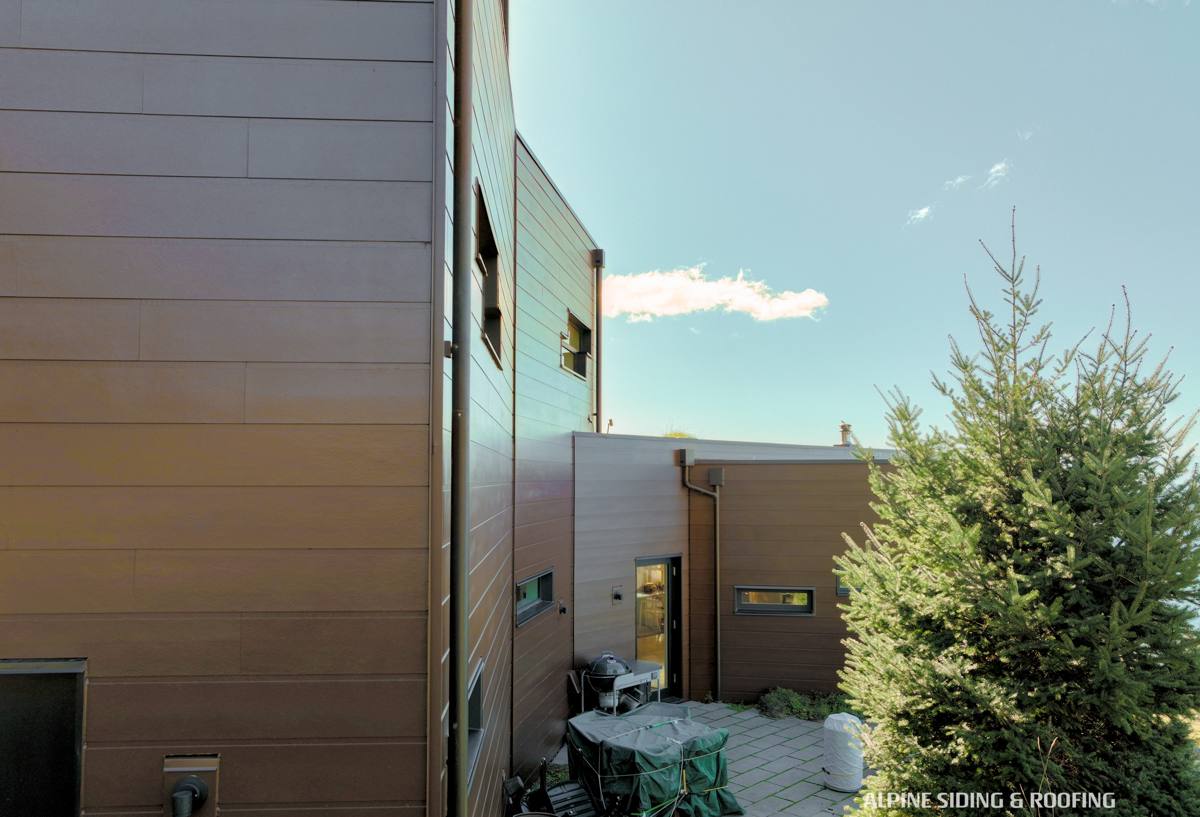
Why We Only Install James Hardie Fiber Cement in Nooksack
We are not a siding company that carries five brands and lets the customer pick based on price. We install James Hardie fiber cement siding, exclusively, on every home we side — including every job we do in Nooksack. That is a deliberate standard, not a sales pitch. We do not install vinyl, LP SmartSide, Cemplank, Allura, primed spruce, or cedar, and we are upfront about why: after years of exterior work in this exact climate, we settled on the one product system that consistently holds up to Whatcom County's rain, humidity, and moss pressure without the maintenance headaches or failure patterns we've seen in the others.
That doesn't mean the alternatives are junk. Vinyl is inexpensive and low-maintenance in dry climates. LP SmartSide is a real engineered wood product with a following. Cedar has genuine curb appeal. But each comes with a real-world trade-off that matters more here than it would somewhere drier: vinyl can warp and doesn't stop moisture from wicking behind it if a seam fails; engineered wood products are still wood-based and rely heavily on paint-film integrity to resist rot; cedar needs ongoing refinishing to keep water out and is a natural food source for the same fungi that thrive in a mossy, shaded valley. James Hardie is fiber cement — sand, cement, and cellulose fiber — so it doesn't rot, doesn't feed fungal growth, and doesn't need to be watertight paint alone to survive a wet winter.
Non-Combustible Matters Here Too
Fiber cement is also non-combustible, which is worth mentioning even in a county known more for rain than wildfire. Whatcom County still sees dry summer stretches and wind events, and a siding material that doesn't contribute fuel to an exterior fire is a real, quantifiable difference — not a marketing line.
What Correct Hardie Installation Actually Involves
James Hardie siding is only as good as the installation behind it. The product itself is engineered to perform, but a rushed or improper install can undercut every advantage it offers — and in a wet climate like Nooksack's, a bad install shows up faster than it would somewhere drier. A correct job includes:
- Proper weather-resistive barrier and flashing at every window, door, and penetration, installed to shed water down and out, not trap it behind the cladding
- Minimum clearance gaps at grade, roof lines, decks, and horizontal trim so the siding never sits in standing water or gets wicked from below
- Hardie-approved fasteners, driven flush (never overdriven), at the correct spacing and blind-nailed where the product calls for it
- Properly sized and sealed joints, with the right sealant chemistry for a factory-finished ColorPlus surface — not a generic caulk that fails in two seasons
- Field-cut edges primed and sealed before installation, since a raw cut edge is the one part of the board that can absorb moisture if left exposed
- Correct panel or plank overlap and course spacing to shed driving rain rather than let it track sideways under wind pressure
Skip any one of these and you can end up with a home that has premium siding on it and a moisture problem behind it within a few years. We've been called in to look at other contractors' Hardie jobs that were installed with the wrong nails, tight-butted joints with no expansion gap, or missing kick-out flashing above a roofline — all things that show up as staining, cracking, or rot at the trim long before the siding material itself would have failed on its own.
ColorPlus Finish and Why It Matters in a Shaded, Damp Valley
Most Hardie siding we install carries the ColorPlus factory finish — a baked-on, multi-coat finish applied under controlled conditions rather than painted on-site after installation. In a climate like Nooksack's, where humidity and shade slow drying time, that matters more than it would in a dry climate. A factory-cured finish bonds more consistently than field-applied paint, resists fading and moisture intrusion at the surface, and comes with a longer color warranty than a site-painted job typically gets. It also means touch-up and color-matching are more predictable if trim or a section ever needs repair down the line.
HZ5 Engineering: Built for This Region, Not a Generic Nationwide Product
James Hardie doesn't sell one siding formulation for the whole country — the company engineers its HZ (HardieZone) product lines for specific climate zones, and the Pacific Northwest falls into the HZ5 category built for wetter, cooler regions with heavy moisture exposure. That's a meaningful distinction for a home in Nooksack: the board composition and moisture-management engineering are matched to exactly the kind of extended damp season, rain volume, and humidity this valley sees, rather than a formulation optimized for a hot, dry climate somewhere else. When we spec a Nooksack job, we're specifying the HZ5 product line for that reason, not defaulting to whatever is cheapest to stock.
What We See on Older Nooksack Homes
A lot of the siding replacement calls we get in and around Nooksack aren't emergencies — they're homes where the existing siding has been quietly losing the fight with moisture for years. Common patterns we run into:
| What We Find | Usual Cause | Why It's Worse Here |
|---|---|---|
| Green-black staining on north and east walls | Moss and algae growth in shaded, slow-drying areas | Long moss season means these surfaces rarely get enough sun to fully dry between rain events |
| Soft or delaminating trim boards | Wood trim or old wood siding absorbing moisture at end grain and joints | Extended wet season gives fungal decay more months per year to work |
| Cupped or bowed lap siding | Wood or engineered wood siding swelling and drying unevenly | Repeated wet/dry cycling in a humid valley accelerates the movement |
| Cracked caulk joints and gapped trim | Standard caulk failing under constant moisture and temperature swing | The region's mild but wet year-round conditions keep sealants under near-constant stress |
| Rust streaking near fasteners | Non-coated or incorrect fasteners corroding | Marine-influenced humidity carried inland accelerates metal corrosion even away from the coast |
None of these are unusual for the region — they're just what happens when a siding material or installation wasn't matched to Whatcom County's actual weather pattern. It's the exact set of problems fiber cement, installed correctly, is built to resist.
Our Process, Start to Finish
1. On-Site Assessment
We walk the exterior with you, look at existing siding condition, trim, flashing, and any moisture or moss patterns already showing, and talk through what's driving the project — full replacement, storm damage, or a remodel.
2. Written Estimate and Product Plan
You get a clear estimate specifying the Hardie product line (plank, panel, or shingle style), HZ5 spec, and ColorPlus color, along with the trim and flashing details for your home specifically.
3. Tear-Off and Substrate Check
Old siding comes off and we check the sheathing and weather barrier underneath before anything new goes up. If there's hidden moisture damage from years of old siding failing quietly, we address it before covering it back up.
4. Installation to Spec
Weather-resistive barrier, flashing, clearances, fastening, and joint sealing done to Hardie's published installation requirements — not shortcuts to save a day of labor.
5. Final Walkthrough
We walk the finished job with you, point out the flashing and clearance details you can't see once everything's buttoned up, and make sure you know what proper Hardie siding maintenance actually looks like (spoiler: very little).
Why Hiring a Crew That Already Works Nooksack Matters
Siding crews that mostly work drier climates or dense urban lots don't always carry the habits this valley demands — the extra attention to flashing, the clearance margins, the fastener choices that account for humidity carried inland from the Salish Sea. We work throughout Whatcom County, from Blaine down through Nooksack and the surrounding valley, and that means we're not guessing at how a wall assembly here behaves over a wet winter — we've seen it, repaired it, and built new installs to avoid repeating it. A crew that shows up once, installs, and leaves for a different climate zone doesn't carry that same accumulated read on how this specific ground and weather pattern treats a house.
Local also means accountability. If a question comes up two years after installation — a joint that needs a look, a question about touch-up paint — you're calling a company that's still working in your area, not chasing down a crew that came through once from out of the region.
Cost Factors to Expect
Every Nooksack home is different, so we don't quote ballpark numbers before seeing the job, but the main factors that move a siding estimate are consistent:
| Factor | Why It Matters |
|---|---|
| Square footage and home shape | More corners, gables, and dormers mean more cutting, flashing, and labor time |
| Current siding removal | Full tear-off vs. siding over an already-sound substrate changes labor scope |
| Substrate repair | Rot or moisture damage found under old siding has to be fixed before new siding goes on |
| Product line and profile | Lap plank, panel, and shingle-style Hardie products carry different material and labor costs |
| Trim and flashing detail | Windows, dormers, and roofline intersections require more precise (and time-consuming) flashing work |
| Access and site conditions | Tree cover, slope, and staging space around the home affect how efficiently the crew can work |
If your Nooksack home's siding is showing moss staining, soft trim, or you're simply planning ahead for a replacement, we're happy to come take a look. The estimate is free, there's no pressure, and you'll get a straight answer about what your home actually needs — use the form below to get started.