 Blaine Roofing
 Bellingham's Roofing Climate: What Homeowners Are Up Against
A roof in Bellingham works harder than most people realize. This part of Whatcom County sits close to the water, which means homes deal with a steady dose of salt-laden marine air, wind-driven rain that comes in at an angle instead of straight down, and long stretches of mild, damp weather that give moss every opportunity it needs to take hold. None of these things alone is unusual for the Pacific Northwest, but together they create a specific set of demands on a roof system that a generic installation job doesn't always account for.
Salt air accelerates corrosion on fasteners and exposed metal. Driving rain finds any gap in flashing or underlayment and pushes water uphill under laps where gravity alone wouldn't take it. And moss doesn't just look bad — left unchecked, it holds moisture against shingles and lifts edges, shortening the life of an otherwise sound roof. A correctly installed roof plans for all three from day one, rather than treating them as maintenance problems to deal with later.
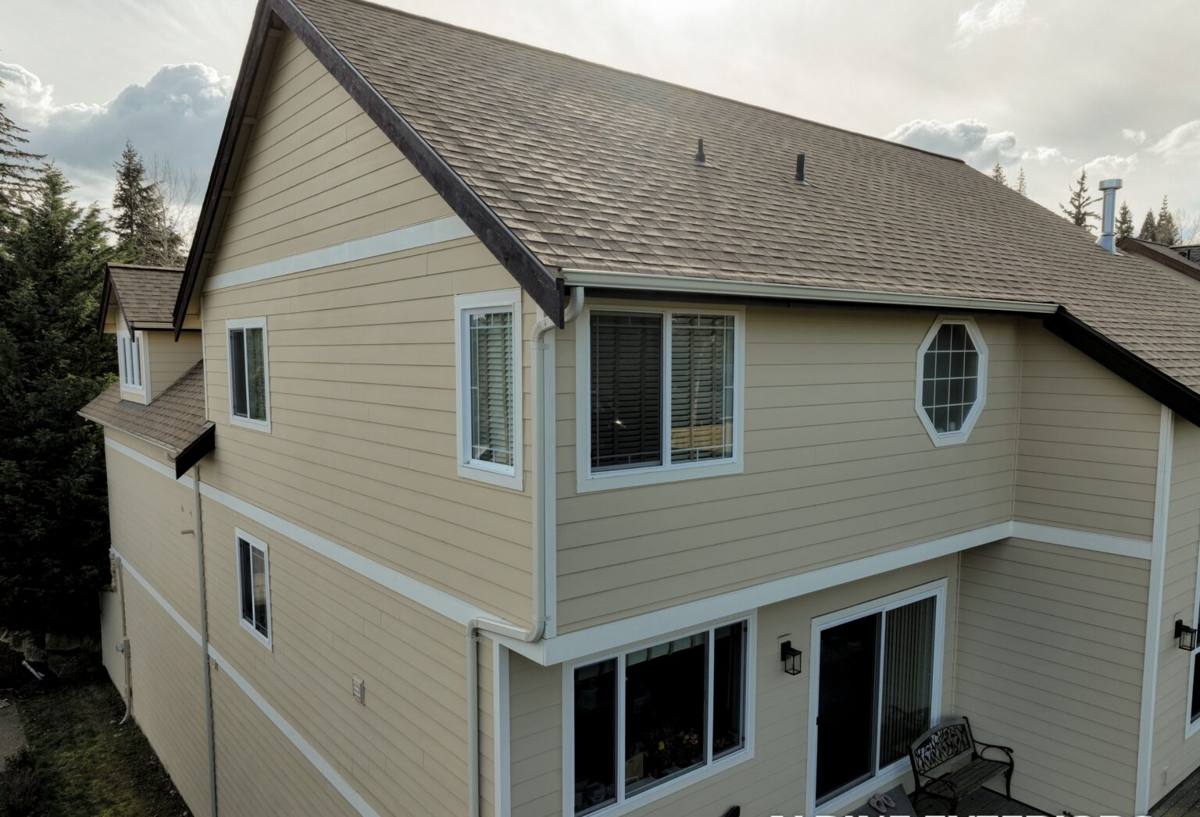
What "Correct" New Roof Installation Actually Means
A new roof is more than shingles nailed to plywood. It's a layered system, and each layer has a job. When any one of them is skipped or done sloppily, the roof may look fine for a year or two before problems show up — usually as leaks in places that are expensive to trace.
A properly built roof, done right for this climate, includes:
- Full tear-off to bare decking, with rotted or delaminated sheathing identified and replaced rather than covered over
- Self-adhered waterproof membrane at eaves, valleys, and other vulnerable transitions where wind-driven rain is most likely to get pushed uphill
- A synthetic underlayment across the rest of the field, which handles sustained wet exposure better than old-style felt
- Metal drip edge at all eaves and rakes, set correctly under the underlayment at the top and over it at the bottom
- Properly lapped and sealed flashing at every wall intersection, chimney, skylight, and roof penetration
- Balanced attic ventilation so moisture from inside the home isn't trapped against the underside of the new roof deck
Skipping any one of these to save a day of labor is where most premature roof failures start — not with bad shingles, but with a shortcut somewhere underneath them.
Roofing Materials That Hold Up Locally
There's no single "best" roofing material for every home — it depends on the roof's exposure, the tree cover on the lot, and what the homeowner wants long-term. What matters is understanding the trade-offs honestly.
| Material | Driving Rain Performance | Moss Resistance | Typical Lifespan |
|---|---|---|---|
| Architectural asphalt shingle | Very good when properly flashed and sealed | Moderate; algae-resistant (AR) versions slow growth but don't stop it | 25–30 years |
| Standing seam metal | Excellent — sheds water fast, minimal seams for wind to exploit | High; smooth surface gives moss little to grip | 40–50+ years |
| Synthetic/composite shingle | Good, comparable to asphalt when installed correctly | Moderate to high depending on product | 30–50 years |
We'll walk through these options during your estimate based on your roof's pitch, shade exposure, and budget — not just push whatever has the highest margin. A shaded, north-facing roof under fir trees has different needs than an open, sun-exposed one two streets over.
A note on algae-resistant shingles
AR shingles contain copper-infused granules that slow algae and moss growth. They help, and we'd recommend them for most Bellingham homes with any tree cover. But they're a mitigation tool, not a guarantee — a roof under heavy shade will still need occasional moss clearing regardless of shingle type.
Ventilation and Moss: The Long Game
Moss doesn't grow because a roof is old — it grows because conditions favor it: shade, moisture that doesn't dry out quickly, and organic debris like needles and leaves that hold water against the shingle surface. Whatcom County's tree canopy and mild, wet winters make this a near-universal issue on shaded roofs, and Bellingham's older, well-treed lots are no exception.
A few things make a real difference during installation, not after the fact:
Balanced intake and exhaust venting
Ridge vents paired with soffit intake keep air moving under the roof deck, which helps the underside dry out and reduces the moisture buildup that moss and algae thrive on. A roof with no soffit intake, or one that's blocked by insulation, won't vent properly no matter how good the ridge vent is.
Slope and valley design
Low-slope sections and poorly designed valleys hold water and debris longer than steep, well-drained ones. We can't change your roof's basic geometry, but we can make sure valleys are flashed and shingled to drain as efficiently as the design allows.
Beyond installation, the honest answer is that moss control on a shaded roof is an ongoing task — periodic gentle cleaning and keeping gutters and valleys clear of debris will do more for a roof's lifespan here than almost anything else.
Flashing and Water Management in Driving Rain
Straight-down rain is easy for any roof to shed. Driving rain — pushed sideways and upward by wind off the water — is what actually tests a roof's details. This is where the difference between an average installation and a correct one shows up most.
The details that matter most in this climate:
- Step flashing at every point where a roof plane meets a wall, individually woven with each course of shingles rather than run as one continuous piece
- Kick-out flashing at the bottom of roof-to-wall intersections, directing water into the gutter instead of behind the siding
- Valley flashing sized and lapped to handle heavy volume, since valleys concentrate runoff from two roof planes into one channel
- Chimney and skylight flashing with proper counter-flashing, not just sealant, since sealant alone degrades faster than metal-on-metal flashing
We treat sealant as a backup, not a primary defense. Any flashing detail that depends entirely on caulk to stay watertight will eventually fail — it's a matter of when, not if.
Salt Air and Coastal Wear
Proximity to the water means airborne salt settles on roofing components year-round, and it's most aggressive on exposed metal and fasteners. This shows up as premature rusting of nail heads, pitting on lower-grade flashing, and corrosion on gutters and drip edge if the wrong materials get used.
For roofs in this area, we specify corrosion-resistant fasteners — ring-shank, hot-dip galvanized or stainless — and choose flashing metals that hold up against salt exposure rather than the cheapest option available. It costs a little more up front. It's also the difference between flashing that lasts the life of the roof and flashing that needs attention in ten years.
Our Installation Process
- On-site inspection and estimate — we look at your current roof, attic ventilation, and any problem areas before recommending materials
- Tear-off and deck inspection — old roofing comes off down to the deck, and any damaged sheathing gets identified and replaced
- Underlayment and flashing — self-adhered membrane at vulnerable areas, synthetic underlayment across the field, new flashing at every penetration
- Material installation — shingles or panels installed to manufacturer specification, with attention to nailing pattern and exposure
- Ventilation check — ridge and soffit venting confirmed to be balanced and unobstructed
- Cleanup and walkthrough — job site cleared of debris and nails, and we walk the finished roof with you before calling it done
Why Local Experience in Bellingham Matters
A roofing crew that regularly works in Bellingham and the surrounding Whatcom County area knows things a crew passing through doesn't — which neighborhoods have heavier tree cover and need extra moss consideration, which exposures take the worst of the wind off the water, and how local permitting and inspection processes actually work. That familiarity shows up in fewer surprises during the job and a roof that's built for the conditions it will actually face, not a generic specification.
It also matters after the job is done. A roof warranty is only as good as the contractor's ability to show up if something needs attention. Working with a crew based in the area, rather than one that installed a roof and moved on to the next region, means someone local is accountable for the work.
Getting Ready for Your New Roof Installation
Once a project is scheduled, a little preparation on your end helps the day go smoothly:
- Clear vehicles from the driveway and any area near the house where a dumpster or material trailer will need to sit
- Remove or secure items hanging on walls near the roofline, since vibration from tear-off can loosen picture frames and shelving
- Move patio furniture, grills, and potted plants away from the perimeter of the house
- Keep pets indoors or offsite during work hours — tear-off is loud and the yard will have debris underfoot
- Let us know about any low-hanging branches near the roof edge so we can plan access safely
- Expect noise and foot traffic overhead for the duration of the project — we'll give you a realistic timeline up front
If your roof is showing its age, or you just want an honest read on what condition it's really in, we're happy to take a look. Reach out for a free, no-pressure estimate using the form below — we'll walk the roof, explain what we find, and give you straight answers about what a new roof installation for your Bellingham home should actually involve.