 Blaine Roofing
 Siding Repair Built for Lynden's Weather, Not a Generic Patch Job
Homes in Lynden take a steady beating from the same weather systems that roll across all of Whatcom County — long stretches of driving rain, salt-influenced marine air moving in off the water, and a moss season that can stretch from fall through spring. None of that damage happens overnight. It shows up as a soft spot near a downspout, a cracked panel by a hose bib, or a dark streak of moss creeping up a north-facing wall. By the time a homeowner notices it, the underlying problem has usually been building for a season or two.
Siding repair is deceptively simple-sounding work. In practice, doing it correctly means understanding why the damage happened in the first place, not just covering it up. A patch that ignores the moisture path behind it will fail again, usually faster than the first time. This page covers what siding repair actually involves for homes in the Lynden area, what we look for, and why we only repair with the same material we install — James Hardie fiber cement — rather than mixing materials to save a trip.
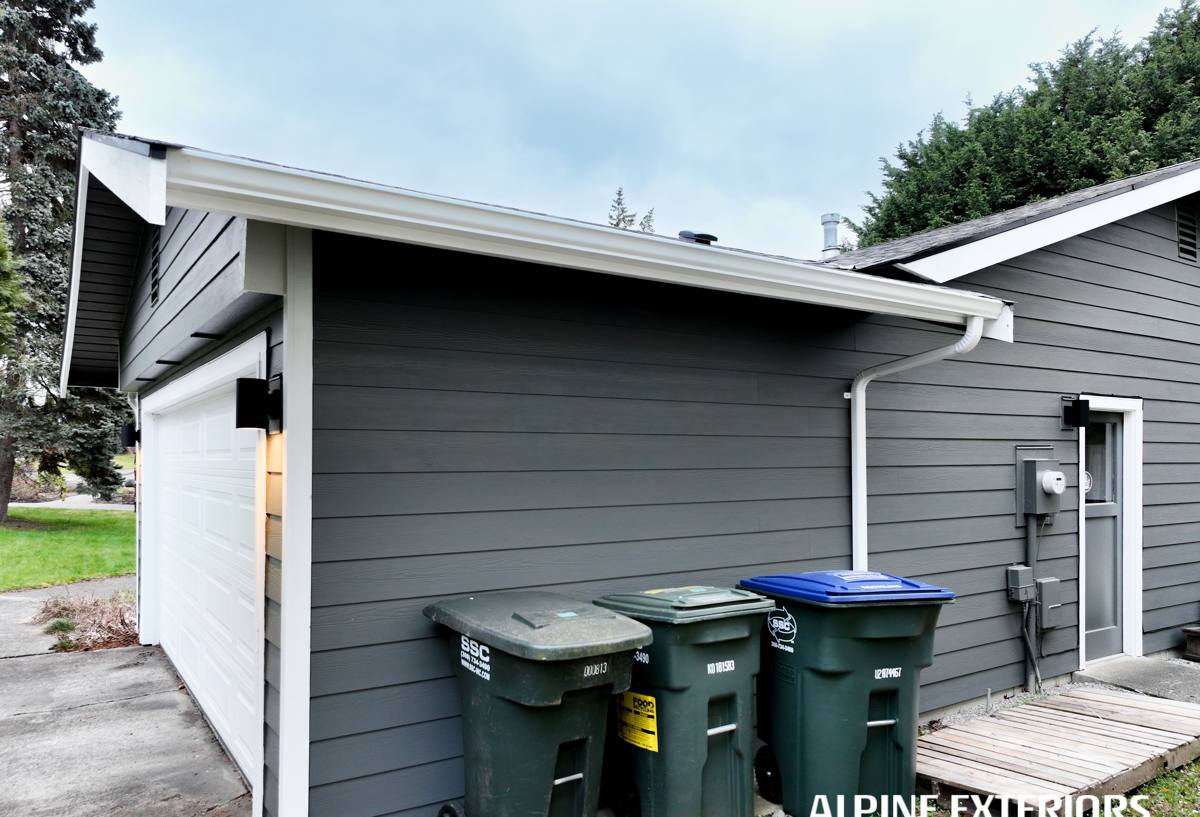
What's Really Damaging Siding in This Climate
Moisture and Driving Rain
Whatcom County doesn't get isolated downpours so much as extended periods of steady, wind-driven rain. That kind of weather pushes water sideways into laps, seams, and butt joints that were never designed to handle standing moisture. Over years, water finds its way behind poorly sealed joints or under caulk that has shrunk and cracked, and it starts working on whatever is underneath — sheathing, house wrap, framing.
Moss and Organic Growth
Shaded walls, north exposures, and anywhere airflow is limited tend to grow moss and algae faster here than almost anywhere else in the country. Moss itself doesn't destroy siding the way rot does, but it holds moisture against the surface far longer than open air would, and it's often the first visible sign that a section of wall stays wet longer than it should. Left alone, that constant dampness accelerates whatever weaknesses already exist in the siding or its fasteners.
Impact Damage and Aging Materials
Cracked corners, dented panels, and impact damage from storms, ladders, or yard equipment are common and usually straightforward to repair on their own. The complication is when that damage sits on an older wall clad in a softer or more moisture-sensitive material — those repairs need extra care so the fix doesn't become a new entry point for water.
Signs Your Siding Needs Repair
Most siding problems give warning signs well before they become structural. Worth checking for, especially heading into another wet Whatcom County winter:
- Soft or spongy spots when you press on a panel, especially near the bottom courses or below windows
- Cracked, bowed, or separated panels, particularly at butt joints and corners
- Persistent moss or dark staining that keeps returning after cleaning
- Caulk that has shrunk, cracked, or pulled away from trim and joints
- Paint or finish that's peeling, chalking, or bubbling in one localized area rather than the whole wall
- Visible gaps where siding meets windows, doors, or roof flashing
- Interior signs — a musty smell, a damp patch on drywall, or peeling interior paint on an exterior wall
Why the Repair Material Matters
A siding repair is only as good as the material used to make it. We repair exclusively with James Hardie fiber cement — the same product we install on full jobs — and we don't patch Hardie siding with vinyl trim pieces, primed wood, or other composite siding just because it's on hand or cheaper to source quickly.
That's a deliberate standard, not a sales pitch. Mixing materials on a repair creates mismatched expansion and contraction rates, different moisture behavior, and a seam that ages differently than the surrounding wall. Fiber cement doesn't swell with moisture, doesn't attract pests, and holds paint and factory finish far more consistently over time than wood or vinyl patches. When we repair a Hardie wall, the replacement piece is Hardie too, cut, primed, and finished to match — not a stopgap that will need redoing in a few years.
If a home in Lynden currently has non-Hardie siding — vinyl, LP SmartSide, cedar, or an older fiber cement product — we'll still repair what's damaged and explain the trade-offs of that material honestly. But when a wall's damage is extensive enough that patching no longer makes sense, our recommendation is always to move to Hardie rather than replace like-for-like with a product that has the same underlying weaknesses.
What a Correct Siding Repair Actually Involves
Diagnosis Before Demolition
Before any siding comes off, we find out how far the damage actually extends. A cracked panel is often just the visible symptom — the real question is whether water has been getting behind it, and if so, for how long and how far it has traveled. That means checking the house wrap, flashing, and sheathing underneath, not just the panel itself.
Matching the Existing Wall
Hardie's factory ColorPlus finish is baked on and color-matched across product runs, which makes replacement sections blend in far better than field-painted patches. Where an exact ColorPlus match isn't available due to an older or discontinued color, we'll be upfront about it before starting the work, not after.
Rebuilding the Moisture Path
This is the part that separates a repair that lasts from one that doesn't. Correct flashing, properly lapped house wrap, and the right gap and sealant at joints all matter more than the visible patch itself. We rebuild the drainage path behind the repair so water sheds the way it's supposed to, rather than just closing up the hole.
Fastening and Finish
Fiber cement has specific fastening requirements — nail placement, spacing, and depth all affect how a panel performs over time. Getting this wrong is a common source of cracking at fastener points down the road, so we follow manufacturer fastening specs rather than treating it like standard lap siding.
Our Repair Process
- Inspection and diagnosis — We look at the damaged area and the wall around it, including a check behind the siding where the damage suggests moisture may have traveled.
- Honest scope and estimate — We tell you plainly whether this is a contained repair or whether the damage has spread far enough that a larger section or full replacement makes more sense.
- Material sourcing and matching — We source the correct Hardie profile, thickness, and finish to match your existing wall as closely as possible.
- Removal and moisture path repair — Damaged siding comes off, and we address whatever is happening underneath — flashing, house wrap, sheathing — before anything new goes back on.
- Installation to spec — New Hardie panels are cut, fastened, and sealed according to manufacturer installation requirements, not shortcuts.
- Final check — We walk the repair with you, confirm the fit and finish, and make sure drainage and sealant lines look right before we consider the job done.
Repair vs. Replacement: How We Decide
Not every damaged section needs a full re-side, and not every crack should just be caulked over. The decision usually comes down to a few factors:
| Factor | Favors Repair | Favors Replacement |
|---|---|---|
| Extent of damage | Isolated to one or two panels | Spread across multiple walls or courses |
| Underlying moisture | No sign of water behind the wall | Rot or sustained moisture found in sheathing |
| Age of existing siding | Newer Hardie install, still within useful life | Original material past its practical service life |
| Color/profile match | Current ColorPlus finish still available | Discontinued finish, visible mismatch likely |
| Cause of damage | One-time impact or isolated failure | Systemic issue — poor original flashing, chronic moss/moisture |
When repair is the right call, we say so — there's no benefit to us or you in replacing more siding than the problem actually requires.
Why a Crew That Already Works in Lynden Matters
Siding repair is easier to get right when the crew doing it already understands how this specific climate behaves on walls throughout the year. That means recognizing the difference between surface moss and a wall that's staying wet because of a flashing problem, knowing which sides of a house in this region tend to take the worst of the driving rain, and understanding how moss season timing affects when a repair should happen versus when it can wait. A crew that works Whatcom County regularly has seen these patterns repeat across dozens of homes, not just the one in front of them.
There's also a practical side to hiring locally: faster response when a repair is time-sensitive, familiarity with the area's typical construction, and accountability that comes from being a name homeowners in Lynden and the surrounding communities can actually check up on.
Get an Honest Look at Your Siding
If you're seeing soft spots, cracked panels, or moss that keeps coming back no matter how often it's cleaned, it's worth having someone look at it before the next wet season sets in. We'll give you a straight answer on whether it's a contained repair, a larger section, or something that's reached the point of full replacement — with no pressure either way. Reach out for a free estimate using the form below.