 Blaine Roofing
 Custer's Climate Is Harder on Siding Than It Looks
Custer sits inland just enough from the water that people sometimes assume it's spared the worst of what Whatcom County's weather throws at a house. It isn't. Salt-laden air still moves in off the Strait and Birch Bay, driving rain comes sideways for months at a stretch, and the same low winter sun angles and standing damp that grow moss on roofs do the same thing to siding, especially on the north and west-facing walls that never fully dry out between storms. Add the freeze-thaw swings that show up most winters, and you have a climate that punishes any siding product with weak points at the seams, the fasteners, or the paint film.
This isn't a reason to panic about your existing siding. It's a reason to be precise about what goes back up when it's time to replace it, and precise about how it's installed. We install James Hardie fiber cement siding exclusively, and on Custer homes specifically, that choice and that installation discipline matter more than they would in a drier, calmer climate.
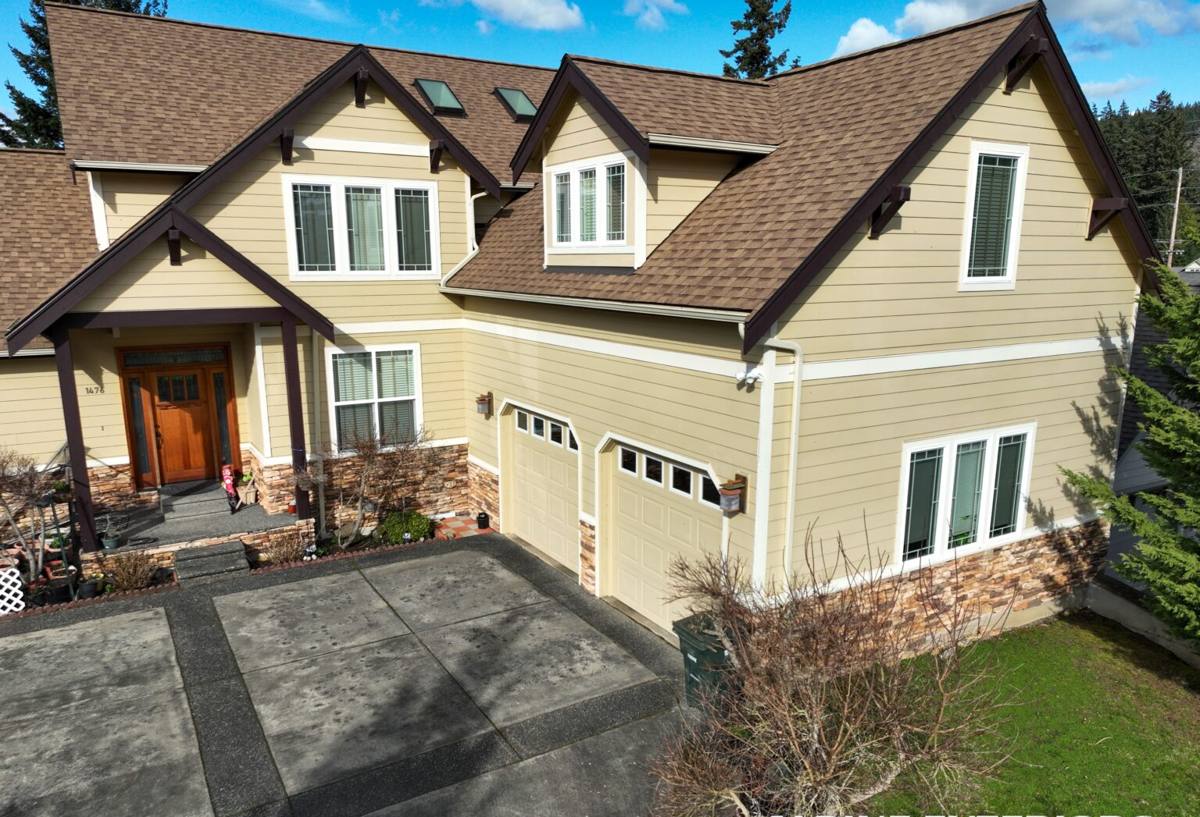
What Salt Air, Rain, and Moss Actually Do to Siding
Salt Air
Airborne salt is corrosive to metal fasteners and trim, and it accelerates the breakdown of lower-quality paint films. It doesn't damage fiber cement itself, but it will find every weak fastener, every exposed cut edge, and every gap in a coating and go to work there first.
Driving Rain
Wind-driven rain doesn't just fall on a wall, it gets pushed sideways into laps, seams, and any gap around windows, doors, and trim. Siding in this region has to shed water outward at every horizontal lap, not just rely on caulk to keep it out. Caulk fails; correct overlap and flashing don't.
Moss and Sustained Moisture
A long moss season means long stretches where shaded, north-facing walls stay damp. Wood-based products absorb that moisture and can swell, cup, or rot at the bottom edge over years. Fiber cement doesn't absorb water the way wood or wood-composite products do, but it still needs to be installed with the correct clearance off grade, decks, and roof lines so water has somewhere to go instead of sitting against the bottom course.
What Correct James Hardie Installation Involves
James Hardie siding is a durable product, but its performance depends heavily on installation matching the manufacturer's specifications. A lot of the siding problems we get called out to look at on older homes trace back to shortcuts taken during installation, not to the material itself. On a Custer job, we hold to these points without exception:
- Minimum clearance between the bottom of the siding and grade, roofing, decks, and walkways, so splashback and standing water can't wick into the board
- Correct fastener type, spacing, and placement, driven flush and not overdriven, since overdriven or misplaced fasteners create weak points that fail first under wind and moisture pressure
- Proper flashing and weather-resistive barrier detailing at every window, door, and penetration, so water is directed outward rather than trapped behind the cladding
- Correct lap and gap dimensions at butt joints and trim, sealed with a product rated for the intended movement and exposure, not just whatever caulk is on the truck
- Field-cut edges primed or sealed per Hardie's specification, since an unsealed cut edge is the single most common point of premature failure
- Panel and plank orientation and starter strip installation that match the specific Hardie product line being used
None of this is exotic. It's the difference between following the manufacturer's installation manual and eyeballing it, and it's the difference between siding that looks right for the first year and siding that actually performs for decades in a coastal climate.
Which James Hardie Product Line Fits a Custer Home
James Hardie makes several distinct product lines, and the right one depends on your home's architectural style, exposure, and what you're trying to achieve visually. We walk through this with every homeowner rather than defaulting to one product for every house.
| Product | Typical Use | Why It Fits Here |
|---|---|---|
| HardiePlank Lap Siding | Most traditional and craftsman-style homes | Classic horizontal lap profile, widely used across the county, good balance of appearance and cost |
| HardiePanel Vertical Siding | Modern homes, gable accents, farmhouse styling | Common in the barn-influenced architecture you see around Custer's more rural lots |
| HardieShingle Siding | Accent gables, dormers, Craftsman detailing | Adds texture without the maintenance burden of real wood shingles in a damp climate |
| HardieTrim Boards | Corners, fascia, window and door trim | Matched fiber cement trim resists the moisture and insect issues that plague wood trim in this area |
All of these are engineered under James Hardie's HZ10 climate designation for our region, which accounts for the moisture exposure typical of the Pacific Northwest. That engineering only pays off, though, if the installation respects the clearances and detailing described above.
ColorPlus Finish: Why Factory Finish Matters Near the Water
One of the most overlooked advantages of James Hardie siding is its ColorPlus factory finish. Instead of a field-applied paint job, the color is baked on in a controlled factory process, which produces a more consistent, more durable finish than most site-applied paint can match, backed by its own finish warranty separate from the product warranty.
In a salt-air environment, that matters. Site-applied paint on any siding material is more vulnerable to early fading, chalking, and adhesion failure when it's constantly exposed to salt-laden moisture. A factory-cured finish holds its color and bond better over time, which means fewer repaint cycles and less maintenance for a home already dealing with driving rain and a long damp season.
Our Process for a Custer Siding Project
Every home is different, but the sequence we follow doesn't change, because skipping a step is exactly how the water-management problems described above end up baked into a new siding job.
- On-site assessment — we look at existing siding condition, moisture damage, trim, flashing, and any structural issues under the current cladding before quoting anything
- Product and line selection — matched to your home's style and exposure, not a one-size default
- Removal and substrate check — old siding comes off, sheathing is inspected for rot or damage before anything new goes up
- Weather-resistive barrier and flashing — installed or repaired to current standards, since this layer does most of the real water-management work
- Siding installation to manufacturer spec — correct clearances, fasteners, laps, and sealed cut edges throughout
- Trim, caulking, and final detail — done last, after the field siding is confirmed square and properly seated
- Final walkthrough — we go over the finished work with you before calling the job done
Why We Only Install James Hardie
We get asked why we don't offer vinyl, LP SmartSide, or other fiber cement alternatives. The honest answer is that we've made a professional judgment call about what holds up in this climate with the least long-term risk to the homeowner. Vinyl siding can warp and become brittle with UV and temperature cycling, and its seams and utility penetrations are common water entry points over time. Engineered wood products like LP SmartSide are wood-based at the core, which means they're more sensitive to sustained moisture exposure than fiber cement, and that sensitivity is a bigger liability in a climate with a long moss season than it would be somewhere drier.
James Hardie's fiber cement composition is non-combustible, dimensionally stable, and, when installed to spec, performs consistently over a long service life in exactly the conditions Custer sees most: salt air, driving rain, and sustained damp. Standardizing on one product line also means our crews aren't relearning installation details for five different systems — they know Hardie's specifications cold, on every job.
Cost Factors on a Custer Siding Project
We don't publish flat prices because siding costs are driven by the specifics of your house, not a generic per-square-foot number. What we can tell you is what actually moves the number up or down, so you know what you're being quoted for.
| Factor | Impact on Cost |
|---|---|
| Total square footage of siding | Primary driver of material and labor cost |
| Removal of existing siding and disposal | Adds labor time, especially with multiple layers or damaged substrate |
| Substrate repair or rot remediation | Variable — depends entirely on what's found once old siding comes off |
| Home style and trim detail | More corners, dormers, and trim lines mean more labor and material cuts |
| Product line mix (plank, panel, shingle, trim) | Combining lines for architectural accents adds modest cost over a single product |
| Site access | Steep lots, limited driveway access, or tight setbacks can add labor time |
Most full siding replacements represent a significant investment, and we'd rather walk your specific house with you and give you real numbers than throw out a range that doesn't mean much until we've seen the property.
Why Local Experience in Custer Matters
A crew that's already worked homes around Custer and greater Blaine knows the practical realities that don't show up in a spec sheet: which lots sit low and hold moisture longer, how wind exposure changes from a sheltered inland lot to one closer to the water, and what past siding failures in this area typically look like when we open a wall up. That experience shows up in small decisions during installation — extra attention at a particularly exposed gable, a flashing detail adjusted for a lot's drainage pattern — that a crew unfamiliar with Whatcom County's coastal-influenced weather might not think twice about.
It also means fewer surprises for you. We're not learning the region on your job.
If your Custer home needs new siding or you're weighing your options before committing to a product, we're happy to walk the property, look at what's there now, and give you a straightforward, no-pressure estimate. Use the form below to get started.