 Blaine Roofing
 Salt Air, Driving Rain, and Moss: Why Birch Point Is Hard on Siding
Birch Point sits right up against the water on the Whatcom County coastline, and that waterfront location is exactly what makes siding decisions here different from an inland Blaine home a few miles east. Homes along this stretch take on marine salt air almost every day, get hit with wind-driven rain off the Salish Sea during fall and winter storms, and sit under a tree canopy that keeps things damp and shaded for much of the year. That combination is tough on any wall cladding, but it is especially hard on the wood-based and vinyl products a lot of homes here were originally built with.
Salt-laden air accelerates corrosion on fasteners and trim, driving rain finds every gap and seam a normal install would leave loose, and a long moss season means anything that holds moisture against the wall stays wet longer than it should. Add the temperature swings of a coastal winter and you get siding that cups, delaminates, or grows moss and mildew years before it should. This is the environment we build every Birch Point installation around, not a generic "Pacific Northwest" spec.
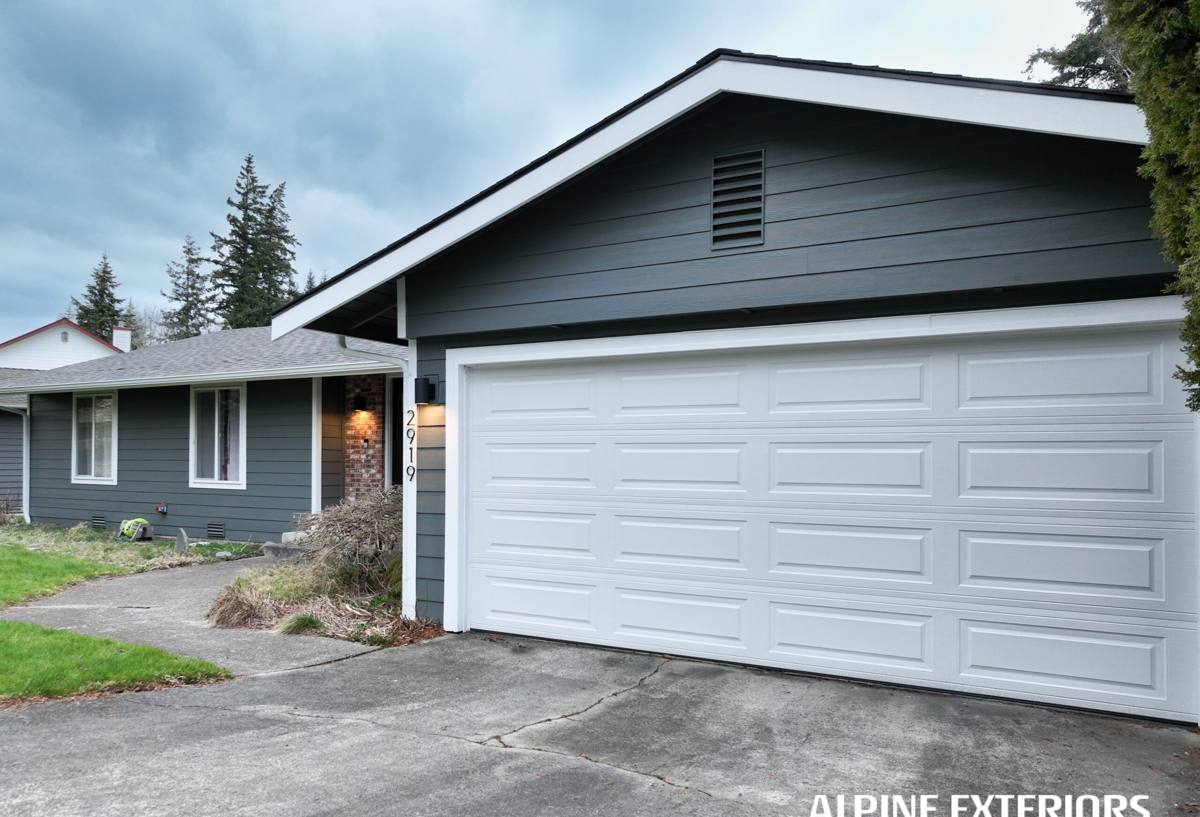
Why We Install James Hardie Here and Nothing Else
We are a James Hardie-only siding crew. We do not install vinyl, LP SmartSide, Cemplank, Allura, primed spruce, or cedar, and that is a deliberate standard, not a lack of options. Fiber cement is non-combustible, it does not swell or rot the way wood-based products can when they stay wet, and it holds its shape and finish through the kind of freeze-thaw and salt-air cycling Birch Point sees every winter. For a waterfront property where siding is a 30-plus year decision, we would rather stand behind one product system we know inside and out than offer a menu of cheaper options we have watched fail early in this exact climate.
HZ5 Engineering for Marine Exposure
James Hardie engineers its siding in climate-specific "HZ" formulations, and the HZ5 line is built for the wetter, harsher weather patterns found in the Pacific Northwest and other marine climates. It is formulated to resist moisture intrusion and freeze-thaw damage better than a generic all-climate board, which matters on a property that gets both driving coastal rain and cold snaps in the same winter. We spec HZ5 as the default for Birch Point work, not an upgrade.
ColorPlus Factory Finish
Field-applied paint is the first thing to fail on a coastal home, because salt air and UV break down site-applied coatings faster than they break down a factory finish. James Hardie's ColorPlus finish is baked on under controlled conditions and backed by its own finish warranty, so the color and sheen hold up longer against the exact kind of weathering Birch Point homes see, and repainting stops being a five-year chore.
What a Correct Installation Actually Involves
Fiber cement siding is only as good as the install behind it. Hardie's own installation manual is specific about clearances, fastening, and moisture management, and skipping any of it is how a good product ends up with problems that get blamed on the siding instead of the installer. On a Birch Point home, we treat the manual as the floor, not a suggestion, because the margin for error is smaller this close to the water.
Moisture Management Behind the Boards
Correct water management starts before a single board goes up: a weather-resistant barrier, properly lapped flashing at every window, door, and penetration, and a rainscreen or drainage plane where the wall assembly calls for one. Salt air and driving rain will find any shortcut here, so we pay particular attention to head flashing over openings and to kick-out flashing where a roofline meets a wall, since those are the two spots that cause the most hidden rot on coastal homes.
Clearances, Fastening, and Gaps
James Hardie specifies minimum clearances from grade, roof lines, and decks, along with specific fastener types, spacing, and butt-joint treatment. Too tight a clearance traps moisture against the bottom of the board; the wrong fastener corrodes early in salt air; an unsealed or poorly flashed joint becomes the entry point for the next storm. None of this is visible once the job is finished, which is exactly why it has to be done right the first time.
Ventilation and Drainage Planes
A shaded, damp lot like much of Birch Point needs the wall assembly behind the siding to be able to dry out between rain events. We build in a drainage gap so bulk water has somewhere to go besides straight into the sheathing, and we make sure soffit and attic ventilation are actually working, since a wall that cannot breathe stays wet longer no matter how good the siding on the outside is.
Our Process for a Birch Point Project
The steps are the same fundamentals every reputable installer should follow, but we sequence them around what actually causes failures in this specific location.
- Walk-through and existing siding assessment — we look at moss growth patterns, caulk condition, and any staining that points to a hidden leak before we ever talk about new siding.
- Measure and material plan — panel sizes, trim profiles, and HZ5 board selection specific to your home's exposure to wind and water.
- Tear-off and substrate check — old siding comes off and we inspect sheathing for rot or soft spots, since that is the point where hidden moisture damage actually gets found and fixed.
- Weather barrier and flashing — house wrap, window and door flashing, and drainage gap installed to Hardie spec before any siding goes up.
- Siding installation — proper clearances, fastener spacing, and joint treatment, with special attention at inside/outside corners and roof-to-wall transitions.
- Trim, caulking, and touch-up paint — factory-finished ColorPlus product needs far less field paint than a generic board, but cut edges and fastener heads still get properly sealed and touched up.
- Final walk-through — we go over clearances, flashing details, and finish quality with you before calling the job done.
Common Problems We Find on Existing Birch Point Homes
Because we work this specific area regularly, we see the same handful of issues repeat on older siding jobs. Most of them trace back to a product or installation shortcut that made sense somewhere drier, not to bad luck.
| What We See | Likely Cause | What a Correct Hardie Install Prevents |
|---|---|---|
| Moss and dark staining on north or shaded walls | Poor drying capacity, no drainage gap, damp lot with heavy tree cover | Rainscreen gap and proper ventilation let the wall dry between storms |
| Bubbling or peeling paint | Field-applied paint breaking down under salt air and UV | Factory-cured ColorPlus finish resists weathering far longer |
| Soft or swollen board edges | Wood-based siding (or unsealed cut edges) absorbing driving rain | Fiber cement does not swell, plus factory-sealed edges and correct caulking |
| Rust streaking below fastener heads | Wrong fastener type for a marine-exposure climate | Corrosion-resistant fasteners specified for coastal HZ5 installs |
| Hidden rot found at tear-off | Missing or poorly lapped flashing at windows or roof lines | Flashing installed and inspected before any siding goes back up |
Color and Finish Choices for a Coastal Lot
Color choice on a waterfront home is partly aesthetic and partly practical. Darker ColorPlus finishes handle UV and salt exposure well because the color is baked into a factory finish rather than sitting on top as field paint, but on a shaded, moss-prone lot we also talk through how a lighter or mid-tone color shows less of the green staining that heavy tree cover can produce over time between cleanings. There is no single right answer here — it depends on how much direct sun and how much overhead canopy your specific lot gets, and we walk through that with you rather than push a default.
What Birch Point Homeowners Should Budget For
Every home is different, but the factors that move a Birch Point siding project up or down in cost are fairly consistent. We do not quote prices sight-unseen, but this is what typically drives the number.
| Cost Factor | Why It Matters Here |
|---|---|
| Substrate condition | Hidden moisture damage found at tear-off adds repair work before new siding can go on |
| Home shape and trim detail | More corners, windows, and roof-to-wall transitions mean more flashing and cutting labor |
| Access and lot terrain | Waterfront lots with slopes or limited staging area can affect scaffolding and material handling |
| Board profile and color | Lap width, panel style, and ColorPlus color selection affect material cost |
| Existing siding removal | Full tear-off versus siding over an already-sound wall changes the labor scope |
Maintenance: What Actually Keeps Hardie Siding Performing Here
One of the honest selling points of fiber cement is how little upkeep it needs compared to wood-based siding, but "low maintenance" is not "no maintenance," especially this close to the water. A short annual routine keeps a correctly installed system performing the way it is designed to.
- Rinse salt residue and grime off the siding once or twice a year with a garden hose and soft brush — skip the pressure washer, which can force water behind panels and joints.
- Check caulking at trim, corners, and penetrations annually and re-seal anything that has cracked or pulled away.
- Keep gutters clear so overflow does not run down the wall face and feed moss growth at the top of the siding.
- Trim back vegetation and tree branches that keep a wall section shaded and damp longer than the rest of the house.
- Watch for moss or algae at the bottom courses and along shaded elevations, and clean it promptly rather than letting it establish.
- Have flashing and caulking at windows and roof-to-wall transitions checked every few years, since those are the details that quietly cause the most damage if they fail.
Why Hiring a Crew That Already Works Birch Point Matters
Siding installation manuals do not fully capture what a specific stretch of coastline throws at a wall assembly. A crew that has already done multiple Birch Point homes knows which elevations take the worst driving rain, which lots hold onto moss longest, and which older homes in the area tend to have hidden flashing shortcuts from a prior remodel. That local pattern recognition shows up in small decisions — an extra flashing detail here, a different fastener spacing there — that a generalist crew working the area for the first time is more likely to miss.
It also matters for permitting and inspection. Blaine and Whatcom County have their own permitting expectations, and a crew that pulls permits here regularly moves through that process without the delays that come from unfamiliarity. For a homeowner, that translates into a job that starts and finishes on the timeline you were told, not one held up by paperwork surprises.
If you are weighing a siding replacement or repair on a Birch Point home, we are happy to walk the property with you, look at what your current siding is telling us, and put together a straightforward, no-pressure estimate for a James Hardie system built for this exact stretch of coastline. Use the form below to get started.