 Blaine Roofing
 Why Everson Homes Need Siding Built for This Climate
Homes in the Everson area sit in one of the more demanding exterior environments in Whatcom County. Marine air moves inland off the Strait and mixes with driving rain that comes sideways during fall and winter storms, soaking siding surfaces that a lot of products simply aren't engineered to handle. Add a long, shaded moss season under the region's tree cover and damp shoulder seasons that never quite dry out, and you have a climate that finds every weak point in a siding system within a few years, not a few decades.
Salt-tinged moisture accelerates corrosion on fasteners and trim. Driving rain forces water sideways into laps, joints, and butt seams that were never designed to shed water from that angle. And moss doesn't just sit on the surface — it holds moisture against the siding face and works into any gap or unsealed edge, especially on north-facing walls and areas with less direct sun. Siding in Everson isn't just a weather barrier, it's a system that has to actively manage water, not just resist it.
That's the lens we use for every fiber cement siding project we take on in this area. It shapes the product we install, the way we detail the installation, and the maintenance conversation we have with every homeowner before we leave the job.
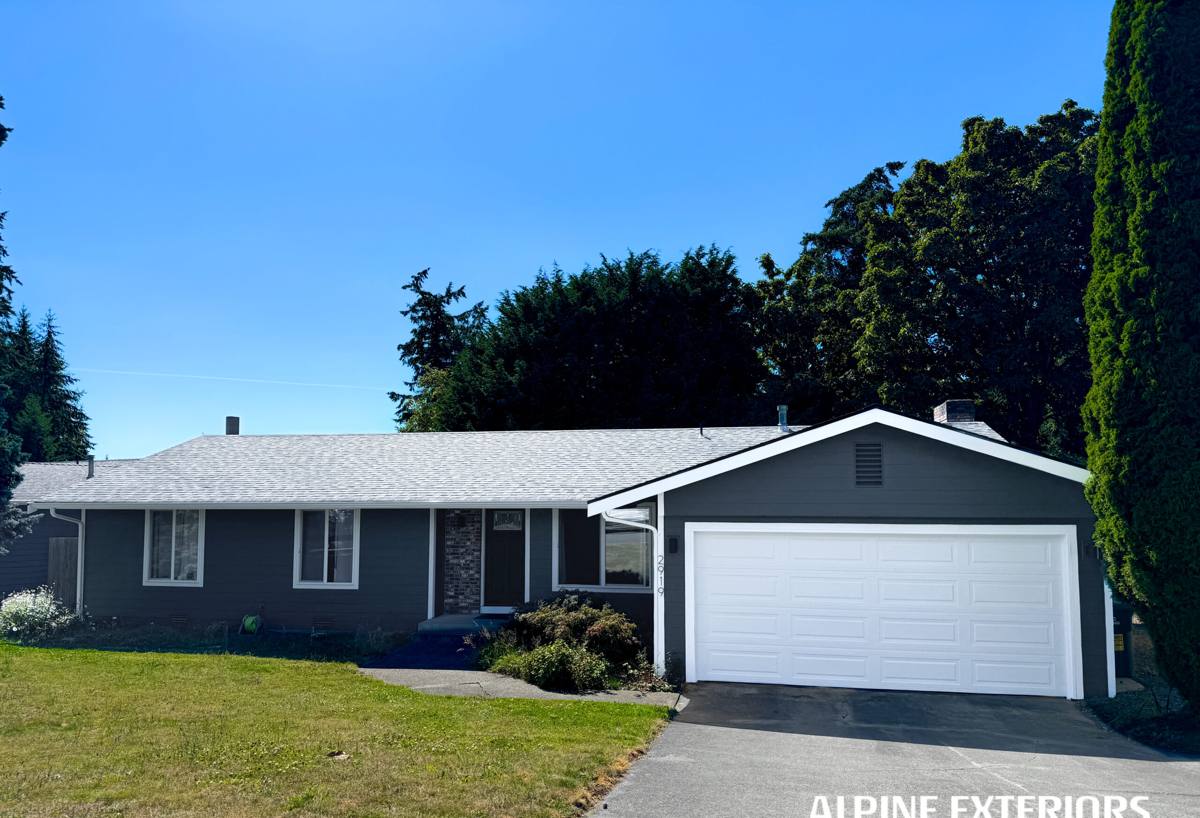
What Fiber Cement Siding Is — and Why We Only Install James Hardie
Fiber cement siding is a composite of cement, sand, and cellulose fiber, manufactured under pressure and heat into planks, panels, and trim. Done right, it's non-combustible, dimensionally stable, and far more resistant to moisture-driven rot than wood-based products. Done wrong — or built from a formula that isn't matched to a wet marine climate — it can absorb water at cut edges, swell, and fail well before its expected lifespan.
We install James Hardie fiber cement exclusively. We don't offer LP SmartSide, vinyl, Cemplank, Allura, primed spruce, or cedar as alternatives, and we're upfront about why: after years of installing and repairing siding in Whatcom County's climate, Hardie's engineering, factory finish, and warranty structure are the only combination we're willing to put our name behind here.
Built for Marine Climates: HZ5 Engineering
James Hardie manufactures its siding in climate-specific "HZ" formulations, and the Pacific Northwest falls under the HZ5 line, engineered specifically for regions with sustained moisture exposure, freeze-thaw cycling, and marine air. That's a meaningfully different product than a generic fiber cement board sold nationwide — the fiber-to-cement ratio and moisture-management properties are tuned for exactly the conditions Everson sees most winters.
The other piece is ColorPlus Technology, Hardie's factory-applied finish. It's baked on under controlled conditions rather than field-painted, which means better adhesion, more consistent color, and a finish that resists the fading and peeling that field-applied paint struggles with in a climate this damp. For homeowners, that translates to fewer repaint cycles and a warranty that covers the finish, not just the substrate.
What a Correct Fiber Cement Siding Installation Actually Involves
Fiber cement siding is only as good as the installation behind it. Most siding failures we're called out to inspect in this region aren't a materials problem — they're a detailing problem. Water found a way in because a step was skipped or rushed.
Weather-Resistive Barrier and Rainscreen Gap
Everything starts underneath the siding, not on top of it. A properly lapped weather-resistive barrier goes over the sheathing first, and in a climate as wet as ours, a rainscreen gap — a small ventilated air space between the barrier and the siding — makes a real difference. It lets any moisture that does get behind the siding drain and dry instead of sitting against the wall assembly.
Fastening, Clearances, and Butt Joints
James Hardie specifies exact fastener types, spacing, and penetration depth, and those specs exist for a reason — under-driven or over-driven nails, or the wrong fastener material, are one of the most common causes of premature failure and telltale surface cracking. Clearances matter just as much: siding needs proper gaps at grade, roof lines, decks, and any horizontal surface where standing water or splash-back can wick moisture into the board's cut edges over time.
Trim, Flashing, and Caulking Details
Butt joints, window and door trim, and any penetration through the siding field are where driving rain finds its way in first. Correct flashing at every horizontal trim piece, sealed and primed cut edges, and appropriate — not excessive — caulking at joints are what keep water moving down and out instead of behind the wall. We treat this stage as the difference between siding that lasts and siding that looks fine for a couple of years before problems show up.
Our Process for Everson Siding Projects
- On-site assessment. We look at existing siding condition, moisture damage, trim, and any rot or sheathing issues before we quote anything.
- Product and color selection. We walk through Hardie's plank profiles, panel options, and ColorPlus palette based on your home's style and exposure.
- Tear-off and substrate check. Old siding comes off and we inspect sheathing for hidden moisture damage before closing the wall back up.
- Weather-resistive barrier and rainscreen installation. This layer goes in correctly before a single piece of siding is hung.
- Siding installation to manufacturer spec. Proper fastening, clearances, and lapping, following James Hardie's published installation requirements.
- Trim, flashing, and caulking. Every joint, corner, and penetration is detailed to shed water, not trap it.
- Final walkthrough. We review the completed job with you and go over what routine maintenance actually looks like going forward.
Comparing Siding Materials for the Everson Climate
| Material | Moisture Behavior in Wet Marine Climate | Typical Maintenance |
|---|---|---|
| James Hardie Fiber Cement (HZ5) | Engineered for sustained moisture and freeze-thaw exposure; dimensionally stable | Occasional wash; factory finish reduces repaint frequency |
| Vinyl Siding | Doesn't absorb water itself, but can warp, crack in cold snaps, and trap moisture behind it if installed loosely | Low, but replacement rather than repair when damaged |
| Primed Wood (Spruce/Cedar) | Naturally absorbs moisture at cut edges and joints; prone to rot in prolonged damp conditions and under moss | Frequent repainting, sealing, and moss/mildew treatment |
| Generic Fiber Cement (non-HZ formula) | Can perform well, but without climate-specific engineering may be more prone to moisture uptake at exposed edges | Depends on finish quality and installation detailing |
What Fiber Cement Siding Costs in Everson
Every home is different, but the main variables that move the price on a fiber cement siding job in this area are consistent from house to house:
| Cost Factor | Why It Matters |
|---|---|
| Home size and wall complexity | More square footage, more corners, dormers, and cutouts mean more labor and material |
| Existing siding removal and substrate condition | Rot repair or sheathing replacement found during tear-off adds scope |
| Plank vs. panel profile and trim style | Different Hardie product lines and trim packages carry different material costs |
| ColorPlus finish selection | Factory-finished color options versus field-painted primed board affect cost and long-term maintenance |
| Access and site conditions | Multi-story walls, tight lot lines, or landscaping obstacles affect labor time |
We give every homeowner a written, itemized estimate after the on-site assessment — not a ballpark over the phone. Given how much driving rain and moss exposure varies wall to wall on the same house, we'd rather look at it in person than guess.
Living With Fiber Cement Siding: Maintenance That's Actually Manageable
One of the reasons we standardized on James Hardie is that ongoing maintenance is realistic for a homeowner, not a second job. A periodic rinse to keep moss and organic buildup from establishing on shaded or north-facing walls, an annual look at caulking around windows, doors, and trim, and prompt attention to anything that looks chipped or damaged is most of what's required. The ColorPlus finish means you're not on a five-to-seven-year repaint cycle the way you would be with field-painted wood siding in this climate.
The manufacturer's warranty coverage is also part of why we don't deviate from this product. A strong, transferable warranty on both the substrate and the factory finish gives homeowners real protection — something that matters more in a climate that stress-tests siding as hard as ours does.
Signs Your Current Siding Is Losing the Fight
- Soft or spongy spots when you press on the siding, especially near the bottom courses or trim
- Persistent moss or dark staining that comes back quickly after cleaning
- Visible cracking, buckling, or gaps opening up at butt joints and corners
- Paint that's peeling, bubbling, or chalking rather than just fading evenly
- Water stains or discoloration on interior walls near exterior corners or window trim
- Siding that feels consistently damp to the touch even after a few dry days
Any one of these on its own isn't necessarily an emergency, but they're worth having looked at before a wet Whatcom County winter turns a small issue into a bigger repair.
Why Hire a Crew That Already Works in Everson
Siding installation details that work fine in a dry inland climate can fall short here. A crew that regularly works Everson and the surrounding Whatcom County area already knows how driving rain behaves against different wall orientations, where moss tends to establish first, and which trim and flashing details actually hold up through a full wet season — not just how they look the day the job wraps. That local track record shapes how we sequence a job, where we add extra flashing attention, and what we flag during the walkthrough so you know what to watch for on your specific home.
It also means we're not learning on your house. We've seen how James Hardie siding performs in this exact climate over multiple seasons, and we install to that experience, not just to the manufacturer's minimum spec sheet.
If your Everson home needs new siding, or you're not sure whether what's on the walls now still has years left in it, we're happy to take a look and walk you through what we'd recommend. Reach out for a free, no-pressure estimate using the form below.