 Blaine Roofing
 Why Siding in Everson Takes a Different Kind of Beating
Everson sits inland from the coast but still lives inside the same Whatcom County weather pattern that defines this whole corner of Washington: damp air moving in off the Salish Sea, long stretches of driving rain from fall through spring, and a moss and algae season that can run most of the year on shaded or north-facing walls. Add in the salt-laden air that carries well past the immediate coastline on windy days, and you get a set of conditions that specifically target siding — not the roof, not the foundation, but the vertical skin of the house that takes the brunt of wind-driven moisture head-on.
Siding doesn't fail all at once. It fails at the edges — at butt joints, around window and door trim, behind gutters that overflow in a hard rain, and at the bottom courses where splash-back keeps material wet longer than anywhere else on the wall. In a climate like ours, those small failure points don't dry out between storms the way they might in a drier region. Moisture gets a chance to work into the material, into the sheathing behind it, and into the framing behind that — which is how a $400 repair problem becomes a $4,000 rot problem if it sits too long.
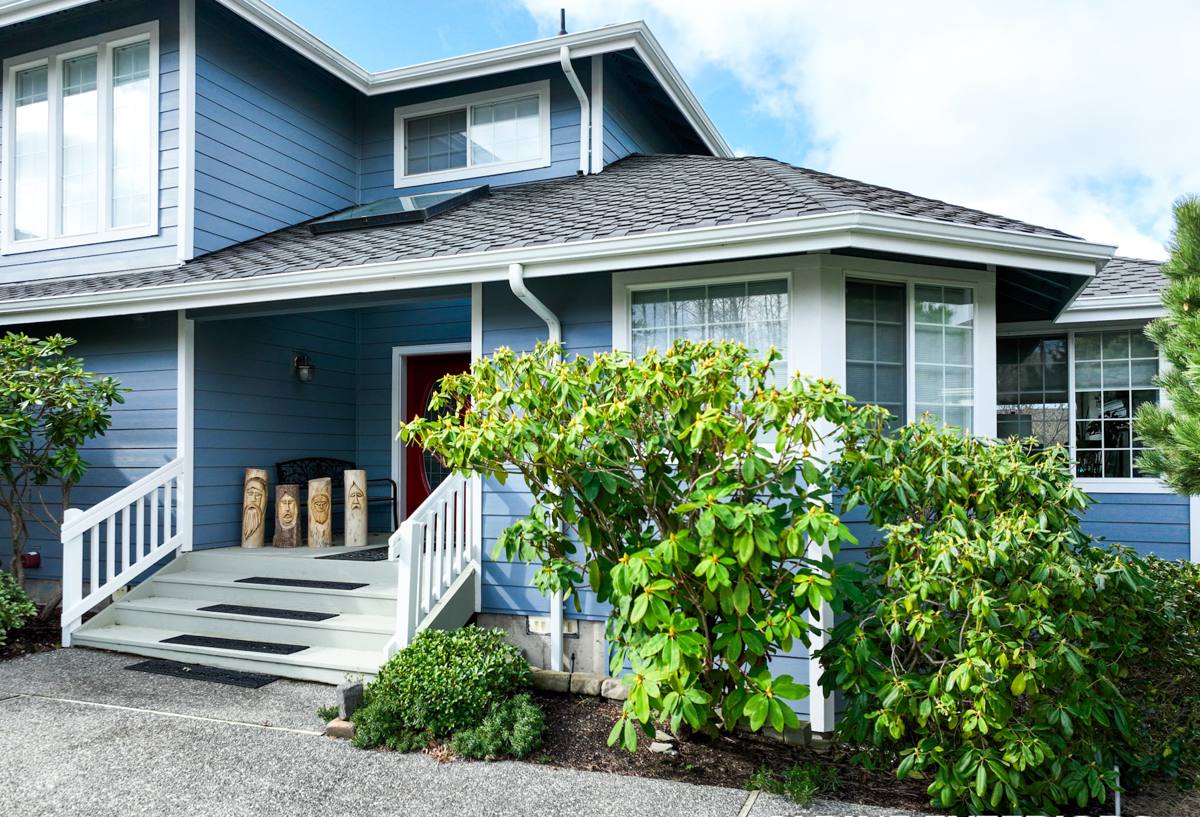
Signs Your Everson Home Needs Siding Repair
Most homeowners don't notice siding damage until it's visible from the street, but the real damage usually starts well before that. Here's what we look for, and what you should look for too:
- Soft or spongy spots when you press on the siding, especially near the bottom few feet of a wall
- Visible cracking, splitting, or buckling panels — common on older wood or engineered wood products
- Persistent black or green streaking that keeps coming back within weeks of cleaning
- Paint that's bubbling, peeling, or failing faster on one side of the house than the others
- Gaps opening up at seams, corners, or where siding meets window and door trim
- A musty smell in an adjacent interior room, which often means moisture has already reached the wall cavity
- Visible daylight or drafts around outlets or fixtures mounted on exterior walls
Any one of these on its own might be minor. Two or three together on the same wall usually means water has been getting behind the siding for a while, not just sitting on top of it.
What a Correct Siding Repair Actually Involves
Diagnosing the Moisture Path First
The mistake we see most often from rushed repairs is replacing the damaged board without figuring out how water got behind it in the first place. If we don't fix the actual entry point — a gap in flashing, a caulk joint that failed, a gutter that's been overflowing onto the wall below — the new material fails the same way the old material did, just on a delay. A real repair starts with pulling back enough siding to see the sheathing and house wrap underneath, not just patching what's visible.
Matching Material and Method
Repairs on mixed or aging siding systems need to match not just color, but material behavior. Patching a fiber cement wall with a different product, or mixing repair techniques that weren't designed to work together, creates new stress points where the materials expand, contract, or absorb moisture differently. We repair with the same class of material already on the house whenever that's the sound choice, and we're upfront when the smarter long-term move is replacing a full wall section instead of patching around a widespread problem.
Getting Water Management Right
This is the part that actually determines whether a repair lasts. Proper flashing above windows and doors, correct lap and overlap at horizontal joints, a functioning weep path at the base of the wall, and sealant used only where it belongs — not as a substitute for proper flashing — are what keep water moving down and away from the wall instead of soaking into it. In a climate that gets driving, wind-pushed rain as often as ours does, water management isn't a finishing detail. It's the whole job.
Repair or Replace? How We Help You Decide
| Situation | Repair usually makes sense | Replacement usually makes sense |
|---|---|---|
| Damage extent | Isolated to one or two wall sections | Recurring across multiple walls or elevations |
| Underlying sheathing | Dry and sound once opened up | Soft, delaminating, or already rotted |
| Siding material | Still structurally sound where undamaged | Original material is failing by design (old cedar, aging LP, brittle vinyl) |
| Age of siding | Well within expected service life | Near or past the material's realistic lifespan |
| Cost over time | One-time fix, unlikely to recur | Repeated repairs to the same wall over recent years |
We'll never push a full replacement when a proper repair will genuinely hold up — that's not how we want to be known in this county. But we'll also tell you plainly when a repair is just delaying a bigger bill, because that's the more expensive path for you in the long run.
Why We Only Repair and Replace With James Hardie Fiber Cement
When a repair does call for new material — whether it's a patch section or a full wall — we install James Hardie fiber cement, and only James Hardie. We don't install vinyl, LP SmartSide, Cemplank, Allura, primed spruce, or cedar, and in a climate like Whatcom County's, that's a deliberate standard, not a brand preference.
Vinyl siding handles rain fine but moves a lot with temperature swings, which loosens fastener holes and joints over the years and gives wind-driven rain more paths to sneak behind it. Engineered wood products like LP SmartSide perform well when the factory finish and sealed edges stay intact, but any cut edge, fastener puncture, or coating breach exposed to our wet season becomes a moisture entry point that's hard to catch early. Cedar and primed spruce are honest, attractive materials, but they need consistent maintenance — refinishing, caulking, moisture monitoring — to hold up against near-constant damp exposure, and that upkeep schedule is a real cost most homeowners underestimate going in.
James Hardie fiber cement is non-combustible, dimensionally stable in wet-dry cycling, and comes from the factory with a baked-on ColorPlus finish that resists the fading and peeling that plague field-painted siding here. Hardie also engineers specific product lines (their HZ5 line, for example) for climates that see sustained moisture exposure — which describes this part of Washington almost exactly. It's not that other materials are junk; it's that we've decided one material system consistently gives Everson and Blaine-area homeowners the fewest callbacks and the longest service life, and we'd rather stand behind one product we know cold than install several we have reservations about.
Our Repair Process for Everson Homes
- On-site inspection. We walk the exterior, check every elevation (not just the damaged spot), and probe suspect areas for hidden moisture.
- Honest scope. We tell you what's actually wrong, what caused it, and whether repair or partial replacement is the right call — in plain terms, before any work starts.
- Open it up. We remove enough siding to expose the sheathing and flashing underneath, because that's where the real problem usually lives.
- Fix the water path. Correct or replace flashing, house wrap, and fastening details before any new siding goes back on.
- Install and finish. New James Hardie material, properly lapped and fastened to manufacturer spec, finished to match the surrounding wall.
- Final walkthrough. We show you what was fixed and why, so you're not guessing about what's under the new siding.
Why It Matters to Hire a Crew That Already Works in Everson
Siding repair done right depends on knowing how a specific climate behaves against a specific wall assembly — which sides of a house in this area take the worst weather, where moss and algae take hold first, how far salt-laden air actually travels inland, and which flashing details tend to fail after a decade of Whatcom County winters. A crew that's already repairing siding on homes around Everson and the broader Blaine service area isn't guessing at any of that. We've seen what our local weather does to the different materials and details over years, and that experience shapes every repair we scope — not just the ones that are obviously damaged, but the ones quietly heading that direction.
What Affects the Cost of a Siding Repair
| Factor | Why it matters |
|---|---|
| How much sheathing damage is hidden | Rot behind the siding adds framing and sheathing repair, not just new boards |
| Access and wall height | Second-story and hard-to-reach sections take more labor time |
| Color and finish matching | Older ColorPlus finishes may need a close-match repaint on repaired sections |
| Extent of the affected area | One panel versus a full wall section changes both material and labor scope |
| Underlying cause | Fixing a gutter or flashing issue alongside the siding prevents a repeat repair |
We give straightforward, itemized estimates so you can see exactly what you're paying for — material, labor, and any additional work the inspection turns up — before we start.
Protecting Your Home Before Small Problems Grow
The single best thing an Everson homeowner can do for their siding is catch problems early, before a wet season turns a loose joint into a rot repair. A quick exterior walk-around after the worst of the winter storms, especially checking low wall sections, corners, and anywhere gutters have overflowed, catches most issues while they're still simple fixes. If something looks off, it's almost always cheaper to have it looked at than to wait and see.
If you're seeing any of the warning signs above, or just want a second opinion on a wall that doesn't look quite right, we're happy to take a look. Reach out for a free, no-pressure estimate — we'll tell you honestly what we find and what it would take to fix it right.