 Blaine Roofing
 Ferndale's Climate and What It Does to Windows
Ferndale sits close enough to Semiahmoo Bay and the Strait of Georgia that salt-laden air is a constant, low-grade stress on anything metal or painted on the outside of a house. Add Whatcom County's long wet season — months of driving rain pushed sideways by wind off the water — and a short window of hard summer sun, and you have a climate that punishes weak points fast. Moss doesn't just grow on roofs here; it takes hold in window sills, corner joints, and anywhere water sits instead of draining.
Original builder-grade windows in this area are often the first thing to show their age. Aluminum frames pit and corrode near the coast. Wood sashes that aren't maintained every year or two start to swell, stick, and rot at the bottom rail. Even vinyl units with poor weatherstripping let in enough moist air that condensation becomes a daily issue on cool mornings. None of this is a design flaw in any one product — it's what happens when a window built for a milder or drier climate gets asked to perform in ours without the right detailing.
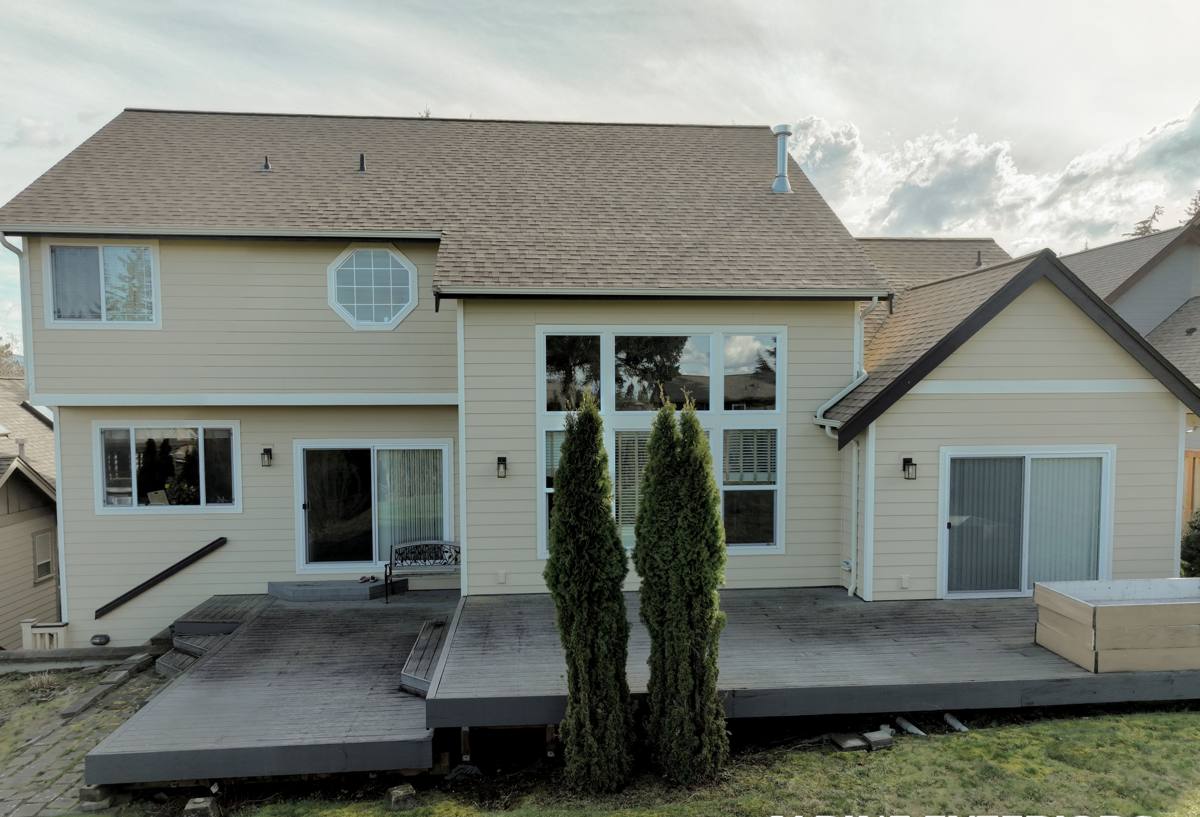
Signs Your Windows Are Losing the Battle
Most homeowners don't replace windows because they woke up one day and decided to. They replace them because a handful of small problems added up. Worth checking for:
- Fogging or a permanent haze between the panes of a double-pane unit — the seal has failed and the gas fill is gone
- Soft or discolored wood at the sill or bottom corners, especially on north- and west-facing walls that catch the worst of the weather
- Drafts you can feel with a hand near the frame on a windy day
- Sashes that are hard to open, or that no longer latch tight
- Visible corrosion, chalking, or pitting on aluminum frames or hardware
- Moss or dark streaking building up in the sill track year after year, no matter how often it's cleaned
- A noticeable jump in heating costs with no other explanation
Any one of these on its own isn't an emergency. Several of them together, especially on an older home, usually means the window system as a whole has reached the end of what it can do.
What "Custom" Actually Means for a Ferndale Home
"Custom" doesn't mean expensive or unusual — it means the window is built to the actual opening and the actual conditions of your house, rather than pulled off a shelf in a stock size and forced to fit. Most homes in and around Ferndale were built in a range of eras, and openings drift out of square over decades as a house settles. A custom window is measured and manufactured to match that opening, with the right frame depth for your wall assembly and the right glass package for which direction it faces.
Custom also covers things like matching sightlines across a room when you're replacing several windows but not all of them, getting egress-sized units in bedrooms that need them, and choosing hardware and finishes that will actually hold up to salt air instead of just looking good on install day. It's less about aesthetics and more about getting a window that fits, seals, and drains correctly for this specific house in this specific location.
Material Options for Coastal Whatcom County
There's no single "best" window material — there's a best fit for your budget, your home's style, and how close you are to the water. Here's how the common options generally hold up in this climate:
| Material | How It Handles Salt Air & Rain | Maintenance | Typical Cost Position |
|---|---|---|---|
| Vinyl | Won't corrode; good weatherstripping is critical for wind-driven rain | Low — occasional cleaning | Lower to mid |
| Fiberglass | Very stable, resists warping and salt corrosion well | Low | Mid to upper |
| Wood, unclad | Handsome but needs a real maintenance commitment near the coast | High — repaint/reseal on a schedule | Mid to upper |
| Wood, clad (vinyl or aluminum exterior) | Exterior cladding shields the wood from salt and moisture | Low exterior, some interior upkeep | Upper |
| Aluminum | Prone to pitting and corrosion near the water unless it's a marine-grade finish | Moderate to high | Varies widely |
We don't push one brand or material as the answer for every house. If a homeowner wants the look of natural wood, we'll say plainly that it means more upkeep this close to the water, and let them weigh that against clad or fiberglass options that trade a bit of that traditional look for a lot less maintenance. That's a decision for the homeowner to make with honest information, not a decision we make for them by only offering one option.
A Note on Warranties
Manufacturer warranties on the glass unit and hardware are separate from the installation warranty. A window can carry a strong factory warranty and still fail early if it's installed without proper flashing and sealant — which is why we stand behind our installation work independently of what the window manufacturer covers.
The Detail That Matters Most: Flashing and Water Management
More window failures in this region come from bad installation than bad product. Driving rain off the water doesn't just hit a window head-on — it gets pushed up and sideways under sills and around trim, looking for any gap. A window that's caulked in place without proper flashing will eventually leak, no matter how good the unit itself is.
A correct install builds a drainage path: flashing tape or pan flashing under the sill so any water that does get past the exterior finish drains back out instead of soaking into the wall framing, house wrap integrated correctly at the head and jambs (shingle-style, so upper layers overlap lower ones), and sealant used at the right points — not as a substitute for flashing, but as a backup to it. Skipping any one of these steps might not show a problem for a year or two. In a climate that gets this much sideways rain, it eventually will.
Our Installation Process
- On-site assessment — we look at each opening, check for existing rot or water damage, and measure precisely rather than going off a rough estimate
- Material and glass selection — we walk through options honestly, including trade-offs, based on the wall's exposure to weather and your budget
- Old window removal — done carefully to check the condition of the framing and sheathing underneath, since that's often where hidden moisture damage shows up
- Repair as needed — any soft or damaged framing gets addressed before a new window goes in; installing a new window over rotten framing just hides the problem
- Flashing and installation — proper drainage path built at sill, jambs, and head, unit set plumb and level, insulated and sealed correctly
- Exterior finish work — trim, caulking, and paint or stain matched to the surrounding wall
- Final walkthrough — every window opens, closes, and locks the way it should before we consider the job done
Energy Performance in a Mild, Wet Climate
Whatcom County doesn't see the extreme temperature swings that drive window selection in other parts of the country, but that doesn't make glass performance an afterthought. The bigger day-to-day issue here is condensation — cold glass surfaces meeting humid indoor air, which shows up as moisture on the inside of windows on cool mornings. A window with a decent U-factor and the right glass coating manages that much better than an older single- or basic double-pane unit.
Orientation matters too. West- and north-facing windows catch more of the driving rain and cooler air, so it's worth putting a bit more into glass performance there, while south-facing windows can sometimes use a lower-cost package without giving up much. This is part of why a room-by-room look at the house, rather than a single blanket spec for every window, gets a better result.
Permits, Codes, and Egress
Window replacement in Whatcom County generally requires attention to current building code, particularly for bedroom windows, which have minimum size and opening requirements for emergency egress. If a bedroom window is being resized or the opening changed, permitting may be required — straight like-for-like replacements in the same opening are more often exempt, but it depends on the specific scope of work. We check this at the estimate stage so there are no surprises once work starts, rather than leaving it for the homeowner to sort out.
Why a Crew That Already Works Ferndale Matters
A window installer who mostly works inland or in a drier part of the state can put in a technically fine window and still get the flashing detail wrong for what this stretch of coastline actually deals with. Crews who work Ferndale and the greater Blaine area regularly see what actually fails here — which corners of a house take the worst weather, which older flashing details don't hold up, and which materials are worth the extra cost near the water and which aren't. That's not something you get from a manual; it's something you get from doing the work in this specific climate, on this specific coastline, season after season.
If your windows are showing their age, or you're planning a remodel and want the openings done right the first time, we're glad to take a look. Reach out for a free, no-pressure estimate — we'll walk the house with you, give you straight answers on materials and cost, and let you decide from there.