 Blaine Roofing
 Decking Built for a Border Town Climate
Homes in the Peace Arch area of Blaine sit close to the water, close to the border, and close to weather that doesn't let up for months at a time. Between the salt-laden air coming off Semiahmoo Bay and the Strait, the driving rain that Whatcom County sees from fall through spring, and a moss season that can run half the year in shaded yards, an outdoor deck here works harder than a deck almost anywhere inland. A composite deck built for this specific stretch of coastline needs different details than the same product installed in a dry, sunny climate — and those details are where most decking problems actually start.
This page covers what a composite deck built for a Peace Arch property actually needs, what a correct installation looks like, and how we approach the job differently because we already know this neighborhood's weather.
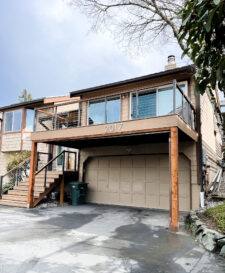
What This Climate Actually Does to a Deck
Before talking about materials, it helps to understand what a deck near the border is up against year-round.
Salt Air and Metal Fatigue
Proximity to saltwater doesn't just affect boats and siding. Salt-laden air accelerates corrosion on any exposed metal — screws, brackets, joist hardware, railing fasteners. A fastener that would last decades in a dry inland climate can start staining, weeping rust, or weakening years earlier this close to the water. This is one of the most overlooked failure points on decks built without coastal exposure in mind.
Driving, Wind-Blown Rain
Rain here rarely falls straight down. Storms pushing in off the water drive moisture sideways, under railings, and into any gap that isn't properly flashed or sealed. A deck ledger board, stair stringer, or post base that isn't detailed for wind-driven rain will trap water long after the rain has stopped.
A Long Moss and Mildew Season
Shaded lots, mature trees, and persistent damp air add up to a moss season that can stretch from early fall well into late spring. Moss and algae don't just look bad on a deck surface — they hold moisture against the boards, make the surface slick and genuinely dangerous underfoot, and, on the wrong material, can work into the surface texture over time.
Why Composite Decking Makes Sense for This Location
Wood decking can absolutely be built well, and we still build wood decks when a homeowner wants that look and is prepared for the upkeep it demands. But for a property exposed to this much moisture and salt air, composite decking removes several of the maintenance burdens that wood carries in this specific climate.
| Factor | Wood Decking | Composite Decking |
|---|---|---|
| Moisture absorption | Absorbs and releases moisture with weather changes, which drives cupping and splitting over time | Minimal water absorption in the board itself, so less swelling and warping |
| Moss and algae resistance | Untreated wood surface gives moss and algae something to grip and stain | Capped boards resist staining and are easier to clean off without damaging the surface |
| Refinishing needs | Sanding, staining, or sealing on a recurring schedule to keep it protected | No staining or sealing required over the life of the board |
| Splintering / board failure | Can splinter, crack, or rot at fastener points as it ages | Does not splinter; failure modes are different and generally slower |
| Upfront material cost | Lower material cost | Higher material cost, offset by lower maintenance cost over time |
Capped vs. Uncapped Composite
Not all composite boards are built the same, and this matters more here than in a drier climate. Uncapped composite boards have exposed wood-plastic fiber on all sides, which can absorb some moisture and is more prone to surface staining and mildew in a persistently damp environment. Capped composite boards have a protective polymer shell on the visible faces, which sheds water and resists staining far better. Given the length of the moss season here, our standard for Peace Arch installations is a fully capped board — it costs more up front, but it's a better match for what this climate actually does to a deck surface.
What a Correct Installation Involves
Composite decking is often marketed as low-maintenance, and the boards themselves are — but the structure underneath the boards is what actually determines how the deck holds up in a coastal climate. A deck can be built with premium composite boards and still fail early if the framing and hardware underneath weren't chosen for this environment.
Framing and Fasteners
The joists, beams, and posts supporting a composite deck near the water need corrosion-resistant hardware — stainless steel or heavy-duty coated fasteners rated for coastal or treated-lumber exposure, not standard interior-grade hardware. This is one of the easiest details to skip and one of the most expensive to fix later, since it usually means pulling up decking to get at the framing.
Flashing and Ledger Attachment
Where a deck attaches to the house, the ledger board needs proper flashing to keep wind-driven rain from working its way behind the siding and into the wall assembly. This detail matters everywhere, but it matters more here because of how much of our rain arrives at an angle rather than straight down.
Drainage and Airflow Underneath
Composite boards need consistent gapping for water to drain through rather than pool on the surface, and the space underneath the deck needs enough airflow to dry out between rain events. A deck built low to the ground with poor underside ventilation is exactly the kind of environment that encourages moss, algae, and mildew to take hold — even on a composite surface.
Fastening the Boards Themselves
Hidden fastener systems designed for the specific board profile keep the deck surface clean and free of exposed screw heads that can corrode, stain, or work loose over time. Fastener spacing and clip type should match the manufacturer's engineering for the board, not be adapted loosely from a wood-decking approach.
How We Approach a Peace Arch Deck Project
- Site and structure assessment — we look at drainage patterns, sun and shade exposure, tree cover, and the condition of any existing structure before recommending anything.
- Framing plan — joist spacing, hardware grade, and ledger flashing are specified for this climate, not a generic build sheet.
- Material selection — we walk through board tiers and finishes with you, including honest trade-offs on cost versus long-term performance in this specific location.
- Installation — framing first, then decking, railings, and stairs, with attention to gapping and drainage at every board.
- Final walkthrough — we go over basic care specific to this climate so the deck starts its life clean and properly maintained.
Cost Factors to Expect
Composite decking costs more up front than pressure-treated wood, and pricing varies by board tier, deck size, height off the ground, and how much structural work the existing framing needs. As a broad range, homeowners in this area typically see installed costs somewhere in the neighborhood of $35 to $75 per square foot depending on these factors — we'll give you a firm number after seeing the site, not before.
| Cost Factor | Why It Matters Here |
|---|---|
| Board tier (uncapped vs. capped) | Capped boards cost more but hold up better against moss, staining, and moisture |
| Framing condition | Older or undersized framing may need upgrading to carry composite board weight and meet current code |
| Fastener and hardware grade | Coastal-rated hardware costs more than standard hardware but avoids early corrosion |
| Deck height and railing requirements | Taller decks require code-compliant railings and stairs, adding material and labor |
| Site access | Tight side yards or sloped lots near the water can add labor time |
Keeping a Composite Deck Clean Through Moss Season
Composite decking is low-maintenance, not no-maintenance, especially in a climate with this much shade and moisture. A little seasonal attention keeps a capped composite deck looking and performing the way it should for years.
- Sweep leaves, needles, and debris off the deck regularly, especially under trees — trapped organic matter holds moisture against the surface.
- Rinse the deck with plain water and a soft-bristle broom or brush a few times a year, more often in shaded areas prone to moss.
- Keep gutters and downspouts near the deck clear so runoff isn't dumping extra water onto the surface or framing below.
- Trim back overhanging branches to let more light and airflow reach the deck surface, which slows moss growth significantly.
- Avoid high-pressure power washing directly on composite boards — a wide fan tip and moderate pressure is enough and won't etch the surface.
- Check railings and stair connections once a year for any early signs of fastener corrosion.
Why Hire a Crew That Already Works in Peace Arch
A deck built by a crew unfamiliar with this stretch of Whatcom County is more likely to underbuild for the salt air, misjudge how much shade a lot actually gets through the year, or skip flashing details that don't matter in a drier climate but matter a great deal here. We work in this area regularly, so we're not guessing at how the weather off the bay behaves or how long moss season really runs on a shaded lot near the border. That local knowledge shows up in the framing choices, the hardware we spec, and the board recommendations we make — before a single board goes down.
If you're planning a new composite deck or replacing an aging wood deck at your Peace Arch property, we're happy to take a look and talk through what your specific lot needs. Reach out using the form below for a free, no-pressure estimate.