 Blaine Roofing
 Decking Built for Cherry Point's Salt Air and Rain
Cherry Point sits right on the Strait of Georgia in unincorporated Whatcom County, a few miles from Blaine's city limits. It's a different environment than a deck built ten miles inland. Homes out here get a steady dose of salt-laden marine air, driving rain that comes in sideways off the water during winter storms, and enough shade from surrounding evergreens to keep moss and algae growing on any surface that doesn't dry out fast. A deck built to a generic, one-size-fits-all spec won't hold up the same way here as it might in a drier, more sheltered part of the county.
Most of the deck calls we get from Cherry Point aren't about decks that failed overnight. They're about decks that started showing problems years earlier than they should have — corroded hardware, soft spots in the framing, decking boards that stay slick with moss from October through April. This page covers what actually holds up in this climate, what a correctly built deck involves, and how we approach the job in this specific area.
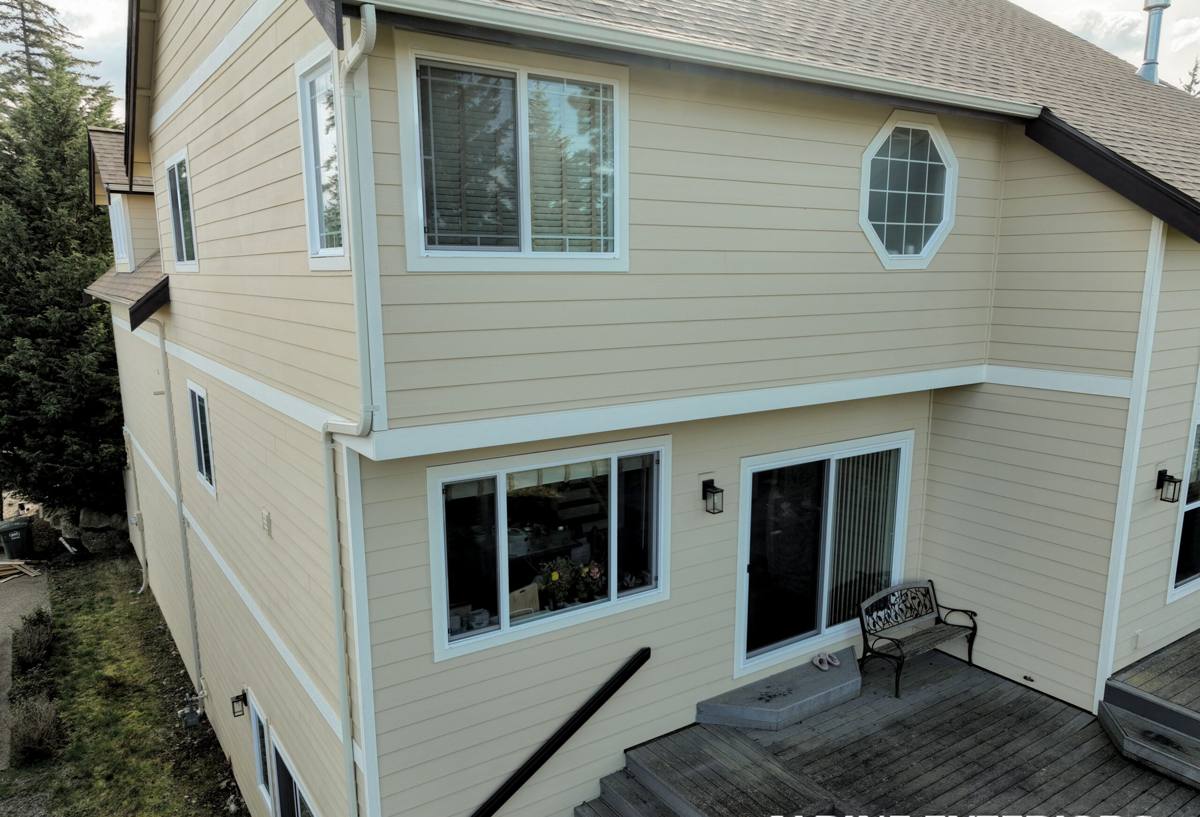
What Salt Air, Rain, and Moss Actually Do to a Deck
Salt air and corrosion
Airborne salt travels further inland than most homeowners expect, and Cherry Point's exposure to the Strait of Georgia means fasteners, brackets, and connectors take a beating year-round, not just during storms. Standard galvanized hardware can start to pit and rust within a few years in a marine-exposure zone like this. Once a fastener corrodes, it loses holding strength long before it looks obviously bad — which is exactly why deck fastener failure is often invisible until someone notices a rail that flexes or a board that's started to lift.
Driving rain and water intrusion
Whatcom County's winter storms don't just drop rain straight down — wind off the water pushes it sideways, into ledger connections, under flashing, and into any gap where end grain is exposed. Water that gets behind a ledger board or under poorly lapped flashing doesn't dry out between storms the way it would in a sunnier climate. That's how you get rot starting at the house connection, which is the single most structurally important part of any attached deck.
Moss, shade, and standing moisture
Cherry Point's tree cover keeps a lot of decks in partial shade for large stretches of the day, especially in the shorter-daylight months. Combine that with regular rain and you get long stretches where deck surfaces simply don't dry out. Moss and algae take hold in exactly those conditions, and once established they hold moisture against the decking surface, which accelerates whatever wear process the material was already prone to — rot in untreated wood, surface degradation in lower-grade composites, and a slip hazard for anyone walking on it barefoot or in wet shoes.
Choosing Decking Material That Actually Holds Up Here
There's no single "best" decking material for every project, but there are real trade-offs that matter more in a salt-air, high-moss environment than they would somewhere drier. Here's how the common options actually compare for Cherry Point conditions specifically:
| Material | Moisture / Salt Air Behavior | Moss Resistance | Maintenance Needed | Typical Lifespan Here |
|---|---|---|---|---|
| Pressure-treated wood | Treatment resists rot but end cuts and fastener holes are vulnerable if not sealed | Low — porous surface holds moisture and organic growth | Annual cleaning and re-sealing | 10-15 years with upkeep |
| Cedar | Naturally moisture-resistant but softer, needs consistent finish maintenance in salt air | Moderate — still needs regular cleaning in shaded areas | Re-finishing every 2-3 years | 15-20 years with upkeep |
| Capped composite | Strong moisture and salt resistance, no absorption into the core | Moderate to good — smoother cap sheds growth more easily than raw wood, but still needs periodic washing in shaded spots | Occasional washing, no sealing or staining | 25-30 years |
| PVC / cellular vinyl decking | Excellent — fully synthetic, unaffected by salt or moisture absorption | Good — smooth, non-porous surface, easiest to keep clean | Occasional washing | 25-30+ years |
Our standard is capped composite or PVC decking for anything in direct salt exposure or heavy shade in this area, cedar where a homeowner wants a natural wood look and is willing to keep up with refinishing, and pressure-treated framing lumber underneath regardless of what decking goes on top — with attention to how it's protected, which matters more than the species itself.
Framing, Flashing, and Fasteners: The Part Nobody Sees
The decking boards are the part you look at. The framing, flashing, and fasteners underneath are the part that determines whether the deck is still safe in fifteen years. In a marine-exposure area like Cherry Point, we treat this part of the job as non-negotiable, not optional upgrades:
- Stainless steel or heavy hot-dip galvanized fasteners rated for coastal/salt exposure, not standard-grade hardware
- Ledger board attached with proper flashing that laps correctly with the house's water-resistive barrier, so wind-driven rain can't track behind it
- Joist tape or a protective barrier on top of framing lumber to keep standing water off end grain and fastener penetrations
- Post bases that hold posts up off concrete or grade, so they're not sitting in the water that collects during heavy rain
- Proper spacing between boards for drainage and airflow underneath, so the structure has a chance to dry between storms
None of this shows up in a photo of the finished deck, and it's exactly the kind of detail that gets skipped when a crew is trying to hit a low price. It's also exactly what determines whether we get called back in five years for a repair, or not.
Design Choices That Fight Moss Before It Starts
Airflow underneath
A deck built low to the ground with poor ventilation underneath stays damp longer after every rain, which gives moss and mildew more time to establish. Where grade and code allow, we build in enough clearance and skirting gaps to let air move underneath.
Board orientation and drainage
How decking runs relative to the slope of the yard and the direction of prevailing wind and rain affects how quickly water sheds off the surface. We account for Cherry Point's exposure to weather off the water when planning layout, not just the look of the finished deck.
Shade management
We can't move a homeowner's trees, and we wouldn't recommend clearing healthy evergreens just to reduce moss — but where a deck design has flexibility in placement or footprint, siting it to catch a bit more sun exposure makes a real difference in how often it needs cleaning.
Our Process for a Cherry Point Deck Project
Site visit and assessment
We look at sun and wind exposure, existing drainage patterns, soil conditions, and — if it's a replacement — what actually failed on the old deck and why, so we're not repeating the same mistake with new material.
Design and material selection
We walk through decking and framing options honestly, including cost and maintenance trade-offs, so the homeowner is choosing based on real information rather than a sales pitch.
Permitting
Cherry Point is unincorporated Whatcom County, so permitting runs through the county rather than city hall. Requirements depend on the deck's height, size, and attachment to the house. We handle that paperwork as part of the job rather than leaving it to the homeowner to sort out.
Construction
Framing first, with all the flashing and fastener details covered above, then decking, then railings and any finishing details. We keep the site clean and walk the homeowner through the finished structure before calling the job done.
Keeping a Cherry Point Deck Healthy Season to Season
Even a well-built deck needs some upkeep in this climate. Here's what actually matters:
- Sweep off standing leaves and debris regularly in fall — wet leaf litter is one of the fastest ways to trap moisture against decking
- Wash the surface at least once or twice a year to remove early moss and algae growth before it gets established
- Check fastener heads and any visible hardware periodically for early rust or pitting, especially on railings and stair connections
- Keep gutters and downspouts near the deck clear so roof runoff isn't dumping extra water onto or under the structure
- Reapply sealant or finish on schedule if you have wood decking — don't wait until it's visibly weathered
- Have someone check the ledger connection and framing every few years, since that's the area most prone to hidden water damage
Why Hiring a Crew That Already Works in Cherry Point Matters
A contractor who mostly builds decks in drier, more sheltered parts of Whatcom County may not default to marine-grade fasteners or account for wind-driven rain unless a homeowner specifically asks. We already build to that standard here because we've seen what happens when a deck isn't built for this exposure — it's the difference between a deck that needs a wash twice a year and one that needs fastener and framing repairs a decade before it should. Working this area regularly also means we're familiar with the county's permitting expectations for this type of property, which keeps the project moving instead of stalling on paperwork.
If you're planning a new deck or need to replace one that's showing its age, we're happy to take a look and put together a straightforward, no-pressure estimate. There's a form below — reach out and we'll get you real numbers for your specific property.