 Blaine Roofing
 Siding Built for California Creek's Weather, Not Just Any Weather
California Creek sits close enough to the water that homes here take a different kind of beating than siding fifty miles inland. Salt-laden air off the Strait works into seams and fastener heads. Driving rain off winter storms hits walls sideways, not just straight down. And Whatcom County's long, damp shoulder seasons mean moss and algae get months of undisturbed growing time on any surface that stays wet. A siding product that performs fine in a dry climate can fail here in ways that never show up in a brochure.
We're a Blaine-based crew, and California Creek is inside our regular service area — not a stretch job we drive an hour for once a year. That matters more than it sounds like it should, and we'll get into why below. First, let's talk about what this specific location actually demands from a siding system.
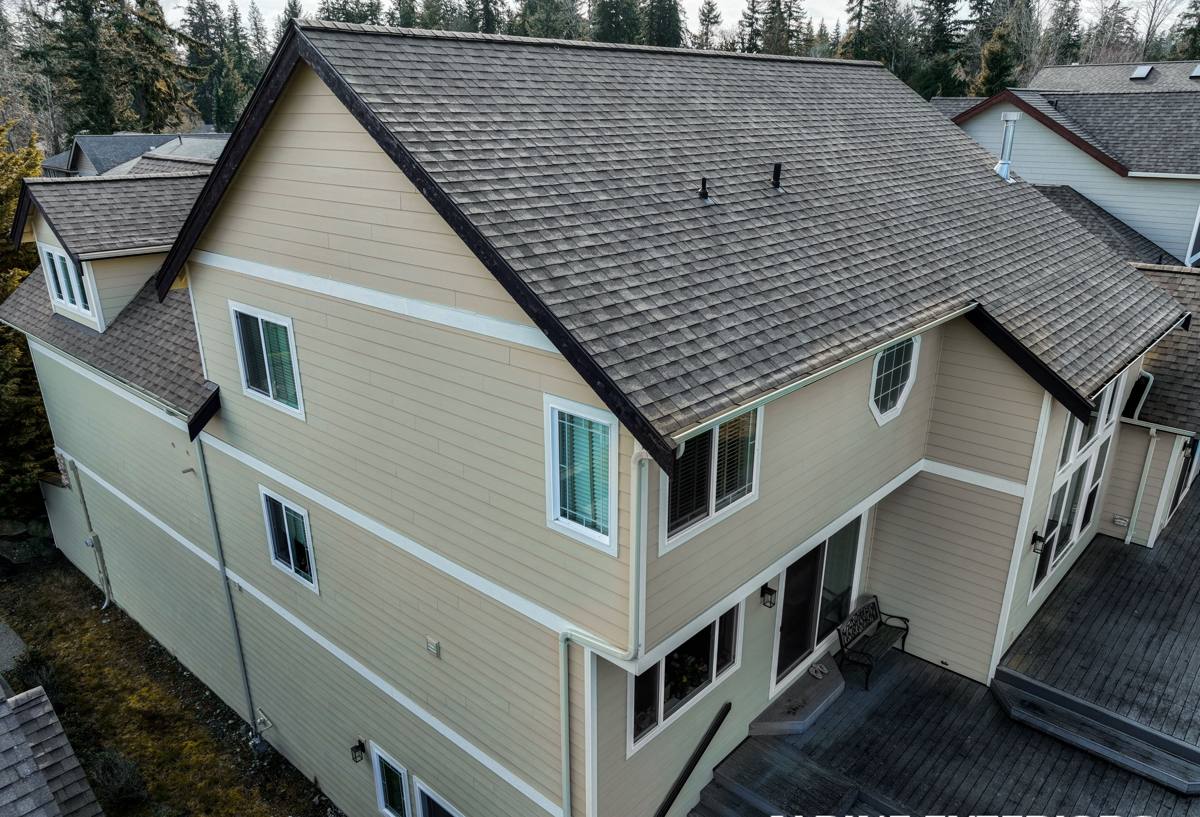
What Salt Air, Rain, and Moss Actually Do to Siding
Salt air
Airborne salt is corrosive to exposed metal — nail heads, flashing, trim fasteners — and it accelerates the breakdown of lower-grade paint finishes. On wood and composite products with a field-applied or thin factory coating, salt exposure shows up as chalking, fading, and early peel, usually starting on the side of the house that faces the water.
Driving rain
Wind-driven rain doesn't just wet the face of the siding — it pushes water sideways into laps, seams, and any gap around windows, corners, and penetrations. If the water-resistive barrier, flashing, and siding overlaps aren't detailed correctly, that water finds its way behind the cladding. Once moisture is behind the siding instead of running off the front of it, you're dealing with sheathing rot, not just a cosmetic problem.
Moss and algae season
Whatcom County's wet season runs long. North-facing walls, shaded elevations, and anything near overhanging trees stay damp for weeks at a time. That's exactly the environment moss and algae need. Porous or absorbent siding materials hold that moisture at the surface, which feeds growth and keeps the substrate wetter for longer. Non-absorbent, factory-finished materials shed water faster and give moss less to hold onto.
Why We Install James Hardie Fiber Cement — and Nothing Else
We don't install vinyl, LP SmartSide, cedar, primed spruce, Cemplank, or Allura. That's not a marketing line — it's a standard we hold because of what this coastal climate does to lesser systems over ten, fifteen, twenty years. Fiber cement from James Hardie is non-combustible, dimensionally stable when it gets wet and dries out repeatedly, and it comes from the factory with a baked-on ColorPlus finish rather than a coating applied on-site or left to the homeowner to maintain.
James Hardie also engineers specific product lines for different climate zones (their HZ5 line is built for the Pacific Northwest's wet-and-cool conditions), which means the product arriving at a California Creek jobsite is already spec'd for the moisture load it's going to see. That's a meaningfully different starting point than a general-purpose siding product being asked to perform in a climate it wasn't designed around.
The tradeoff homeowners should understand going in: fiber cement costs more up front than vinyl and is heavier and less forgiving to install than either vinyl or wood. It rewards a crew that installs it to spec and punishes one that doesn't. That's exactly why installation quality matters as much as the product choice — which is the next section.
What a Correct Fiber Cement Installation Actually Involves
Fiber cement siding fails early almost exclusively because of installation mistakes, not product defects. In a driving-rain, salt-air environment like California Creek, these details aren't optional extras — they're the difference between a wall system that sheds water and one that traps it.
- Correct water-resistive barrier installed and lapped shingle-style so water is directed outward at every seam
- Proper flashing at all windows, doors, and penetrations, integrated with the WRB rather than just caulked over it
- Minimum required clearance between siding and grade, decks, and roof lines to keep the bottom edge out of standing moisture
- Correct fastener type, spacing, and placement per the Hardie install guide — not general carpentry nailing patterns
- Proper joint and butt-seam treatment, including factory-primed or sealed cut edges
- Rainscreen or adequate drainage gap where conditions call for it, so moisture that does get behind the cladding can drain and dry
- Caulking only where specified — over-caulking traps moisture instead of releasing it
Skip or rush any one of these and you can end up with a product rated for decades performing more like one rated for a fraction of that, regardless of the manufacturer's name on the box.
Our Process on a California Creek Job
1. On-site assessment
We walk the exterior, check current siding and sheathing condition, note water-exposure patterns specific to the lot — which elevations face prevailing wind and rain, where moss is already established, where trees keep a wall shaded and damp.
2. Tear-off and sheathing check
Old siding comes off and we inspect the sheathing underneath. Any rot or soft spots get flagged and addressed before anything new goes up — covering a compromised wall with new siding just hides the problem.
3. Water-resistive barrier and flashing
New WRB goes on with correct laps, and flashing is integrated at every window, door, and penetration. This step is the one that determines whether the wall actually keeps water out over time.
4. Hardie panel or lap installation
Installed to James Hardie's fastening and clearance specifications, with attention to the local exposure conditions on each elevation.
5. Trim, caulk, and final inspection
Trim work finished, caulking applied only where it belongs, and a final walkthrough before we call the job done.
Why a Crew That Already Works California Creek Matters
Two contractors can both be "certified" to install James Hardie siding and still produce very different results here. A crew that regularly works this specific stretch of Whatcom County coastline already knows which elevations on a typical California Creek lot take the worst of the driving rain, how far moss creeps up a north wall by mid-winter, and how salt exposure differs from a job three miles inland. That's not something you learn from a manufacturer's install manual — it's learned by doing the work in this exact environment repeatedly.
Being Blaine-based also means we're not disappearing after the final invoice. Warranty follow-up, a caulking touch-up years down the road, a question about a trim detail — that's a short drive for us, not a special trip.
Fiber Cement vs. Common Alternatives in a Coastal Whatcom Climate
| Factor | James Hardie Fiber Cement | Vinyl | Untreated Wood / Primed Spruce |
|---|---|---|---|
| Salt air resistance | Factory ColorPlus finish holds up well | Can become brittle and fade faster near salt exposure | Coating breaks down; wood underneath is exposed |
| Driving rain / moisture behavior | Dimensionally stable, doesn't swell or warp | Sheds water but seams and fastener points can leak | Absorbs moisture, prone to swelling and rot |
| Moss and algae resistance | Non-porous surface sheds water, slows growth | Resists moss but can trap moisture behind panels | Porous surface holds moisture, feeds growth |
| Fire resistance | Non-combustible | Combustible, can melt/deform | Combustible |
| Maintenance over time | Low — factory finish, minimal repainting | Low but limited color/repair options as it ages | High — regular repainting and moisture monitoring |
Cost Factors Homeowners Should Understand Up Front
Every California Creek home is different, so we won't quote a number without seeing the house, but the factors that move a fiber cement siding project up or down in cost are consistent:
- Home size and number of stories (staging and access cost more on taller walls)
- Current siding material and whether full tear-off is needed versus removal of an already-failing layer
- Condition of the sheathing underneath — rot repair adds cost but is not optional to skip
- Amount of trim, corner detail, and architectural complexity
- Panel versus lap siding profile, and color selection (standard ColorPlus colors versus custom)
- Site access — tight lots, fencing, and landscaping can add labor time
We walk through all of this during the on-site assessment so there are no surprises once work starts.
Get a Straight Answer for Your California Creek Home
If you're weighing a siding replacement on a California Creek property and want to know what it actually needs given the salt air, rain exposure, and moss pressure specific to your lot, we're glad to take a look. Reach out for a free, no-pressure estimate — use the form below and we'll walk the property with you.