 Blaine Roofing
 Board & Batten Siding, Built for How Custer Actually Weathers
Custer sits inland just enough from the Strait of Georgia and Drayton Harbor to feel like it should be sheltered, but ask anyone who has repainted a barn or repaired a fence line out here and they'll tell you otherwise. Salt-laden air still rides in on the wind, driving rain still comes sideways off the water during winter storms, and the tree cover and open fields that give this part of Whatcom County its character also mean siding stays damp longer than it would in a drier inland town. Board and batten siding — with its bold vertical lines and exposed seams — can be a beautiful fit for the farmhouses, shops, and newer builds around Custer. It can also be one of the least forgiving siding styles if it's installed wrong, because every batten line is a potential water path if the details underneath aren't right.
This page is about that one job, done correctly, for this one area. Not a general siding overview — the specific things that matter when you're putting vertical board and batten on a home that has to survive Custer's mix of coastal moisture and rural shade.
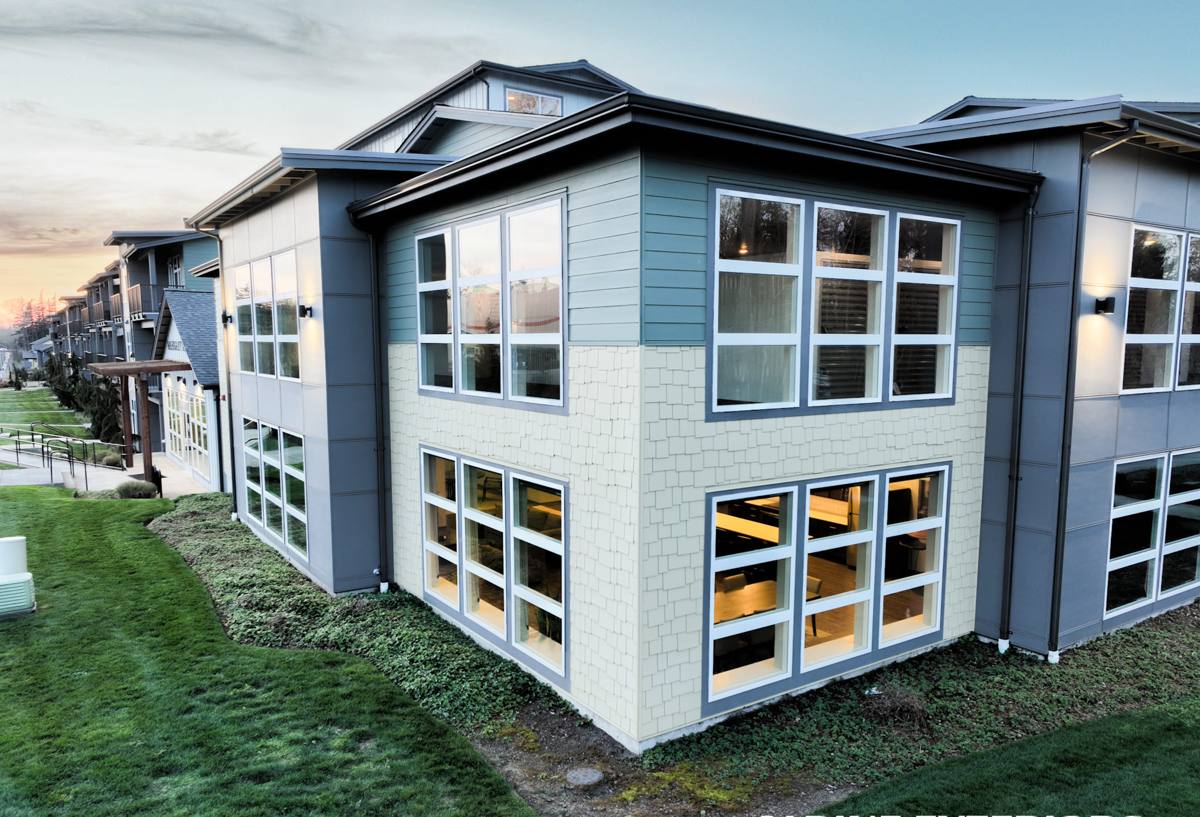
What Board & Batten Siding Actually Is
Board and batten is a siding pattern, not a single product. Traditionally it meant wide vertical boards with narrower strips (battens) nailed over the seams between them to cover the gaps and shed water. Done in real wood, that seam-covering system depends entirely on the wood staying stable — and wood moves with humidity, which is exactly what this climate provides in abundance.
We install this look exclusively in James Hardie fiber cement, using their engineered vertical siding panels and factory-milled battens rather than field-cut wood boards. The panels are dimensionally stable — they don't swell, cup, or shrink the way wood does when they cycle through Custer's wet winters and drier summers — and they arrive with a factory-applied ColorPlus finish baked on under controlled conditions, not brushed on at the jobsite. That matters more here than in a lot of places, because a field-painted vertical siding job with dozens of exposed batten edges gives moss and mildew a lot of surface area to take hold on, and repainting board and batten on a two-story elevation is not a small job to repeat every few years.
Why the Vertical Pattern Needs Extra Discipline
Every seam in a board and batten wall is a joint, and every joint is a decision point: how it's fastened, how it's flashed, and how it drains. On a lap siding wall, water mostly just runs down the face. On a vertical wall, water can also run along the grain of the boards and pool behind battens if there's no gap for it to escape. Get that detail wrong and you won't see it for a year or two — you'll see it as staining, soft trim, or a moss line creeping up from the bottom of the wall.
What Custer Homes Specifically Need From Their Siding
Three regional factors shape how we approach every board and batten job in this area:
- Salt air: Even a few miles inland from the water, airborne salt accelerates corrosion on fasteners and metal flashing. We spec fasteners and flashing rated for that exposure rather than whatever's cheapest at the yard.
- Driving rain: Whatcom County's winter storms don't just rain down, they push rain sideways into wall assemblies. Vertical siding needs a real drainage plane behind it, not just caulk at the seams, or wind-driven rain will find its way past the face.
- Long moss season: Between tree-shaded lots and the extended damp season, north-facing and shaded walls in Custer stay wet longer than a lot of homeowners realize. Siding that holds moisture at the surface becomes a moss and mildew farm; a factory finish and correct clearances resist it far better than bare or field-painted material.
None of these are exotic problems. They're the same three things that eventually wear out most exterior work in this part of the county. The difference is whether the installation accounts for them up front or leaves the homeowner fighting them every spring.
What a Correct Board & Batten Installation Involves
This is the part that separates a siding job that looks right on day one from one that still performs right in year fifteen. A correct install includes:
- A weather-resistive barrier installed and lapped correctly before any siding goes up
- A drainage gap (rainscreen) behind the panels so bulk water and incidental moisture can escape instead of sitting against the wall sheathing
- Fasteners at the manufacturer's specified pattern and embedment, sized and rated for coastal air exposure
- Correct board and batten overlap and fastening so seams shed water rather than trap it
- Flashing integrated at every window, door, and penetration — not caulk used as a substitute for flashing
- Proper clearance from grade, decks, and roof lines so the bottom of the wall isn't sitting in standing moisture or splash-back
- Factory-finished cut edges sealed per manufacturer spec at every field cut
Skip any one of these and the wall may still look sharp for a season or two. The failures that show up later — soft sheathing, streaking, moss colonizing a shaded elevation — almost always trace back to one of these steps being shortcut, not to the siding material itself.
Where Shortcuts Usually Hide
The two most common corners cut on board and batten jobs are skipping the drainage gap (nailing panels tight to the wall to save a step) and using caulk to bridge gaps that should have been flashed. Both are invisible at closeout and both are exactly the kind of thing that costs a homeowner in Custer a repair bill three or four winters later.
Our Process for Board & Batten Jobs in Custer
- Assessment: We look at the existing wall assembly, elevation exposure (which walls take direct weather versus which sit in shade), and any moisture or moss already present before quoting anything.
- Prep: Removal of existing siding where needed, repair of any damaged sheathing found underneath, and installation of the weather barrier and drainage layer.
- Install: Hardie vertical panels and battens installed to manufacturer fastening and flashing specifications, with extra attention to shaded and water-exposed elevations.
- Detailing: Flashing and sealing at every window, door, corner, and penetration — the details that determine whether the wall stays dry for decades or just for a few years.
- Final walk-through: We review the finished work with you before calling the job done.
Why We Only Install James Hardie for This Style
Board and batten in particular is where the gap between siding products shows up fastest, because there are more seams and edges exposed to weather than on a standard lap wall. We don't install vinyl board and batten, LP SmartSide, cedar, or primed wood versions of this look. Vinyl vertical panels can show waviness and don't hold up the same way to sustained wind-driven rain along their seams. Wood and wood-composite versions depend on paint and caulk maintenance that's hard to keep up with on a busy two-story wall, especially in a climate that gives paint film so little time to fully dry between storms. James Hardie's fiber cement is non-combustible, holds its factory finish for years rather than months, and is engineered specifically for climates like this one under its HZ5 product line. That's why it's the only board and batten system we put on homes.
Cost Factors for Board & Batten Siding
| Factor | Why It Affects Price |
|---|---|
| Wall prep and sheathing condition | Damaged sheathing found under old siding has to be repaired before new siding goes on |
| Number of seams and battens | Vertical patterns have more linear seams than lap siding of the same square footage, meaning more fastening and flashing labor |
| Elevation exposure | Walls facing prevailing wind and rain need the same care as any other, but complex rooflines and multiple penetrations add flashing time |
| Trim and corner detail | Board and batten's clean look depends on corner and trim work being done carefully, which takes more time than a simple lap corner |
| Color and finish selection | ColorPlus factory finishes are included in the panel cost and avoid a separate field-painting bill down the line |
Maintenance: What to Watch For Once It's Installed
Correctly installed Hardie board and batten is low-maintenance, not no-maintenance. A short seasonal check goes a long way in this climate:
- Look at shaded and north-facing walls each fall for early moss or algae growth before it spreads
- Keep gutters clear so overflow isn't running down the wall face during heavy rain events
- Keep landscaping and mulch beds pulled back from the bottom edge of the siding
- Rinse siding periodically to clear salt air residue and organic buildup, especially on walls closest to open exposure
- Have caulking at trim and penetrations checked every few years and refreshed if it's cracking or pulling away
Why Hiring a Crew That Already Works Custer Matters
Custer isn't a subdivision with identical lots — it's a mix of older farm properties, wooded acreage, and newer construction, each with its own exposure pattern to wind, rain, and shade. A crew that already works this part of Whatcom County has seen how a shaded, tree-lined wall behaves differently from an open one a quarter mile away, and prices and installs accordingly instead of applying a one-size-fits-all approach. That local familiarity is what keeps a board and batten install from becoming a callback a few winters later.
If you're considering board and batten siding for a home in Custer, we'd be glad to take a look and walk you through what your specific walls need. Reach out for a free, no-pressure estimate using the form below.