 Blaine Roofing
 Why Birch Bay Roofs Take a Different Kind of Beating
Birch Bay sits right up against the water, and that changes what a roof has to deal with year-round. Homes here get more direct wind exposure than roofs set back in town, more wind-driven rain forcing its way under shingle edges and flashing, and a longer moss season because the shoreline air stays damp and shaded roof sections rarely get a chance to dry out fully between storms. None of that means a Birch Bay roof is doomed to fail early — it means the repair standard has to account for salt-laden air, sustained wind loading, and moisture that lingers longer than it would a few miles inland.
Storm damage repair in this kind of environment isn't just about patching what broke during one bad night of weather. It's about recognizing that the same conditions that caused the damage are still present, and a repair that doesn't account for them will fail again, usually at the same spot.
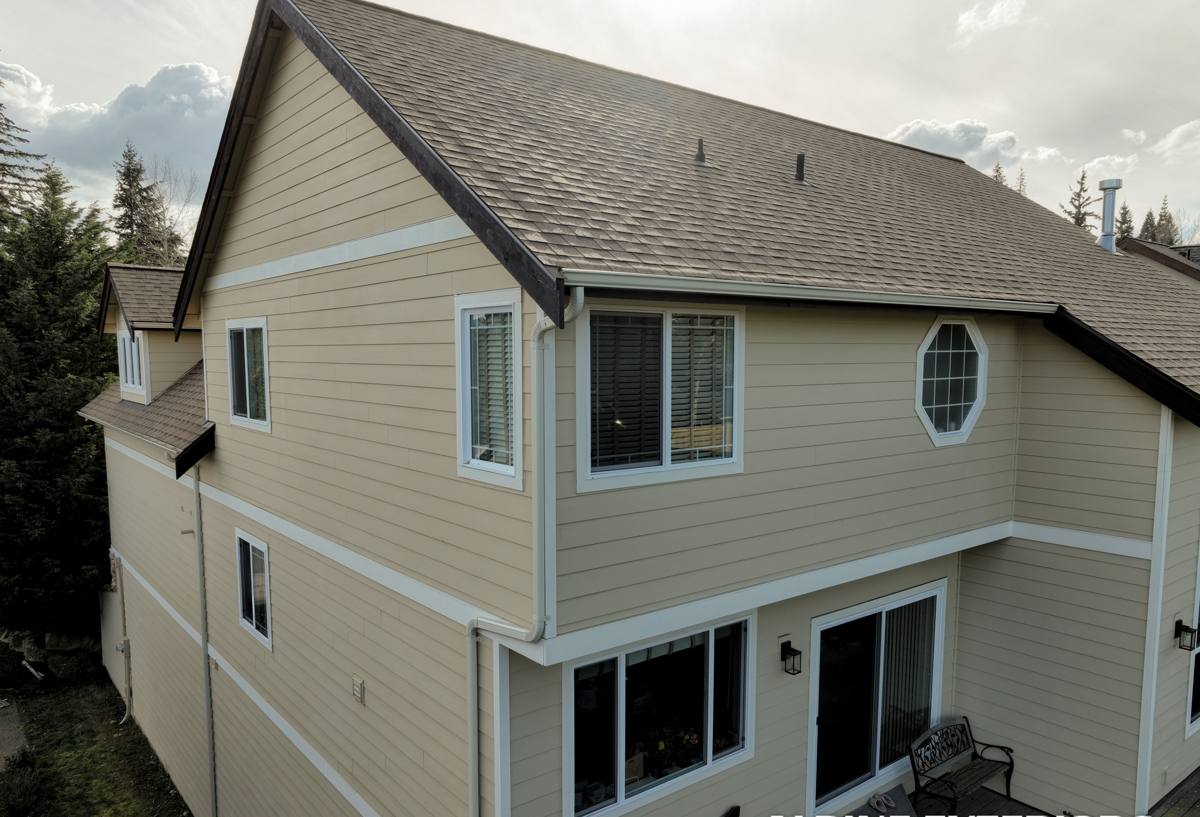
What Storm Damage Actually Looks Like Here
Wind Damage
Whatcom County storms coming off the water tend to hit in gusts rather than steady pressure, and that's harder on roofing than people expect. Shingles get lifted at the tab edge, the sealant strip breaks its bond, and the shingle doesn't necessarily blow off — it just stops being sealed. From the ground it can look fine. The first sign is often a leak weeks later, once rain finally finds the opening.
Moisture Intrusion at Flashing and Penetrations
Flashing around chimneys, vents, and roof-to-wall transitions is where storm damage most often turns into interior damage. A bent flashing edge or a cracked sealant bead lets driving rain track sideways under the roofing material, sometimes traveling several feet before it shows up as a stain on a ceiling.
Moss-Related Deterioration
Moss isn't storm damage on its own, but it makes storm damage worse. Moss holds moisture against the shingle surface and roof deck longer than bare roofing would, and it lifts shingle edges as it grows under them — which is exactly the kind of small gap that a hard rain event turns into an active leak. A storm that a moss-free roof would shrug off can be the one that finally gets through on a section that's been holding moss for a season or two.
Gutter and Drainage Failure
Wind-driven debris and heavy rainfall can overwhelm gutters or pull them loose from their fasteners. When water can't leave the roof edge properly, it backs up under the drip edge and starts working on the fascia and the first course of shingles — damage that often gets misdiagnosed as a roofing problem when the real cause is the drainage.
Why Waiting Costs More Than the Repair
A lifted shingle or a cracked flashing seal doesn't announce itself. There's usually no dripping ceiling the day it happens — just a small gap that lets moisture in gradually. By the time a homeowner notices a stain, soft spot, or musty smell, water has often been getting into the decking for weeks or months. What would have been a straightforward shingle and flashing repair turns into deck replacement, insulation replacement, and sometimes drywall and paint work inside the house. The repair itself rarely gets more expensive with time — the damage around it does.
What a Correct Storm Damage Repair Involves
A proper storm repair isn't just "replace what's missing." It's a sequence, and skipping steps is how the same leak comes back after the next storm.
- Full-slope inspection, not just a look at the obvious damage — one wind event often loosens more shingles than the ones that actually blew off.
- Decking check underneath any area with a suspected leak, since soft or delaminated decking has to be replaced before new roofing goes down, not covered up.
- Flashing repair or replacement at every penetration and transition near the damaged area, since flashing is the most common source of repeat leaks.
- Matching materials as closely as possible so the repair blends and performs consistently with the surrounding roof, rather than creating a patchwork of different ages and exposures.
- Proper sealing and fastening sized for wind exposure, since a repair done to a lighter standard than the original roof will be the next thing to fail.
- Gutter and drainage check so water leaving the roof doesn't undo the repair from below.
How Our Process Works
Inspection First
We start with a walk of the roof and an inspection from the interior where access allows — attic, ceiling below the affected area — because storm damage often shows up in more than one place. We tell homeowners plainly what we find, including when a repair is genuinely enough and a full replacement isn't needed yet.
Emergency Protection When Needed
If a storm has left an active leak or exposed decking, our first priority is stopping water intrusion — tarping or temporary sealing — before we scope the permanent repair. This isn't billed as a separate sales opportunity; it's just the right order of operations.
Documentation for Insurance
Most storm damage claims move faster and get approved more consistently when the damage is documented clearly and specifically — what happened, where, and why it's storm-related rather than wear and tear. We provide that documentation as part of the inspection, which homeowners can use directly with their insurance carrier.
The Repair Itself
We complete the repair to the standard above: deck, flashing, materials, and fastening matched to the exposure this roof actually sees, not a generic minimum.
Follow-Up
We check back after the repair to confirm it's holding, particularly through the next significant weather event, since that's the real test of any storm repair.
Repair vs. Replacement: What Actually Decides It
Homeowners often assume any storm damage means a full new roof. Usually it doesn't. The honest answer depends on a handful of factors:
| Factor | Favors Repair | Favors Replacement |
|---|---|---|
| Extent of damage | Isolated to one slope or area | Spread across multiple slopes |
| Roof age | Roof has significant remaining service life | Roof was already near the end of its expected life |
| Decking condition | Decking is sound once exposed | Widespread rot or delamination found |
| Moss history | Minimal moss, good airflow and drainage | Heavy, longstanding moss affecting large sections |
| Prior repairs | First significant repair on this roof | Multiple past patch repairs stacking up |
We walk homeowners through where their roof falls on this before recommending either path — there's no reason to sell a full replacement when a targeted repair genuinely solves the problem, and no reason to keep patching a roof that's telling you it's done.
Our Standard for Materials and Workmanship
In a salt-air, high-moisture environment, some shortcuts that might get away with it further inland won't hold up in Birch Bay. Our standard is to use fasteners and flashing rated for coastal exposure, seal every penetration rather than relying on a single bead of caulk, and never lay new shingles over decking we haven't confirmed is sound. We also don't recommend roofing systems that depend on a lot of ongoing maintenance to perform in this climate — not because any particular product is bad, but because a system that needs frequent upkeep to stay watertight is a poor match for a coastal exposure where moisture and moss pressure are already working against the roof. We'd rather install something that performs with reasonable, normal maintenance than something that punishes a missed maintenance year with a leak.
Signs You Should Have Your Roof Checked After a Storm
- Shingles or shingle pieces in the yard or gutters after a windstorm
- Granules collecting in gutters or at downspout outlets
- Visible lifted or curling shingle edges, especially on the windward slope
- New water stains on interior ceilings or upper walls
- A musty smell in the attic that wasn't there before
- Sagging or soft-feeling areas when walking the attic near the roof deck
- Gutters pulled loose, bent, or overflowing during rain
- Visible daylight through the roof deck from inside the attic
Why Local Experience in Birch Bay Matters
A crew that regularly works Birch Bay roofs already knows which storm patterns cause which kind of damage in this specific location — which slopes take the worst of the wind off the water, how much moss pressure to expect on shaded or north-facing sections, and what flashing details tend to fail first in this exposure. That's different knowledge than a crew that mostly works dry, wind-sheltered neighborhoods and treats every storm repair the same way. It also means faster response when a storm hits, since we're not driving in from far outside the area to get a tarp up.
We work throughout Blaine and Whatcom County, and Birch Bay's shoreline exposure is one of the more demanding environments we handle regularly — which is exactly why we build repairs to the standard above rather than a generic one.
If a recent storm has left you with missing shingles, a new leak, or just some uncertainty about whether your roof came through okay, we're happy to take a look. The estimate is free, there's no pressure to move forward, and you'll get a straight answer about whether you need a repair, a bigger fix, or nothing at all right now.