 Blaine Roofing
 Building a Deck That Actually Holds Up in Birch Bay
Birch Bay sits right on the water, and that changes what a deck needs to survive out here compared to a deck built twenty miles inland. Salt-laden air off the bay works on metal fasteners and connectors year-round, not just during storms. Driving rain off Georgia Strait and the Salish Sea comes in sideways more often than straight down, which means water finds its way into joints, end grain, and ledger connections that a "textbook" deck design might not fully protect. And the long stretch of gray, wet months every fall through spring gives moss, algae, and mildew months of uninterrupted growing time on any horizontal wood surface that doesn't drain and dry properly.
None of that means a deck in Birch Bay can't last. It means the build has to account for those conditions from the footings up, not patch around them later with sealant and hope.
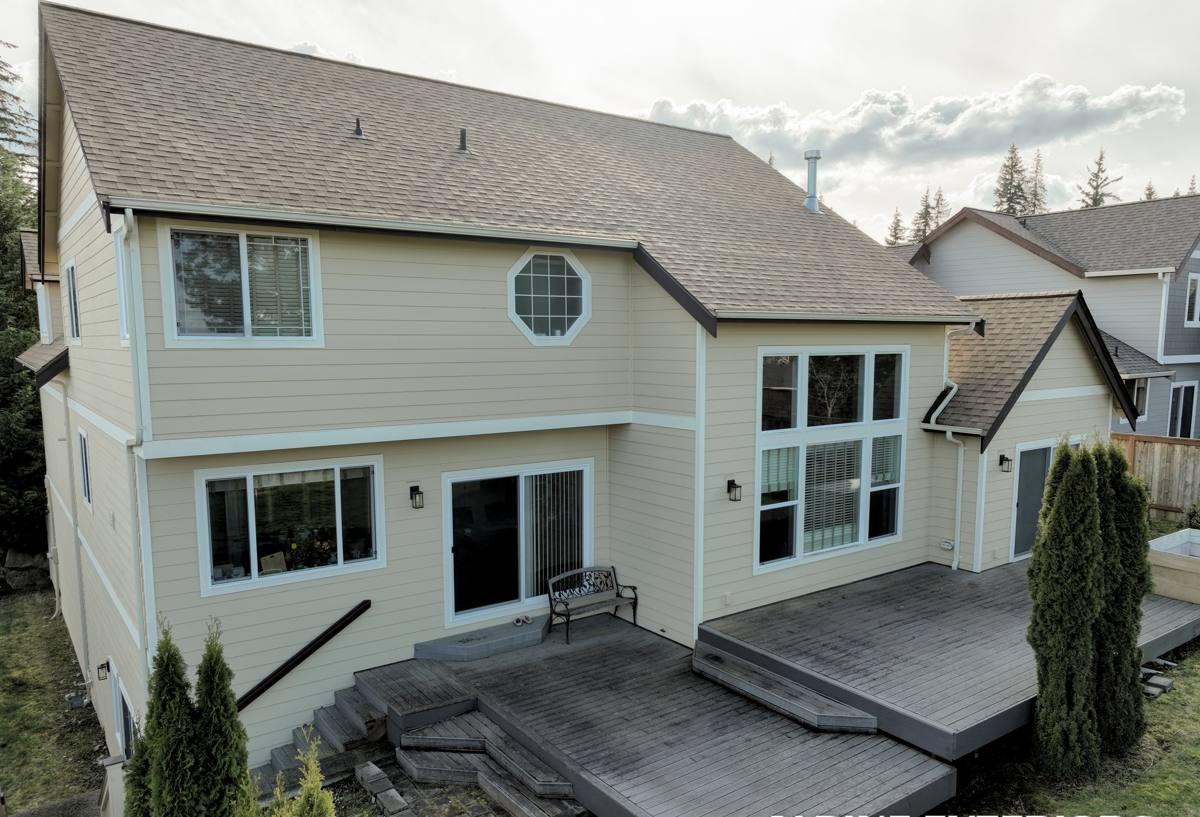
What Birch Bay's Climate Actually Does to a Deck
Salt Air and Metal Fatigue
Even homes a few blocks off the water get measurable salt exposure. Standard galvanized fasteners and brackets that would be fine in a drier, inland part of Whatcom County can start corroding noticeably sooner here. Corrosion at a joist hanger or ledger bolt isn't cosmetic — it's a structural connection slowly weakening, often in a spot you can't see without pulling boards.
Driving Rain and Water Intrusion
Wind-driven rain pushes moisture into places gravity alone wouldn't reach: up under rail caps, into the gap where a ledger board meets the house, and along stair stringers. If flashing, gaps, and drainage weren't planned into the original build, water gets trapped rather than shed, and trapped water is what eventually rots framing from the inside out.
Moss, Algae, and the Long Wet Season
Whatcom County's fall-through-spring stretch gives moss and algae extended time to establish on decking, especially in shaded areas or spots that don't get much direct sun and wind to dry them out. Beyond making a deck slippery — a real safety issue on stairs — persistent moisture retention from moss growth is what accelerates wood decay and eats into the lifespan of even good decking material.
What a Correctly Built Deck Includes Out Here
A deck built for Birch Bay conditions isn't a different product line — it's the same core deck-building fundamentals, applied with more discipline because the climate doesn't forgive shortcuts the way a drier inland location might.
- Footings sized and set for our soil and frost conditions, not just minimum code depth
- Corrosion-resistant fasteners and structural connectors rated for coastal or high-moisture exposure, used throughout — not just at visible points
- Proper ledger board flashing where the deck attaches to the house, so water is directed away from the connection instead of pooling against it
- Joist spacing and blocking that accounts for the decking material's actual span rating, not just a generic layout
- Airflow underneath the deck so the substructure can dry out between rain events instead of staying damp for weeks
- Drainage-conscious board spacing and slope so water sheds off the surface instead of sitting on it
Choosing Decking Material for a Birch Bay Property
There's no single "right" decking material for every home — it depends on how much maintenance you want to take on, your budget, and how close you are to the water. Here's how the common options actually compare under our conditions.
| Material | Upfront Cost | Maintenance | How It Handles Salt Air & Moisture |
|---|---|---|---|
| Cedar | Moderate | Regular cleaning and refinishing needed to resist moss and moisture staining | Naturally rot-resistant but still needs upkeep near the water; can gray and absorb moisture if neglected |
| Pressure-treated lumber | Lower | Periodic sealing and cleaning recommended | Treatment resists decay but hardware and fastener choice matter as much as the wood itself |
| Composite (capped) | Higher | Low — occasional washing | Doesn't absorb moisture the way wood does, resists moss buildup better, though surface can still get slick when wet |
| PVC decking | Highest | Lowest — no sealing or staining ever needed | Fully synthetic, essentially immune to rot and salt corrosion, though it's the most expensive option up front |
We'll walk through these trade-offs honestly during an estimate rather than pushing whatever has the best margin. If you want the lowest long-term maintenance and don't mind the higher upfront cost, capped composite or PVC makes sense this close to the bay. If you like the look and feel of real wood and are willing to stay on top of cleaning and refinishing, cedar or treated lumber can absolutely work — it just asks more of you over the years.
A Note on Product Selection
We don't install every decking product on the market, and that's a deliberate choice rather than a limitation of availability. Some lower-tier composite and capped products have installation tolerances or moisture-handling characteristics that make them a poor fit for a coastal, high-rainfall environment like Birch Bay. We'd rather recommend a product with a track record that matches our climate than install something that looks fine on day one and causes callbacks in year three.
Hardware and Fasteners: The Part Nobody Sees
The decking boards get all the attention, but the hardware underneath is what determines whether a deck is still safe in fifteen years. Near Birch Bay, we treat fastener and connector selection as a structural decision, not a cost-saving one:
- Stainless steel or coated fasteners rated for coastal/high-corrosion exposure at structural connections
- Joist hangers and post bases matched to the fastener type, so you're not mixing metals that accelerate corrosion at the contact point
- Ledger bolts and flashing installed to keep water off the connection, since that joint carries a significant share of the deck's structural load
- Hidden fastening systems, where used, chosen for proven performance in wet climates rather than lowest cost
Mixing incompatible metals — for example, the wrong fastener in contact with certain treated lumber or composite hardware — can actually speed up corrosion instead of preventing it. This is a detail that's easy to get wrong if a crew isn't used to building in salt air regularly.
Railings, Stairs, and Code Requirements
Guardrails, stair railings, and baluster spacing aren't optional details — they're governed by building code, and inspectors in Whatcom County check them. Beyond meeting minimums, we think about how railings perform in this climate specifically: cap rails need to shed water rather than trap it against the top of a post, and any metal railing components need the same corrosion resistance as the structural hardware underneath the deck.
Stairs deserve particular attention in a moss-prone climate. Tread spacing, surface texture, and how quickly a stair tread dries after rain all affect how slick it gets during the wetter months. We factor that into material choice and layout, not just code compliance.
Our Process for a Birch Bay Deck Build
1. On-Site Assessment
We look at sun and wind exposure, distance from the water, existing drainage patterns around your home, and any moss or moisture issues on your current deck or nearby structures. That tells us how aggressively to design for this specific property rather than a generic Whatcom County build.
2. Honest Material and Design Conversation
We walk through decking material options, layout, and railing choices with real trade-offs explained — cost, maintenance, and how each option holds up to salt air and rain specifically at your location.
3. Permitting
New decks and significant deck rebuilds typically require a permit locally, and we handle that process as part of the job so you're not left navigating it alone.
4. Build
Footings, framing, flashing, decking, and railings — built to the standards above, with attention to the connections and drainage details that matter most for coastal exposure.
5. Final Walkthrough
We go over the finished deck with you, including basic maintenance expectations for your specific material choice, so you know what upkeep to expect given our climate.
Living With Your Deck: Maintenance in a Salt-Air, Moss-Prone Climate
Whatever material you choose, a little seasonal attention goes a long way toward getting the full lifespan out of a Birch Bay deck:
- Sweep debris off the deck surface regularly, especially in fall when leaves and needles trap moisture against the boards
- Rinse or gently wash the surface periodically to slow moss and algae buildup, particularly in shaded or low-airflow areas
- Check railings, stairs, and any visible hardware once or twice a year for early signs of corrosion or loosening
- Keep gutters and downspouts near the deck clear so runoff isn't dumping extra water onto or under the structure
- For wood decking, plan on periodic cleaning and resealing on a schedule appropriate to the product — don't wait until graying or moss growth is obvious
- Trim back vegetation that's shading the deck and keeping it from drying out between rain events
Why a Crew That Already Works Birch Bay Makes a Difference
Deck building isn't exotic work, but building one that's genuinely set up for a coastal Whatcom County property takes a crew that's paying attention to the details a generic build would skip — fastener selection, flashing at the ledger, drainage under the structure, and material choices that match how much upkeep you actually want to do. A contractor who works Blaine and Birch Bay regularly has already seen how decks in this specific environment age, what fails first, and what holds up. That's not something you can get from a spec sheet alone.
If you're planning a new deck, or replacing one that's showing its age from years of salt air and rain, we're happy to take a look and give you a straightforward, no-pressure estimate. There's no cost or obligation — just an honest read on what your property needs and what it would take to build it right.