 Blaine Roofing
 Why Decks in Point Roberts Wear Out Faster Than Inland Decks
Point Roberts sits on a small peninsula that juts into the Strait of Georgia, surrounded almost entirely by saltwater. That location gives homeowners some of the best views in Whatcom County, but it also means every deck out here is fighting a harder battle than a deck built twenty miles inland. Salt-laden air corrodes fasteners, hinges, and metal connectors faster than plain moisture does. Driving rain off the water finds its way into every seam, screw hole, and butt joint that isn't properly flashed or sealed. And because Point Roberts stays damp and shaded for long stretches of the year, moss and algae get a running start on any horizontal wood surface, holding water against the boards long after a storm has passed.
None of this means a deck can't last here. It means a deck built or replaced without accounting for salt exposure, wind-driven rain, and a long moss season will fail years before it should. We've built our deck replacement process around those three factors specifically, because a generic deck build that would hold up fine in a drier part of the county won't hold up the same way a few hundred yards from the water.
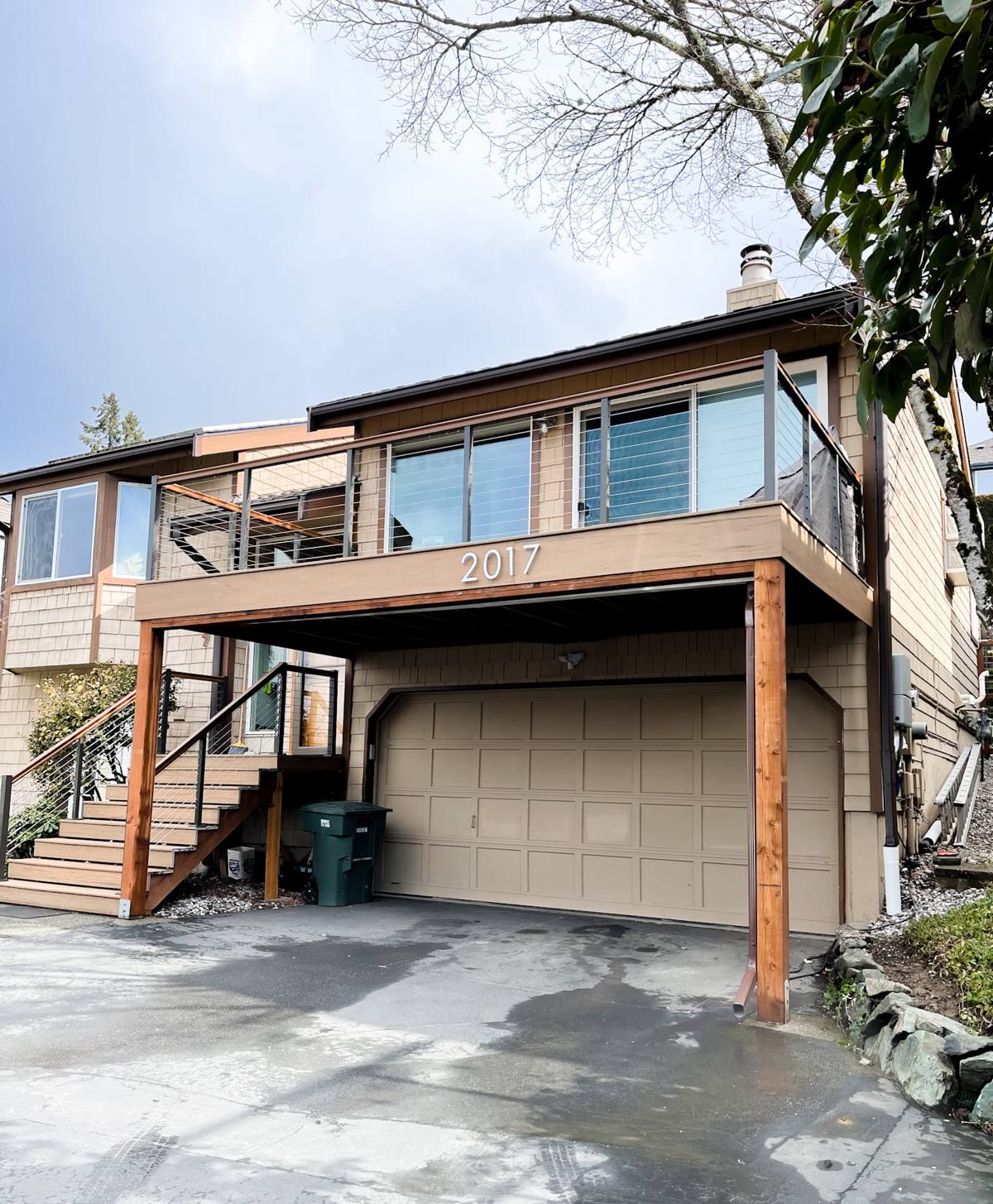
Signs a Deck Needs Replacement, Not Another Repair
Homeowners often ask us to patch a board or two, and sometimes that's genuinely all that's needed. But there's a point where repair stops being the honest answer. Here's how we tell the difference on a Point Roberts deck.
- Soft or spongy spots in the decking boards, especially near the house or in shaded corners where moss holds moisture
- Rust streaking or corrosion around fasteners and metal brackets — a strong sign salt air has been working on the hardware longer than the surface shows
- Gaps opening up between the ledger board and the house, or visible daylight where the deck meets the siding
- Joists or beams that flex noticeably when walked on, not just the surface boards
- Persistent moss or black algae staining that returns within weeks of cleaning, even after pressure washing
- Railing posts that wobble at the base — often a sign the post base or structural connection has rotted from the inside out
If what you're seeing is limited to a handful of surface boards and the frame underneath is sound, repair can be the right call and we'll say so. If the framing, ledger connection, or multiple structural members are compromised, patching individual boards just delays a bigger problem and can mask a safety issue underneath.
What a Correct Deck Replacement Actually Involves
A deck replacement done right in this climate is not just pulling up old boards and screwing down new ones. The parts of the deck you never see are what determine whether it lasts fifteen years or forty.
Ledger Board and House Connection
The ledger board — where the deck attaches to your house — is the single most common failure point on any coastal deck, and it's also a code-critical structural connection. We check the flashing behind it, the fasteners holding it, and the waterproofing between the ledger and the siding. Salt air accelerates corrosion on ledger fasteners specifically, since this is often the least ventilated part of the structure.
Framing and Structural Members
Joists, beams, and posts get inspected for rot, especially at the ends where boards meet and moisture collects. Any framing that's compromised gets replaced, not sistered over. In a high-moisture, salt-exposed environment like Point Roberts, we lean toward pressure-treated or naturally rot-resistant framing lumber and stainless or hot-dip galvanized structural hardware rated for coastal exposure — standard zinc-coated connectors corrode faster here than they would inland.
Flashing and Drainage
Every point where the deck meets the house, and every joist that sits under decking, needs proper flashing or a drainage gap so water doesn't sit and soak in. This is the detail that separates a deck that sheds driving rain cleanly from one that traps it against the wood.
Decking Surface and Fasteners
The visible boards get the most attention from homeowners, but the fasteners holding them down matter just as much. In salt air, we use fasteners rated for coastal or marine-grade exposure rather than standard exterior-grade hardware, because standard fasteners are exactly where you'll see the first rust streaks on an older deck.
Decking Material Options for a Salt-Air Climate
There's no single "best" decking material — every option is a trade-off between upfront cost, maintenance, and how it behaves in wet, salty, shaded conditions. Here's how the common choices stack up for a Point Roberts property specifically.
| Material | How It Handles Salt Air & Moisture | Maintenance | Typical Lifespan |
|---|---|---|---|
| Pressure-treated wood | Good if properly sealed and re-coated; moss and algae need regular cleaning | Annual cleaning, re-stain or seal every 2-3 years | 15-20 years |
| Cedar | Naturally moisture and rot resistant, but still needs sealing near saltwater | Cleaning plus periodic sealing | 15-25 years |
| Composite decking | Doesn't rot or absorb moisture; surface can still grow moss/algae in shaded, damp spots | Periodic washing, no staining or sealing | 25-30+ years |
| PVC/capped polymer decking | Fully moisture-sealed surface, best resistance to salt air and standing moisture | Low — occasional washing | 30+ years |
We don't push one material as universally "right." A wood deck maintained on schedule can look great for decades, and plenty of Point Roberts homeowners prefer the look and feel of real wood. Composite and PVC cost more upfront but trade ongoing maintenance for durability against exactly the conditions — salt, moisture, and moss — that are hardest on wood out here. We'll walk through the honest trade-offs for your specific site, sun exposure, and budget rather than defaulting to whatever's easiest to sell.
Our Deck Replacement Process, Start to Finish
- On-site assessment. We inspect the existing deck, ledger connection, framing, and footings to confirm replacement is the right call and identify any hidden rot or drainage issues.
- Design and material selection. We talk through decking material, railing style, and layout, with honest input on what holds up best given your deck's sun and wind exposure.
- Permitting. Deck replacements typically require a permit through Whatcom County, since Point Roberts is unincorporated and falls under county jurisdiction rather than a local city building department. We handle this step as part of the project.
- Demolition and disposal. Old decking, framing, and hardware are removed and hauled off, with the site protected during teardown.
- Structural rebuild. Ledger, framing, posts, and footings are rebuilt or reinforced to current code, using coastal-rated hardware and fasteners throughout.
- Flashing and waterproofing. All critical water-entry points — the ledger, joist tops, and any post connections — are flashed or wrapped before decking goes down.
- Decking and railing installation. Boards, fascia, stairs, and railings are installed to your chosen material and layout.
- Final walkthrough. We go over the finished deck with you, including care instructions specific to the material you chose.
Access and Logistics: What's Different About Building in Point Roberts
Point Roberts has a geography most contractors never have to plan around. It's a U.S. exclave — the only way to reach it by road is by driving through Canada, since it's cut off from the rest of Washington State by water and the international border. That has real, practical effects on a construction project. Material deliveries, equipment, and crew movement all need to account for border crossing logistics and timing, and it changes how a project gets scheduled compared to a job in Blaine or Bellingham proper. A crew that hasn't planned a Point Roberts job before can run into delays they didn't anticipate — a load of decking material stuck at the crossing, or a crew arrival window that doesn't line up with the rest of the schedule.
Because we've worked in Point Roberts before, we build that reality into the project timeline from the start rather than discovering it mid-job. It's a small thing that makes a real difference in whether your replacement finishes on the schedule you were told.
Cost Factors for a Point Roberts Deck Replacement
Every deck is different, so we won't quote a number without seeing the site, but these are the variables that move the price up or down.
| Factor | Effect on Cost |
|---|---|
| Deck size and shape | Larger and multi-level decks require more material and labor |
| Decking material chosen | Wood costs less upfront; composite and PVC cost more but reduce long-term maintenance |
| Framing condition | Extensive rot or an out-of-code ledger connection adds structural rebuild work |
| Height and stairs | Elevated decks and stair runs add framing, railing, and code requirements |
| Railing style | Cable, glass, or composite railing costs more than standard wood or metal baluster systems |
| Site access | Difficult access or Point Roberts delivery logistics can affect labor and scheduling |
Caring for Your New Deck After Replacement
A properly built deck still needs upkeep in this climate — the goal of a good replacement is to make that upkeep manageable, not eliminate it entirely.
- Sweep debris and standing leaves off the deck regularly, especially in fall, so moisture doesn't sit against the boards
- Clean moss and algae as soon as it appears rather than letting it establish — it's far easier to remove early
- Check railing posts and stair connections once a year for looseness, especially after winter storms
- If you chose wood, re-seal or re-stain on the schedule recommended for the product, not just when it looks faded
- Keep gutters and downspouts near the deck clear so runoff isn't draining directly onto or under the decking
- Trim back vegetation that shades the deck surface and slows drying after rain
Why Local Experience in Point Roberts Matters
A deck replacement is a structural project, not just a cosmetic one — it involves ledger connections, footings, and load-bearing framing that has to hold up under real weather, not showroom conditions. Building that correctly for Point Roberts means accounting for salt air corrosion on hardware, wind-driven rain finding its way into every seam, and moss that will find any shaded, damp corner you leave for it. It also means understanding the practical realities of getting materials and crews to and from an exclave community, and knowing that permitting runs through Whatcom County rather than a city office.
We're a Blaine-based crew that already works this stretch of Whatcom County, including Point Roberts, so these aren't unfamiliar variables we're solving for the first time on your project. That familiarity shows up in fewer surprises, a more realistic schedule, and a deck built to actually hold up to the conditions it'll face.
If your deck is showing its age or you're not sure whether it needs repair or full replacement, we're happy to take a look. Reach out for a free, no-pressure estimate using the form below, and we'll give you an honest read on your deck's condition and what it would take to get it right.