 Blaine Roofing
 Peace Arch Sits Right Where Blaine's Weather Gets Serious
Homes in the Peace Arch area sit close to the water and close to the border, which means they take the full brunt of what Whatcom County's marine climate can throw at a house. Salt-laden air off the water works into every gap and fastener a builder left exposed. Driving rain off the Strait doesn't fall straight down here — it comes in sideways, hunting for the weak seam in a wall assembly. And the long gray stretch from fall through spring keeps siding damp for weeks at a time, which is exactly the environment moss and algae need to take hold and spread.
None of that is unusual for this part of Washington. But it does mean siding decisions that work fine forty miles inland don't always hold up here. A product or a detail that's "good enough" in a drier climate can fail years early in Peace Arch. That's the lens we use on every siding job in this neighborhood — not what's easiest to install, but what actually survives the conditions.
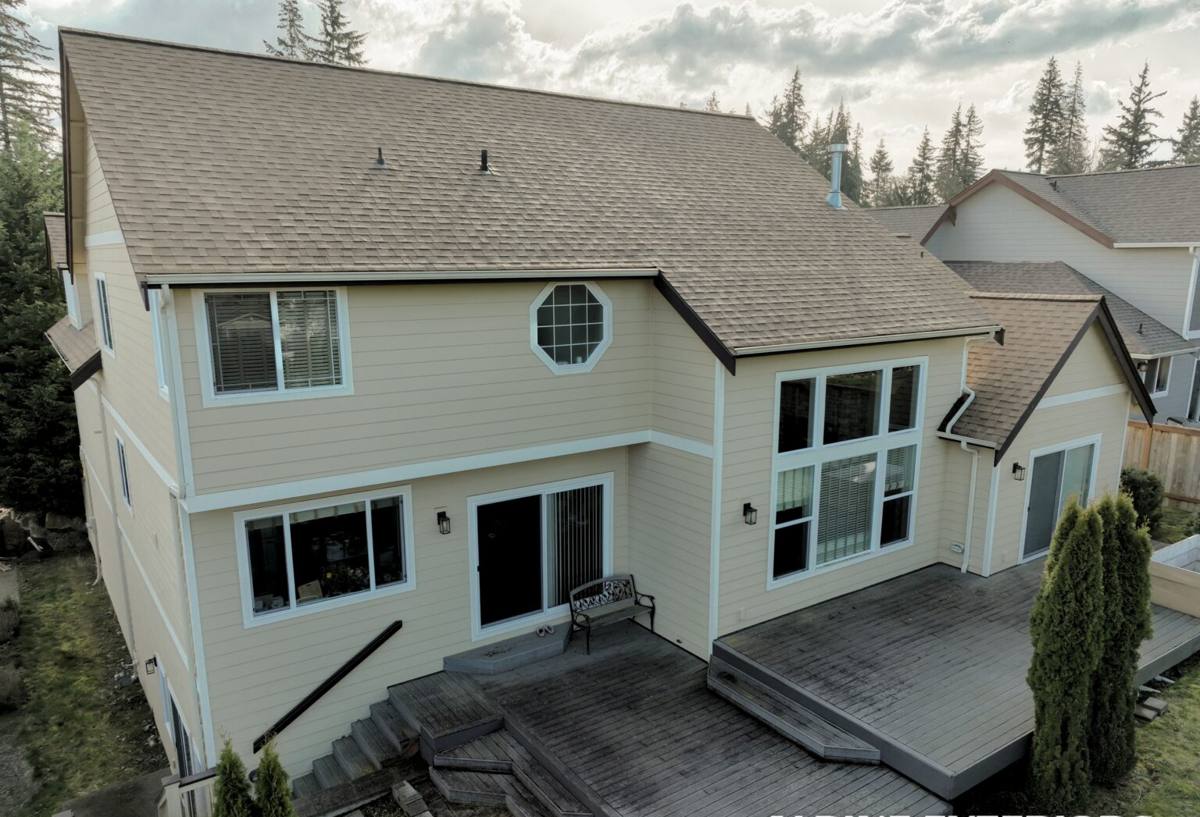
Why Fiber Cement Is the Right Material Here
Fiber cement is cement, sand, and cellulose fiber pressed and cured into a dense, stable board. It doesn't absorb moisture the way wood does, it doesn't rot, and it doesn't feed the insects that go after untreated wood siding. For a neighborhood that deals with sustained dampness and salt exposure for a good part of the year, that combination matters more than almost anything else on the spec sheet.
We install James Hardie fiber cement exclusively — not because it's the only fiber cement product on the market, but because it's the one we're willing to put our name behind in this climate. Hardie's boards are manufactured with a factory-applied finish system (ColorPlus) rather than relying on field-applied paint to do all the work of holding up against salt air and UV. That distinction shows up in how a house looks after five winters, not just on installation day.
What We Don't Install, and Why
We don't install vinyl, LP SmartSide, primed wood, or cedar siding, and we don't install other fiber cement brands like Cemplank or Allura. Vinyl can warp and its seams give wind-driven rain a path inward. Wood and engineered wood products need a paint film and caulk joints to stay intact, and both of those fail faster under salt exposure and constant moisture than most homeowners expect. We're not saying every one of those products is junk — some have real advantages in the right climate. We're saying that after years of doing exterior work in this specific part of Washington, James Hardie is the product we trust to hold up here, and it's the only one we'll put a warranty behind.
What a Correct Installation Actually Involves
Fiber cement siding is only as good as the wall assembly underneath it. A beautiful plank job over a poorly detailed water-resistive barrier will still let moisture in — it'll just take a couple of years to show up as staining, soft trim, or rot in the sheathing. In a climate like Peace Arch's, we treat the details below as non-negotiable, not optional upgrades.
Moisture Management Behind the Siding
Every job starts with a continuous water-resistive barrier, properly lapped and taped at seams, with flashing integrated at every window, door, and penetration so water is directed out and down rather than trapped behind the cladding. We install rainscreen furring strips where the wall assembly calls for it, creating a drainage gap and airflow path behind the siding. That gap is what lets any moisture that does get past the outer layer actually dry out instead of sitting against the sheathing — which matters a lot more here than in a drier inland climate.
Fastening and Clearances
Hardie specifies fastener type, spacing, and embedment depth for a reason — get it wrong and you either split the board over time or leave a fastener head that telegraphs through the finish. We also hold the manufacturer's minimum clearances: siding kept clear of grade, roofing, decks, and patios so it isn't sitting in standing water or splash-back. Skipping these clearances is one of the most common shortcuts we see on older installs in this area, and it's usually the first place moisture damage shows up.
Caulking, Trim, and Joint Details
Butt joints, trim intersections, and penetrations get sealed with a high-quality, paintable sealant rated for exterior use — not just at install, but detailed in a way that sheds water rather than relying on caulk alone to keep it out long-term. Corner trim and window trim are set with the same attention to flashing and back-priming cut edges, since a cut end of fiber cement is the one spot on a board that isn't factory-sealed.
| Detail | Why It Matters in Peace Arch |
|---|---|
| Rainscreen gap | Lets moisture from wind-driven rain dry out instead of sitting against the sheathing |
| Factory-primed/sealed cut edges | Salt air attacks unsealed edges first; exposed cuts are where rot starts |
| Proper fastener spacing/depth | Prevents splitting and loosening under repeated wet-dry cycling |
| Ground and roof clearances | Keeps siding out of splash-back and standing moisture near grade |
| Continuous flashing at penetrations | Directs driving rain out and down instead of behind the wall |
James Hardie's Climate Engineering for This Region
James Hardie builds its boards to different specifications depending on climate zone, under what it calls the HardieZone system. Blaine and the rest of coastal Whatcom County fall into the cooler, wetter HZ5 zone, and the HZ5 product formulation is engineered for that kind of freeze-thaw and moisture cycling rather than the hot, humid conditions Hardie's HZ10 line is built for. That's not a marketing distinction — it's a different board formulation suited to a different climate, and it's part of why we don't treat "fiber cement" as a single interchangeable product.
Hardie also backs its siding with a transferable limited warranty and a separate finish warranty on ColorPlus products, which matters in a market like Peace Arch where homes do sell and buyers want documentation that the exterior was done right.
Our Process for a Peace Arch Siding Job
- Walkthrough and assessment — we look at existing siding condition, trim, window flashing, and any signs of past moisture intrusion before we ever talk product.
- Tear-off and sheathing check — old siding comes off and we inspect the sheathing underneath for soft spots or hidden rot before anything new goes up.
- Water-resistive barrier and rainscreen — a continuous, properly lapped barrier and drainage gap go in first, since this is the layer that determines how the whole wall performs over time.
- Flashing at every opening — windows, doors, and penetrations get integrated flashing before trim or siding covers them.
- James Hardie plank or panel installation — installed to manufacturer fastening and clearance specs, not shortcuts.
- Trim, caulking, and final detailing — joints sealed, cut edges treated, and a final walkthrough with the homeowner.
Living With Fiber Cement Siding in a Salt-Air, Moss-Prone Climate
Fiber cement is low-maintenance compared to wood, but "low-maintenance" doesn't mean "no maintenance" — especially this close to the water. Salt residue and organic growth still need periodic attention, and staying ahead of small issues is what keeps a fiber cement exterior looking good for decades instead of just looking good for the first few years.
- Rinse siding with a garden hose once or twice a year to clear salt residue and airborne debris before it builds up
- Keep gutters clean and downspouts directed away from the wall so runoff isn't constantly wetting one section of siding
- Trim back vegetation and tree cover that keeps siding shaded and damp longer than the rest of the house
- Watch north-facing and shaded walls for early moss or algae growth, since those areas dry out slowest
- Re-caulk joints if you notice cracking or gaps, rather than waiting for water staining to appear
- Have trim and flashing points checked periodically, especially after major wind or rain events
None of this requires the sanding, scraping, and repainting cycle that wood or engineered wood siding demands. It's the difference between occasional upkeep and a recurring project.
Why Local Experience in This Neighborhood Matters
A siding crew that's worked in Peace Arch and the surrounding Blaine area already knows what this climate does to a wall assembly, because they've seen it firsthand — which walls take the worst of the wind-driven rain, how fast moss establishes on a shaded north elevation here, and where past installations in the area have cut corners that showed up as problems years later. That's not something you can fully substitute with a spec sheet. It shows up in small decisions on the job: where to add extra flashing attention, how much clearance to hold at grade on a lot that sits low, which details are worth the extra hour because this is coastal Whatcom County and not somewhere drier.
It also means we're a known, reachable crew if a question comes up after the job is done — not a company that did one job in the area and moved on.
What Affects the Cost of a Peace Arch Siding Job
| Factor | Why It Moves the Price |
|---|---|
| Tear-off scope | Removing old siding, trim, or damaged sheathing adds labor before new material goes up |
| Wall complexity | Dormers, multiple stories, and cut-up elevations take more time and material than a simple rectangle |
| Sheathing repair | Any rot or soft sheathing found during tear-off needs to be replaced before siding can go on correctly |
| Product line and profile | Lap width, panel style, and ColorPlus vs. field-painted finish affect material cost |
| Trim and detail work | Corner boards, window trim, and flashing detail add labor time relative to a stripped-down install |
We won't quote a number without seeing the house — every one of these factors changes the estimate, and a fair price starts with an honest look at the actual wall, not a square-footage guess.
Ready for an Honest Look at Your Siding
If you're weighing a siding project on a Peace Arch home, we're glad to come take a look, tell you what we see, and explain what a correct James Hardie installation would involve for your specific house — no pressure, no upsell into a product we don't stand behind. Use the form below to request a free estimate.