 Blaine Roofing
 Why Windows Take a Beating in Dakota Creek
Dakota Creek sits close enough to Semiahmoo Bay and the Strait of Georgia that salt-laden air is a daily fact of life, not an occasional nuisance. That air finds its way into every gap, seal, and unprotected fastener on the outside of a house. Add in Whatcom County's long stretch of driving rain — the kind that comes in sideways off the water rather than straight down — and a window's job isn't just to look good and keep heat in. It has to actively shed wind-driven water, resist corrosion, and keep doing both for fifteen, twenty, thirty years without babysitting.
Then there's moss season, which around here is really most of the year. Constant damp shade off tree lines and north-facing walls keeps organic growth active on siding, trim, and window sills far longer than it would in a drier climate. Moss and algae hold moisture against wood and vinyl surfaces, and where a window's seals or flashing are already marginal, that sustained dampness is what turns a small gap into a rot problem or a fogged-out sealed unit.
None of this is unique to any one house — it's just the deal with living this close to the water in this part of the Pacific Northwest. Windows built and installed for a drier, calmer climate tend to underperform here faster than their warranty paperwork suggests.
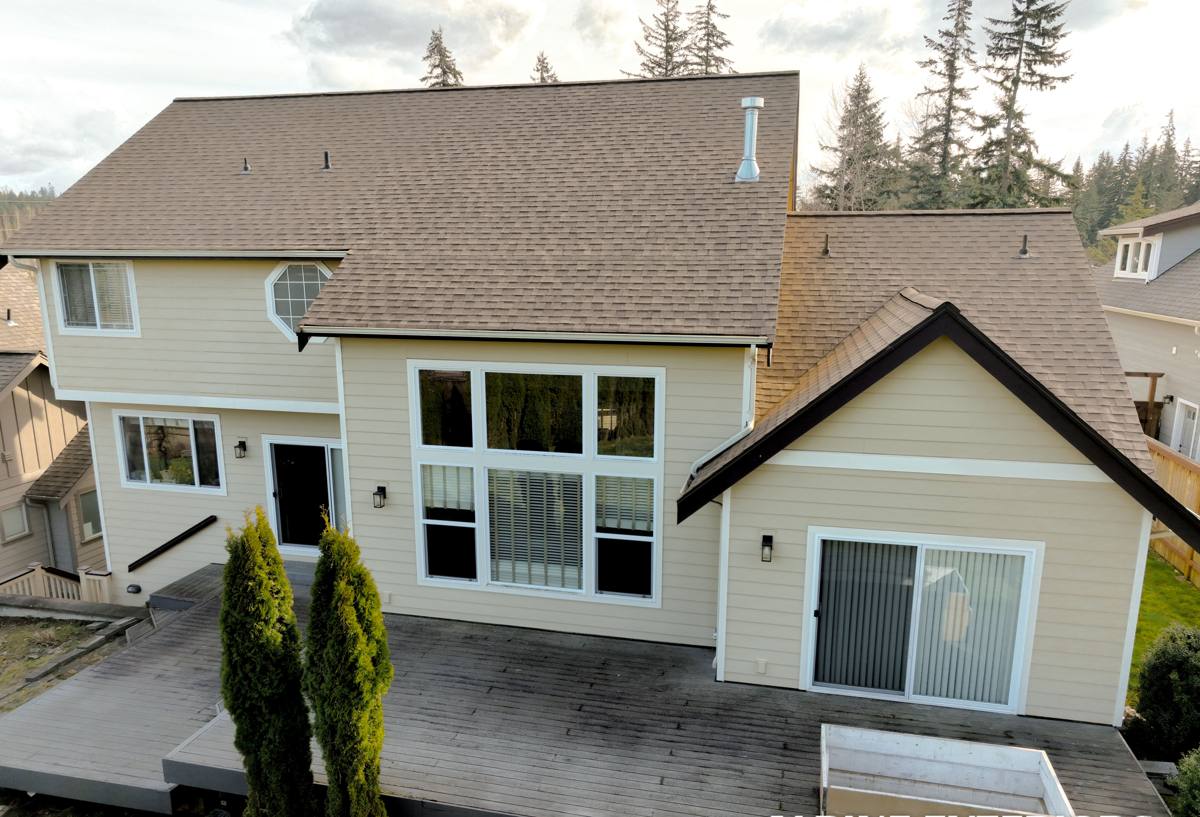
What "Energy-Efficient" Actually Means for This Climate
Energy efficiency gets marketed as an insulation story — U-factor, R-value, low-E coatings — and those numbers matter. But in a marine climate like Blaine's, efficiency is just as much about water and air management as it is about thermal performance. A window with excellent glass but a poorly integrated frame will still leak air around the perimeter, and once moisture gets behind trim or into wall framing, any energy savings from the glass itself become beside the point.
For Dakota Creek homes, we look at efficiency as three things working together:
- Thermal performance — the glass package and frame material's ability to resist heat transfer, which affects comfort and heating costs through our wet, moderate winters.
- Air sealing — how tightly the window unit integrates with the wall opening, so wind off the water doesn't push cold air and moisture through gaps.
- Water management — flashing, sill pans, and drainage details that direct wind-driven rain away from the wall assembly instead of trusting caulk alone to keep it out.
A window that scores well on paper but is installed without proper flashing and sealing will underperform a modest window installed correctly. Installation quality is at least as important as the product spec sheet.
Frame Material: What Holds Up Near the Water
Homeowners often ask which frame material is "best," but the honest answer depends on how close the home sits to salt exposure and how much upkeep the owner wants to do. Here's how the common options compare for a Dakota Creek setting:
| Frame Material | Salt Air Performance | Maintenance | Notes |
|---|---|---|---|
| Vinyl | Good — won't corrode or rust | Low; occasional rinsing | Solid value option; quality varies widely by manufacturer |
| Fiberglass | Excellent — very stable in temperature and moisture swings | Low | Higher upfront cost, holds paint and finish well over time |
| Wood / Wood-Clad | Fair — needs a well-maintained exterior cladding to protect the wood core | High if unclad; moderate if clad | Best interior look, but the wood core is vulnerable if seals fail |
| Aluminum | Poor to fair — prone to corrosion and condensation without a thermal break | Moderate | Generally not our recommendation for this climate unless thermally broken |
We steer most Dakota Creek clients toward vinyl or fiberglass for a straightforward reason: both resist the corrosion and moisture absorption that salt air and constant dampness cause over time, and neither depends on a perfect paint job to stay protected. Wood-clad windows can still be the right call for a specific architectural look, but we're upfront that they carry more long-term maintenance responsibility in this environment.
Glass Packages Worth Considering
Double-pane, low-E, argon-filled glass is the standard baseline for this region and performs well for most homes. Triple-pane glass adds meaningful sound dampening and a slightly better thermal number, but the cost jump doesn't always pencil out unless the home is on a busy road or facing directly into prevailing weather. We'll walk through this trade-off honestly rather than upselling glass a home doesn't need.
Signs Your Current Windows Are Working Against You
Before recommending replacement, we look for concrete signs the existing windows are past their useful life rather than just old. A window can be decades old and still perform fine if it was installed well and maintained. Watch for:
- Visible fogging or moisture trapped between panes — the seal on the insulated glass unit has failed
- Drafts you can feel near the frame on a windy day, especially during a storm off the water
- Soft or discolored trim and sill areas, which often points to water intrusion behind the frame
- Difficulty opening, closing, or latching — frames that have swollen, warped, or shifted
- Visible corrosion on aluminum frames or hardware
- Persistent moss, algae, or black staining collecting on sills and unable to be cleaned off
- A noticeably higher heating bill compared to similarly sized rooms elsewhere in the house
Any one of these on its own might just need a repair. Several of them together, especially on the weather-facing side of a house, usually mean the windows are no longer doing their job.
What Correct Installation Involves
The window unit itself is only part of the equation — how it's integrated into the wall is what determines whether it performs for the long haul in this climate. Our process on every Dakota Creek job includes:
Sill Pan and Flashing
A sloped sill pan directs any water that gets past the exterior seal back outside instead of letting it pool at the bottom of the opening. Flashing tape is layered shingle-style — bottom to top — so water always sheds downward and outward, never behind the layer below it.
Air Sealing at the Rough Opening
The gap between the window frame and the rough wall opening gets sealed with an appropriate low-expansion foam or backer rod and sealant, not just caulked around the trim after the fact. This is one of the most common shortcuts we see on prior installations, and it's usually the first place a draft shows up.
Exterior Trim and Caulking
Exterior caulk is a maintenance item, not a substitute for proper flashing — we treat it as the last line of defense, not the primary one. We use sealants rated for marine/coastal exposure rather than generic caulk that breaks down faster under UV and salt exposure.
Interior Finish
Once the window is set, shimmed level and square, and sealed, interior trim is reinstalled or replaced to match the home, and the work area is left clean.
Cost Factors for a Dakota Creek Window Project
Every home is different, so we don't quote sight unseen, but these are the main variables that move the price up or down:
| Factor | Why It Matters |
|---|---|
| Window size and count | Larger openings and whole-house replacements naturally cost more per project, though often less per window than piecemeal jobs |
| Frame material | Vinyl is typically the most budget-friendly; fiberglass and wood-clad cost more upfront |
| Glass package | Triple-pane and specialty coatings add cost over standard double-pane low-E glass |
| Condition of existing framing | Rot or water damage found once old windows come out adds repair scope |
| Access and story height | Second-story or hard-to-access windows take more labor and equipment |
| New construction vs. retrofit | Retrofitting into an existing wall requires more careful flashing work than new construction framing |
Whole-home window replacement projects for a typical single-family home in this region generally run from the low thousands into the mid five figures, depending heavily on the factors above. We'll give you a specific, itemized number after seeing the actual openings — not a phone estimate.
Living With Moss Season After Installation
New windows don't stop moss and algae from growing nearby, but correct installation and the right material choices make a real difference in how much upkeep they need. Vinyl and fiberglass frames rinse clean easily and don't provide the porous surface that organic growth needs to take hold the way untreated wood can. Keeping gutters clear and trimming back vegetation that shades a wall also goes a long way — most window problems we see traced back to moss aren't the window's fault, they're the result of standing moisture being allowed to sit against the frame or sill for months at a time.
We're happy to point out simple maintenance habits specific to your home's exposure during the estimate, at no cost, whether or not you end up replacing anything right away.
Our Process, Start to Finish
- On-site assessment — we look at every window in question, check for water damage or rot around the openings, and talk through what you're trying to solve (efficiency, drafts, appearance, or all three).
- Honest recommendation — we'll tell you if a window needs replacing or if a repair or better sealing will do the job.
- Written estimate — itemized by window, material, and labor, with no vague allowances.
- Installation — proper flashing, sealing, and finish work as outlined above, with the work area protected and cleaned up daily.
- Final walkthrough — we check operation, seals, and finish work with you before calling the job done.
Why Local Experience in Dakota Creek Matters
A crew that regularly works this specific stretch of Whatcom County already knows which wall orientations take the worst of the wind-driven rain, which frame materials hold up against the salt air coming off the bay, and how long moss season really runs here compared to what a generic install guide assumes. That's the difference between a window that's technically installed and one that's installed correctly for this exact environment. We're not learning the local climate on your project — we've already seen how it treats windows over the years.
If your windows are drafty, fogged, hard to operate, or just costing you more in heating than they should, we're glad to take a look. Reach out for a free, no-pressure estimate using the form below, and we'll give you a straight answer about what your home actually needs.