 Blaine Roofing
 Building a Deck That Can Actually Handle Blaine Harbor
Blaine Harbor sits right where salt air, wind-driven rain, and a long wet season all meet, and a deck built without that in mind will show its age fast. We've built and repaired decks up and down this stretch of Whatcom County, and the pattern is always the same: the decks that fail early weren't built wrong in an obvious way, they were built like a deck anywhere else in the country. A deck here needs to be planned differently from the ground up, not just finished with a coat of sealer at the end.
This page walks through what a custom deck actually needs to hold up near Blaine Harbor, what a correct build involves structurally, and how our process works from first estimate to final walkthrough.
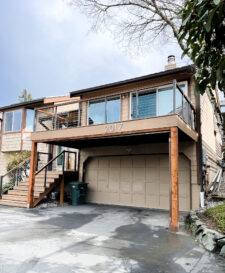
What the Marine Climate Actually Does to a Deck
It helps to understand the specific damage mechanisms at play, because they're different from what a deck contractor inland deals with.
Salt Air and Metal Hardware
Salt-laden air corrodes standard fasteners, brackets, and hangers far faster than the same hardware would wear inland. Once a joist hanger or ledger bolt starts rusting, it loses holding strength quietly — you often can't see it until the deck starts to feel spongy or a railing gets loose.
Driving Rain and Water Intrusion
Rain here doesn't just fall straight down; wind pushes it sideways into ledger connections, under railing posts, and into any seam that isn't properly flashed. A deck built with flat, unflashed connections will take on water at exactly those joints, and that's where rot starts.
Moss and a Long Wet Season
Whatcom County's wet season runs long, and shaded or low-airflow areas of a deck — under railings, in corners, along the house — grow moss and algae readily. Moss holds moisture against the decking surface, and on wood that means accelerated decay; on composite it mostly means staining and a slip hazard, which is a real safety issue on stairs and landings.
Decking Material: Comparing Your Real Options
There's no single "best" decking material for Blaine Harbor — there's a best fit for your budget, how much upkeep you want to do, and how the deck will be used. Here's an honest comparison of the three main routes homeowners choose between.
| Material | Upfront Cost | Maintenance | How It Handles Salt Air & Moisture | Typical Lifespan |
|---|---|---|---|---|
| Pressure-treated wood | Lowest | Annual cleaning, periodic re-staining/sealing | Needs consistent sealing to resist moisture and salt; fasteners are the weak point | 10-15 years with upkeep |
| Cedar or other natural wood | Moderate | Regular sealing and cleaning to maintain color and resist decay | Naturally more rot-resistant than treated pine, but still needs a moisture barrier and sealed cuts | 15-20 years with upkeep |
| Composite (wood-plastic blend, e.g. brands like Trex or TimberTech) | Higher | Occasional washing, no staining or sealing | Resists rot and salt corrosion well; surface can still grow moss film if not cleaned | 25-30 years |
| PVC/capped polymer decking | Highest | Lowest — mostly just rinsing | Fully resists moisture absorption; best option where salt spray and rain are constant | 25+ years |
We install all of these, and we'll give you a straight answer about which one fits your situation rather than steering you toward whatever has the best margin. If you want the lowest-maintenance option and plan to keep the house long-term, composite or PVC earns its higher price near the harbor. If you love the look and feel of real wood and don't mind the upkeep, a well-sealed cedar deck built with the right substructure will still last.
What Happens Below the Decking Is What Actually Matters
Homeowners naturally focus on the decking boards because that's what you see and walk on, but the framing underneath is what determines whether a deck lasts 10 years or 30. This is also where most corner-cutting happens on lower-bid jobs, because it's hidden once the project is done.
Ledger Attachment and Flashing
Where the deck attaches to the house is the single most common failure point we find on older decks in this area. A ledger board needs proper flashing that directs water away from the house framing, not just caulk or a wrap that degrades in a few years. Driving rain finds every gap.
Joist Hardware and Fasteners
We use hardware rated for corrosive, coastal environments — stainless steel or heavy hot-dip galvanized connectors and fasteners rather than standard-grade hardware that's fine 20 miles inland but not here. This is a small cost difference upfront and a big difference in how the deck holds up over time.
Footings and Post Bases
Post bases should hold the post above the concrete, not embed wood directly in it, so water doesn't wick up into the post end grain. Footing depth also needs to account for local frost and drainage conditions, not just meet the minimum.
Drainage and Airflow Underneath
A deck built low to the ground with poor airflow underneath stays damp longer after every rain, which speeds up decay and moss growth on the underside of the boards. Grading the ground under the deck and leaving adequate clearance makes a real difference over the deck's life.
Checklist: Signs an Existing Deck Is Losing the Battle
If you already have a deck near the harbor, here's what to check before it becomes a safety issue rather than a maintenance item:
- Soft or spongy spots when you walk across the decking
- Rust staining running down from screws, bolts, or hardware
- A railing post that wiggles or feels less solid than it used to
- Green or black film building up in shaded corners or on stair treads
- Gaps opening up where the deck meets the house siding or trim
- Visible daylight or water staining at the ledger board connection
- Boards cupping, splitting, or separating at the fastener holes
Any one of these on its own might just mean a maintenance visit. Several together usually mean the substructure is compromised and it's worth a real inspection before you plan any more use of it.
Railings, Stairs, and the Details That Get Overlooked
Railings take a disproportionate amount of weather exposure because they're the tallest, most exposed part of the structure, and they're also a life-safety component. Post attachment needs to be solid enough to meet code load requirements, and every fastener in a railing system should be corrosion-resistant hardware, not just what happened to be in the truck. Stair stringers deserve the same attention as the main frame — they see concentrated foot traffic and, near the harbor, they're often the first place moss becomes a slip hazard because they're frequently shaded.
Our Process for a Blaine Harbor Deck Project
- On-site assessment. We look at sun and wind exposure, drainage on the lot, how close you are to the water, and what you actually want to use the deck for.
- Material and design conversation. We walk through the real trade-offs between wood, composite, and PVC for your specific spot and budget — no upsell pressure, just an honest recommendation.
- Permitting. Decks in Blaine and unincorporated Whatcom County generally require a building permit, particularly when the deck is attached to the house or built above a certain height. We handle this so it's not on your plate.
- Build with coastal-grade hardware. Proper ledger flashing, corrosion-resistant fasteners and connectors, correctly set footings, and adequate under-deck drainage and airflow — every time, not as an upgrade option.
- Final walkthrough. We go over maintenance expectations for whichever material you chose, so you know exactly what upkeep (if any) to expect year to year.
Why a Local Crew Matters More Than It Sounds Like It Should
A deck built by a crew that hasn't worked this specific stretch of coastline will often default to standard-grade hardware and generic flashing details, because that's what works everywhere else. It's not negligence — it's just not knowing what this environment does over five or ten years. We've seen the early failures that come from that gap, and we build to avoid them from the start: right hardware, right flashing, right drainage, on every deck, whether it's a small landing off a back door or a full multi-level deck built for entertaining.
Working repeatedly in Blaine and around the harbor also means we're not guessing at permitting steps or relearning site conditions every time — that familiarity keeps projects moving and keeps surprises to a minimum.
Getting Started
If you're planning a new deck near Blaine Harbor or you're not sure whether your current one is still sound, we're glad to take a look. Reach out for a free, no-pressure estimate using the form below — we'll walk the site, answer your questions honestly, and give you a clear picture of what the job would actually involve.