 Blaine Roofing
 Building Decks for Bellingham's Coastal Climate
Bellingham sits close enough to the water that every deck built here has to answer to the same conditions: salt-laden air rolling off the Sound, driving rain that comes in sideways more often than straight down, and a moss season that can stretch from October clear through April. A deck that looks fine in the driveway on installation day has to survive all of that, year after year, without turning into a slip hazard or a rot problem. That's the standard we build to.
Whatcom County's marine climate is milder than most of the country, which is exactly why people spend so much time on their decks here — but mild doesn't mean dry. The combination of moisture, shade from mature trees, and salt air means decking, fasteners, and framing all take more abuse than they would inland. A deck built with materials or details that work fine in Spokane or Boise can fail early in Bellingham. We build for the coast, not for a catalog spec sheet.
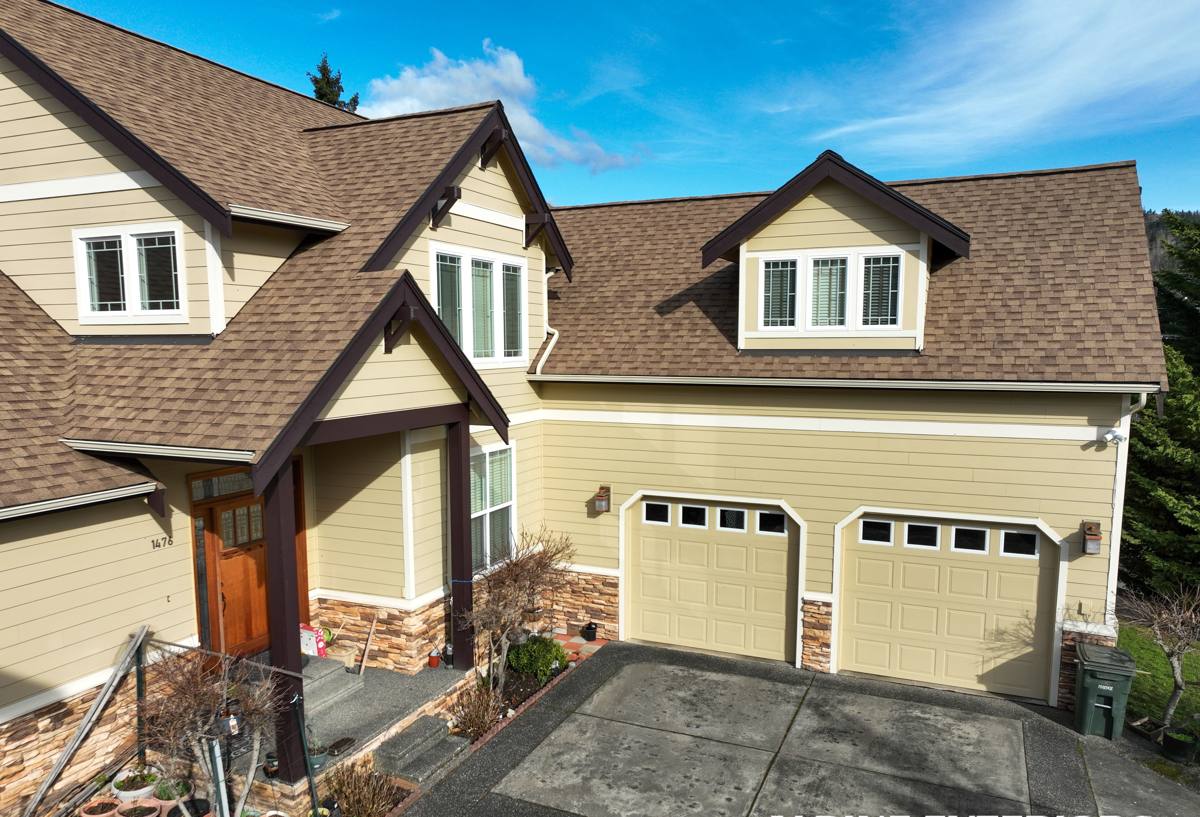
What Local Homes Actually Need From a Deck
Most of the decks we're asked to fix or replace in this area didn't fail because of bad workmanship on day one — they failed because the original build didn't account for how much water this region moves through a structure over a decade or two. The issues we see repeatedly:
- Ledger boards and framing that trap moisture against the house instead of shedding it
- Decking with tight, un-vented board spacing that never fully dries between rains
- Fasteners and hardware that weren't rated for coastal exposure and started corroding within a few years
- Shaded, north-facing sections that grow moss and algae fast and become genuinely slippery
- Stairs and railings that weren't built with wet-weather footing in mind
A deck built correctly for Bellingham addresses every one of these from the start, not as a repair five years later.
Orientation and Exposure
Which side of the house a deck sits on changes how hard it gets hit by the weather. In this part of Whatcom County, west and southwest-facing decks generally take the brunt of wind-driven rain off the water, while north-facing decks tend to stay shaded and damp longer after a storm, which is exactly the combination that grows moss fastest. Neither orientation rules out a great deck — it just changes which details deserve the most attention, from drainage on the exposed side to material choice and airflow on the shaded side.
Drainage and Ventilation Come First
Before we talk about decking material or railing style, we talk about how water moves through and off the structure. Proper flashing at the ledger, correct board spacing for airflow, and framing that doesn't create low spots where water pools are the difference between a deck that lasts fifteen-plus years and one that needs structural repair in five. This is invisible work — nobody admires good flashing — but it's the single biggest factor in how long a deck holds up in this climate.
Decking Materials: What Holds Up Here and What Doesn't
There's no single "best" decking material — there's a best material for a given budget, sun exposure, and how much maintenance a homeowner actually wants to do. Here's how the common options compare specifically for a shaded, damp, coastal Whatcom County property:
| Material | How it handles moss/moisture | Maintenance | Typical lifespan here |
|---|---|---|---|
| Pressure-treated wood | Prone to moss and algae in shade; needs regular cleaning | Annual cleaning, periodic sealing | 10-15 years |
| Cedar | Naturally moisture-resistant, but still grows moss in deep shade | Sealing every 2-3 years | 15-20 years |
| Composite (capped) | Sheds water well; can still get slick with algae film | Occasional wash-down | 25-30 years |
| PVC decking | Non-porous, resists moss growth best of the group | Occasional wash-down | 25-30+ years |
We're upfront that composite and PVC decking cost more up front than wood, and that's a real trade-off, not a sales pitch. For a deck that gets heavy shade or sits close to the water, the reduced maintenance and better moisture resistance usually pay for themselves in avoided sanding, sealing, and moss scrubbing. For a sunnier, more open lot, a well-maintained cedar deck can perform just as well for a lot less money. We'll walk your specific site with you and give you a straight answer on what fits.
Fasteners and Hardware Matter More Than People Think
Standard galvanized fasteners can start showing corrosion within a few seasons this close to salt air. We use stainless steel or coated fasteners rated for coastal and treated-lumber exposure, along with structural hardware — joist hangers, post bases, hurricane ties — matched to the same standard. It costs a little more in materials and shows up nowhere on the finished deck, but it's the difference between hardware that's still solid in twenty years and hardware that's rusting through in eight.
Railing and Guard Considerations
Railings take their own beating from salt air and rain, and they matter as much for safety as for looks. Wood railings need the same sealing schedule as wood decking, aluminum and vinyl railing systems shed water without much upkeep, and cable or glass panel systems look great but call for hardware inspected regularly since it's under constant tension in a corrosive environment. Whatever material you choose, guard height and baluster spacing need to meet current building code, and we make sure they do — this isn't an area where a lower price justifies cutting a corner.
Managing Moss and Slip Risk From the Start
Moss isn't just cosmetic here — a mossy deck board is genuinely slippery, especially on stairs, and that's a real safety issue for a deck that gets used through a wet Whatcom County winter. A few things reduce moss buildup significantly when they're built in from the start rather than added later:
- Adequate board spacing and sub-deck airflow so surfaces actually dry out between storms
- Decking material chosen with shade exposure in mind, not just appearance
- Grooved or ridged surface profiles on stair treads for better wet-weather footing
- Keeping decking clear of overhanging branches where practical, to reduce standing debris and shade
None of this eliminates the need for occasional cleaning — nothing does in this climate — but a deck designed with moss and moisture in mind needs far less scrubbing than one that wasn't.
Our Deck Building Process
We keep the process straightforward because homeowners deserve to know what's happening at each stage, not just when the invoice arrives.
1. On-Site Assessment
We walk the property, look at sun and shade exposure, existing drainage patterns, and how the deck will actually be used — entertaining, grilling, a quiet spot for morning coffee. That shapes the layout and material recommendation more than any catalog would.
2. Design and Material Selection
We go over decking, railing, and hardware options with honest pros and cons for your specific site, not a one-size-fits-all pitch. You'll know the trade-offs before you commit to anything.
3. Permitting
Deck projects in Whatcom County jurisdictions often require permits depending on size, height, and attachment to the house. We handle that process so it's not something you have to chase down yourself.
4. Structural Build
Ledger flashing, framing, and footings go in first — the parts that determine how long the deck actually lasts. This is where we take the most care, because it's the part that's covered up once decking goes down.
5. Decking, Railing, and Finish Work
Decking, railing, stairs, and any lighting or finish details are installed and inspected before we walk the site with you.
6. Final Walkthrough
We go over the finished deck together, explain any maintenance the material needs, and make sure everything meets what we agreed on at the start.
Repair Versus Replace
Not every aging deck needs to be torn out. If the framing and footings are sound and the problems are limited to surface decking, railings, or specific rotted boards, targeted repair can extend a deck's life for a reasonable cost. But if we find soft or rotted framing, undersized or corroded footings, or a ledger connection that's been letting water into the house structure, repair is usually a short-term fix on a longer-term problem. We'll tell you plainly which situation you're in and why, rather than defaulting to whichever option is more profitable for us.
A quick self-check for homeowners wondering which category their deck falls into:
- Boards feel spongy or visibly sag when you walk on them — likely a framing issue, not just a surface one
- Railings wobble at the posts, not just the balusters — check post connections and footings
- Persistent black staining or a musty smell near the ledger — possible moisture intrusion at the house connection
- Surface graying, splintering, or moss buildup with solid structure underneath — usually a candidate for resurfacing rather than full replacement
- Deck was built more than 20 years ago with no upgrades to flashing or hardware — worth a structural inspection even if it looks fine
Why Local Experience in Bellingham Matters
A crew that already works this specific stretch of Whatcom County knows things a traveling contractor has to learn on your project: which sides of a lot get hit hardest by wind-driven rain, how shade patterns from mature Pacific Northwest trees affect moss growth on a given site, and what permitting looks like locally. That familiarity shows up in fewer surprises during the build and a deck that's designed for the conditions it will actually face, not generic conditions from a national spec sheet.
We also stand behind the work after the crew leaves. A deck is a long-term structure, and we want ours to still be solid and safe well past the point most homeowners stop thinking about who built it.
Get a Straight Answer on Your Deck Project
Whether you're planning a new deck, wondering if your current one needs repair or replacement, or just want an honest read on what materials make sense for your property's sun and shade, we're glad to come take a look. Reach out for a free, no-pressure estimate using the form below.