 Blaine Roofing
 Why Storm Damage Hits Dakota Creek Roofs Differently
Homes along Dakota Creek sit close to open water at the northern edge of Whatcom County, and that proximity changes what a storm actually does to a roof. Wind coming off Semiahmoo Bay and Drayton Harbor doesn't just blow rain sideways — it drives it upward, under shingle tabs and flashing edges that were never designed to shed water moving in that direction. Add in salt-laden air that accelerates corrosion on fasteners and metal flashing, plus a moss season that runs long on shaded, north-facing slopes, and you get roofs that are working harder year-round than a roof twenty miles inland ever has to.
That combination means storm damage here rarely shows up as one dramatic event. More often it's a series of smaller compromises — a lifted shingle tab, a stressed flashing seal, a fastener that's started to back out — that a winter storm finally pushes past the point of holding back water. By the time a homeowner notices a stain on a ceiling, the damage that caused it may have started weeks or months earlier.
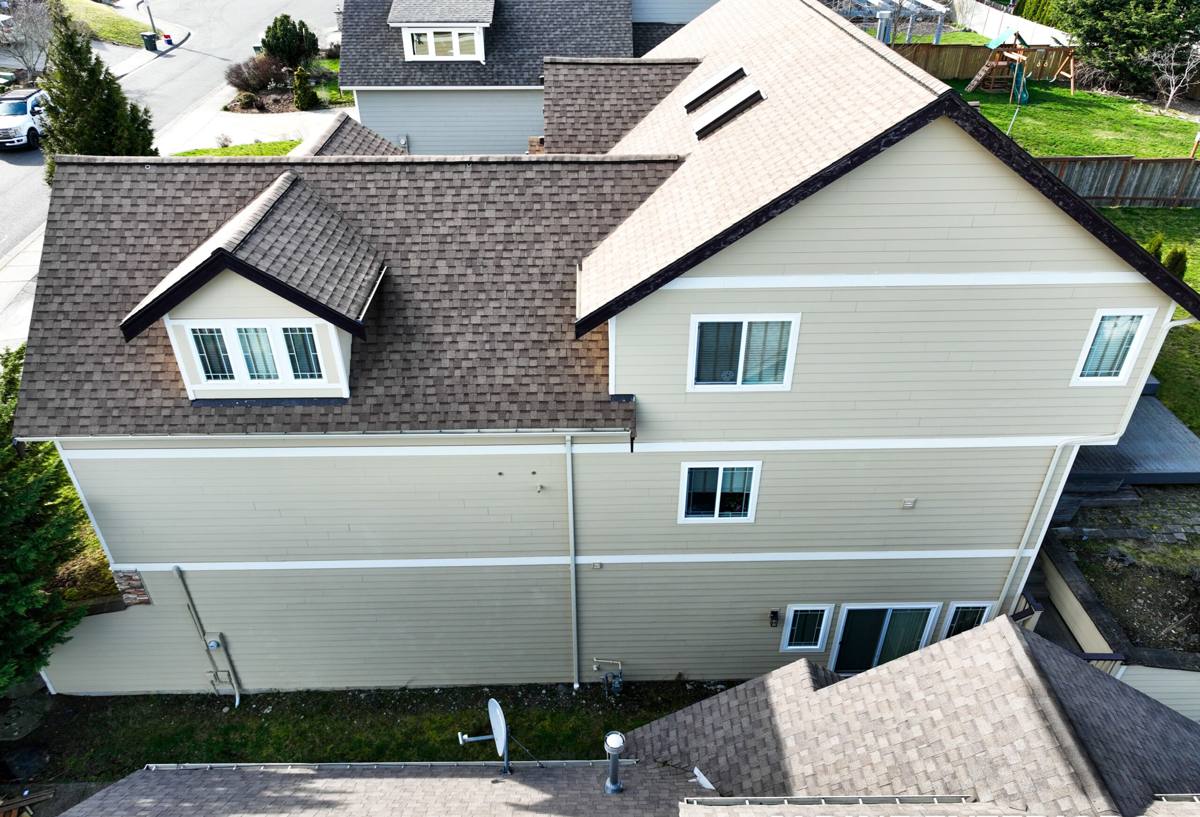
What Storm Damage Actually Looks Like
Not all storm damage is obvious from the ground, and not all of it needs a full roof replacement. Knowing what you're looking at — or having someone who does — matters before you spend money on the wrong fix.
Common Damage Types After a Blaine Storm
- Wind-lifted or creased shingles: Tabs that have been pried loose from their seal strip, even if they've settled back down, often won't reseal correctly on their own.
- Torn or displaced flashing: Around chimneys, vents, and roof valleys, where wind-driven rain finds the smallest gap.
- Granule loss: High wind and driving rain strip protective granules off shingles, accelerating UV and moisture damage even where the shingle looks intact.
- Debris punctures: Fir and cedar branches are common storm debris in this part of Whatcom County, and even small branches can puncture or crack shingles.
- Saturated decking: The damage you can't see from a ladder — plywood or OSB sheathing that's absorbed moisture through a compromised roof surface and has started to soften.
Some of these are visible from the ground with binoculars. Others only show up in an attic inspection, which is why a proper storm damage assessment checks both the roof surface and the underside of the deck, not just what's easy to photograph from the driveway.
Repair vs. Patch: What Separates Them
A patch stops the immediate leak. A repair addresses the reason water got in and restores the roof's ability to shed it correctly going forward. On Dakota Creek roofs, that distinction matters more than it does inland, because the same wind-driven rain that caused the original damage will find any shortcut in the fix.
What a Correct Repair Involves
- Matching shingle type, weight, and where possible color to the existing roof, not just the nearest available product.
- Replacing underlayment in the repaired section, not just the visible shingles, since compromised underlayment is often the real reason water got through.
- Rebuilding flashing details at valleys, chimneys, and penetrations with proper laps and sealant — not just caulking over the old metal.
- Checking fastener corrosion in the surrounding area, since salt air degrades fasteners faster than shingles wear out.
- Verifying the decking underneath is dry and sound before new material goes down over it.
Skipping any of these steps can leave a roof that looks fixed but fails again in the next significant wind event — often in the same spot, because the underlying cause was never addressed.
Our Process for Storm Damage Calls in This Area
When a storm damage call comes in from a Dakota Creek property, the process starts with the same basic steps every time, because skipping steps under time pressure is how repairs get done wrong.
- Initial assessment: A ground and roof-surface inspection to identify visible damage, followed by an attic check if there's any sign of water intrusion.
- Temporary protection: If the roof has an active leak or exposed decking, we get it tarped or otherwise protected before anything else, so the problem doesn't get worse while a permanent repair is scheduled.
- Documentation: Clear notes and photos of the damage, useful both for your own records and for an insurance claim if you're filing one.
- Written repair plan: What needs to be replaced, what can be left alone, and a straightforward explanation of why — not a bid padded with unnecessary line items.
- The repair itself: Done to match the existing roof system as closely as possible, with attention to the flashing and underlayment details that matter most in this climate.
We don't recommend replacing an entire roof section when a targeted repair will hold up. We also won't tell you a patch is fine when the underlying decking is already compromised. The goal is an honest read on what the roof actually needs.
Insurance Claims: What We Do and Don't Do
We're not insurance adjusters, and we won't pretend to be one. What we can do is provide a clear, documented, professional assessment of the storm damage — photos, a written description, and a repair scope — that you can hand to your insurance company or use to push back if an initial claim assessment seems incomplete. Many storm-related roof claims in this area come down to whether the damage was properly documented before repairs started, so getting an inspection soon after a storm, even if you're not sure you'll file a claim, is worth doing.
We won't inflate a damage report to help a claim along, and we won't tell you damage exists that isn't there. An honest assessment protects you either way — whether you're filing a claim or paying out of pocket.
What Storm Damage Repair Typically Costs
Costs vary widely based on the extent and location of the damage, but the factors below are what actually drive the number on any given job.
| Factor | Why It Matters |
|---|---|
| Size of the damaged area | A single lifted shingle section costs far less than a valley or slope that needs full re-do |
| Decking condition | Sound decking keeps a repair contained; saturated or soft decking adds material and labor to replace it |
| Roof pitch and access | Steep or hard-to-access roof sections take longer and require more safety setup |
| Flashing complexity | Valleys, chimneys, and multiple penetrations require more precise, time-intensive work than open field repairs |
| Material matching | Older or discontinued shingle lines can be harder to match, sometimes requiring a larger repair area for a visually consistent result |
Straightforward repairs to a small damaged area are often a modest expense measured in a few hundred to low thousands of dollars. Repairs involving decking replacement, extensive flashing work, or a full slope tend to run higher. We'll always give you a specific number after seeing the actual damage rather than a rough guess over the phone.
Repair or Replace: How to Tell
Not every storm-damaged roof needs a repair — some need a conversation about replacement instead, particularly if the roof was already near the end of its service life before the storm hit.
- If the roof is under roughly ten to twelve years old and the damage is localized, a repair is almost always the right call.
- If the roof is already showing widespread granule loss, curling, or moss damage across multiple slopes, storm damage in one area may just be the first visible sign of a roof that needs replacing soon anyway.
- If decking damage is extensive or has spread beyond the immediately visible leak area, a partial replacement of the affected roof section may make more sense than a patchwork repair.
- If the roof is old enough that matching materials is no longer possible, a repair may leave a visibly mismatched patch even if it's structurally sound.
We'll tell you honestly which category your roof falls into rather than defaulting to whichever option costs more.
What to Do Right After a Storm
The steps you take in the first day or two after storm damage can make a real difference in both the cost of repair and the strength of any insurance claim.
- Photograph visible damage from the ground — don't get on the roof yourself, especially in wet or windy conditions.
- Check the attic and ceilings for staining, dampness, or new odors, which can indicate a leak even without visible roof damage.
- Note the date and general conditions of the storm for your own records.
- Get a professional inspection scheduled promptly — small leaks left unaddressed through additional rain events get worse fast in this climate.
- Avoid temporary fixes like store-bought roof sealant on a wet roof, which can trap moisture and complicate a proper repair later.
Why Local Experience on This Stretch of Coast Matters
A crew that regularly works roofs in and around Blaine has already seen how salt air corrodes standard fasteners faster than manufacturer estimates assume, how wind off the water drives rain into places a drier-climate roofer wouldn't think to check, and which roof orientations in this area hold moss long enough to cause real damage underneath. That's knowledge that shows up in the details of a repair — the flashing lap, the fastener choice, the underlayment extension — not in anything you'd see by comparing two bids side by side. It's also why we'd rather do a repair right the first time than come back out in six months for the same leak in a different spot.
If you've got storm damage on a Dakota Creek roof, or you just want a professional look after a rough stretch of weather, we're glad to come take a straightforward, no-pressure look and put together a written estimate — use the form below to get started.