 Blaine Roofing
 Everson's Climate Is Harder on a Roof Than It Looks
Everson sits inland in the Nooksack River valley, and that location comes with its own set of roofing challenges. Morning fog settles in low-lying areas and burns off slowly under tree cover, which means roof surfaces here stay damp longer than they would on an open, breezy lot. Add in Whatcom County's long wet season and the moss and moss-friendly shade that comes with mature trees, and you get roofs that age faster than their warranty paperwork suggests. We also work the coastal side of the county out of Blaine, where salt air and driving rain create a different but related set of problems, and that broader regional experience is exactly what tells us how moisture behaves on a roof once it's had time to settle in — whether it's blowing in off the water or hanging in a river valley overnight.
None of this means an Everson roof is doomed to fail early. It means the roofing system underneath the shingles or metal has to be built to manage moisture, not just shed rain when it's falling straight down. A lot of the roofs we get called out to replace weren't bad roofs to start — they were roofs installed without accounting for how slowly things dry out in this part of Whatcom County.
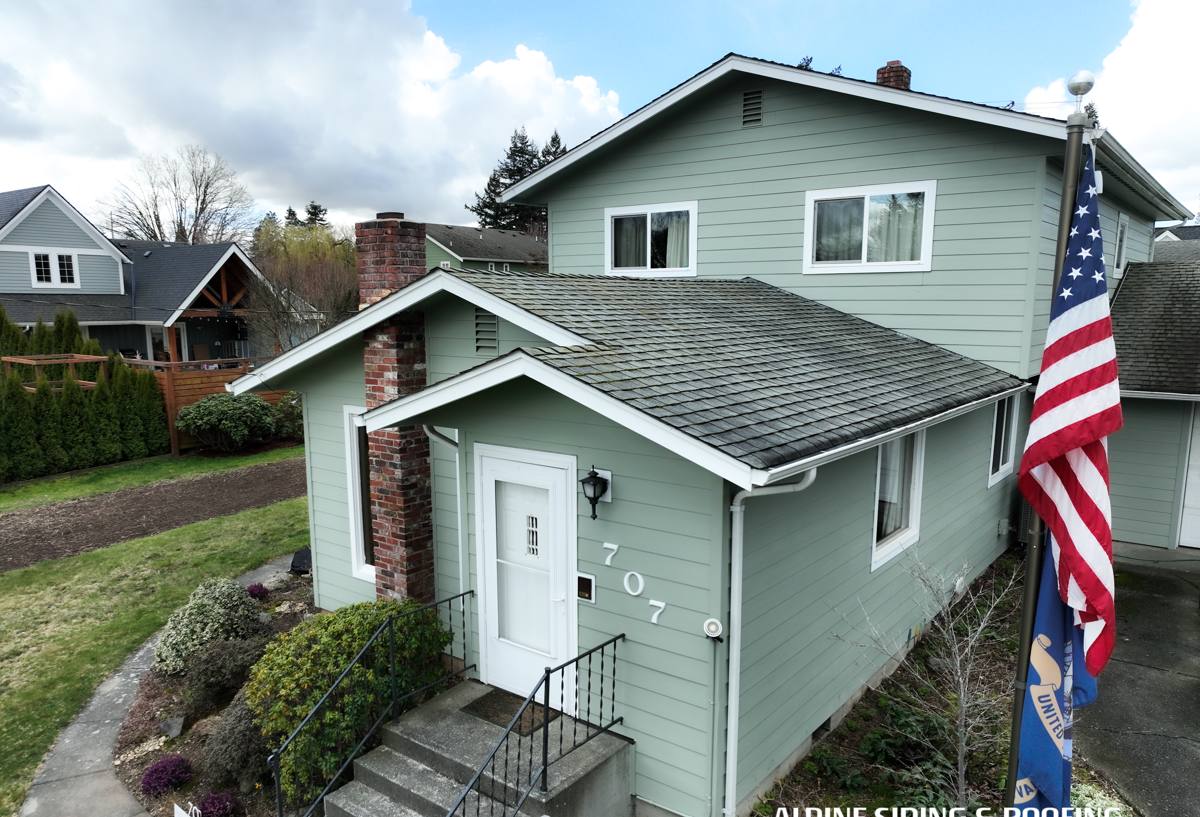
Signs an Everson Roof Needs Replacement, Not Just a Repair
What you can see from the ground or attic
Moss is the most obvious local sign, but moss itself isn't always the real problem — it's what moss holds onto. A moss mat traps water against the roofing material long after a storm passes, and over a few seasons that constant dampness breaks down shingle granules, softens underlayment, and can work its way into fastener holes. If you're pulling moss off every year or two and it keeps coming back thicker, that's a pattern worth having looked at rather than repeated indefinitely.
What shows up inside the house
- Dark staining or a musty smell in the attic, especially near the eaves or where the roofline meets an exterior wall
- Soft or discolored ceiling drywall, even if it's small and hasn't grown in size recently
- Daylight visible through the roof deck from inside the attic
- Granules collecting in gutters in noticeably larger amounts than in past years
- Shingles that look "shadowed" or uneven in color across large sections of the roof, which usually means the mat underneath is starting to fail
Any one of these on its own might be a repair. Two or three together, especially on a roof already past the middle of its expected life, usually points to replacement being the more honest recommendation.
What a Correct Replacement Actually Involves
Full tear-off and deck inspection
We don't install new roofing over old material. A tear-off is the only way to actually see the deck — plywood or planking that's been hiding moisture damage doesn't show itself until the old layer comes off. In a river-valley climate like Everson's, catching soft or delaminated decking early and replacing just those sections is far cheaper than discovering it years later as a sagging roofline or an interior leak.
Underlayment and moisture barrier
This layer matters more here than in drier parts of the state. A synthetic underlayment with good self-sealing properties around fasteners, plus ice-and-water shield style membrane at eaves, valleys, and any roof-to-wall transitions, gives the roof a second line of defense for the days when wind-driven rain or heavy fog gets past the primary surface.
Flashing at every transition
Chimneys, skylights, dormers, and roof-to-wall junctions are where the vast majority of leaks start — not out in the open field of the roof. Flashing has to be replaced, not reused, during a full roof replacement. Reusing old flashing to save time is one of the more common shortcuts we see on roofs we're asked to fix or replace early, and it's one we don't take.
Correct material installation
Every roofing product has an install spec from the manufacturer — nailing pattern, exposure, starter course, ridge treatment. Skipping or rushing any of these steps is usually invisible on installation day and shows up two or three years later as blow-offs, granule loss, or leaks at the ridge. We follow manufacturer specs because that's what keeps the warranty valid and the roof performing the way it's supposed to.
Choosing a Roofing Material for Everson's Conditions
There's no single "best" roofing material — there's a best fit for your home, your budget, and how much shade and moss pressure your particular lot deals with. Here's how the common options stack up for a climate like this one:
| Material | Moss/moisture resistance | Typical lifespan | Cost factor |
|---|---|---|---|
| Standard asphalt composition shingle | Moderate — benefits from good ventilation and periodic moss treatment | 20-25 years | Lowest upfront cost |
| Algae-resistant (AR) composition shingle | Better — copper/zinc granules slow moss and algae growth | 25-30 years | Slightly higher than standard shingle |
| Standing seam metal | Strong — smooth surface sheds moss and debris more easily | 40-60 years | Higher upfront cost, lower long-term maintenance |
| Synthetic/composite shake | Good — doesn't absorb moisture like wood, resists rot | 30-50 years | Mid-to-upper range |
We generally steer Everson homeowners toward algae-resistant shingle or metal on lots with heavy tree cover, simply because the maintenance burden of a standard shingle roof under constant shade is real — you'll be treating moss more often, and moss treatment done wrong can shorten a roof's life instead of extending it. That's a maintenance and moisture-behavior tradeoff, not a knock on standard shingles, which still perform fine on more open, sun-exposed lots.
Ventilation Matters as Much as the Shingles
A roof can have the best materials available and still fail early if the attic underneath can't breathe. Balanced intake at the eaves and exhaust at the ridge keeps warm, moist air from condensing on the underside of the deck — which is a major driver of hidden rot in roofs that see fog and heavy humidity for months at a time. During replacement, we check existing ventilation and correct it where it's undersized or blocked, since a new roof installed over bad ventilation just inherits the same slow-moisture problem the old one had.
Our Process for an Everson Roof Replacement
- On-site inspection and honest assessment of whether replacement or repair is the right call
- Written estimate outlining material options, scope of work, and timeline
- Scheduling that accounts for Whatcom County's wetter stretches, so tear-off and dry-in happen in a realistic weather window
- Full tear-off, deck inspection, and any necessary deck repair
- Underlayment, flashing, ventilation correction, and material installation to manufacturer spec
- Final walkthrough and cleanup, including magnetic sweep for nails and debris
We keep communication straightforward throughout — if we find deck damage or a ventilation issue once the old roof is off, you'll hear about it and see it before any additional work happens, not after the invoice.
Why a Crew That Already Works Everson Matters
Roofing permit requirements and inspection expectations vary by jurisdiction, and Whatcom County's rural and small-town areas have their own quirks compared to a larger city. A crew that already handles roofs in and around Everson knows what local building department review typically expects, which keeps a replacement moving instead of stalling on paperwork. Just as important, a crew that works this specific area regularly has a feel for how the local combination of tree cover, fog, and seasonal rain actually behaves on real roofs nearby — not just in a manufacturer's climate zone chart. That local pattern recognition is part of what shapes the material and ventilation recommendations above.
Roof Replacement Checklist for Everson Homeowners
- Get a full tear-off, not an overlay, if the roof is at or past its expected lifespan
- Ask specifically about ventilation — intake and exhaust should be addressed together
- Confirm new flashing is included at every chimney, skylight, and wall transition
- Choose a material rated for algae/moss resistance if the lot has heavy shade or tree cover
- Get the manufacturer warranty terms in writing, including what voids it
- Ask how deck damage, if found, will be priced and communicated before work proceeds
- Schedule around the wetter months where possible to protect the install window
If you're weighing repair versus replacement, or just want a straight answer on how much moss damage your roof has actually taken on, we're happy to take a look. There's no pressure and no obligation — just fill out the form below and we'll set up a free estimate.