 Blaine Roofing
 Why Nooksack Roofs Take a Different Kind of Beating
Nooksack sits in a part of Whatcom County where three things gang up on a roof at once: salt-laden air moving in off the water, long stretches of driving rain that comes in sideways as much as straight down, and a moss season that can run most of the year in shaded, north-facing sections of a roof. Any one of these is manageable on its own. Together, they shorten the life of roofing materials that aren't specifically suited to the combination, and they punish installation shortcuts that would go unnoticed in a drier, calmer climate.
Salt air accelerates corrosion on any exposed metal — fasteners, flashing, gutters — unless the coatings and hardware are chosen with that exposure in mind. Driving rain finds every gap in flashing and underlayment that a straight-down rain would never reach, because wind pushes water uphill under laps and around penetrations. And moss doesn't just sit on a roof looking bad — it holds moisture against the surface, works into seams, and lifts material at the edges over time. A roof built for a drier inland climate simply isn't built for what a Nooksack roof deals with every winter.
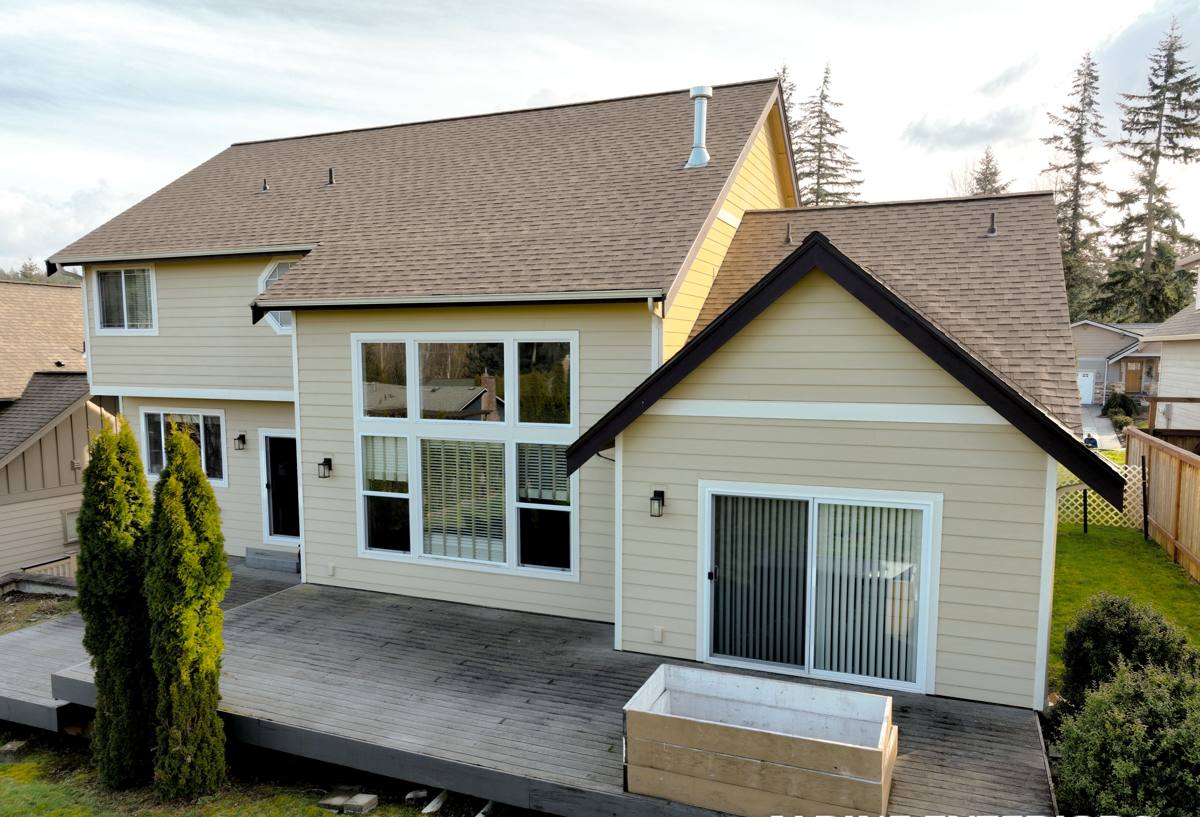
Why Metal Roofing Fits This Specific Area
Metal roofing has real advantages for a property in this kind of environment, but only when the right system and coatings are specified. Done correctly, a metal roof:
- Sheds driving rain fast, with steep-sloped panel profiles that don't give wind-driven water time to work against a seam
- Gives moss far less to hold onto than a rough-textured surface, since smooth painted steel or aluminum doesn't offer the surface grip organic growth needs to establish
- Holds up to coastal salt exposure when the panel finish, fastener hardware, and flashing metal are matched to each other — mixing incompatible metals is where corrosion problems actually start
- Handles the freeze-thaw and heavy moisture cycling common to this part of Whatcom County without the layered failure points a shingle roof develops over the same years
That said, metal roofing is not automatically the right fit for every roof or every budget, and it is not forgiving of a rushed or generic install. The value is in the details below — the parts of the job that don't show up in a sales pitch but decide whether the roof performs for the next several decades or needs attention in five years.
Where Metal Roofing Makes the Most Sense in Nooksack
Homes with steeper rooflines, heavy tree cover, or a clear line of sight toward open water tend to see the biggest benefit from switching to metal — steep pitches shed rain and moss debris faster, tree cover means more organic material landing on the roof over a season, and open exposure means more salt air contact. Lower-pitch roofs and heavily shaded roofs still benefit, but they need extra attention to ventilation and panel spacing, covered further down.
What a Correct Metal Roof Installation Actually Involves
Metal roofing looks simple from the ground — panels, seams, done. The parts that determine whether it holds up in this climate are underneath and at the edges.
Underlayment and Moisture Barrier
A metal roof in a high-rainfall coastal climate needs a full synthetic or self-adhered underlayment layer, not a minimal felt covering. This is the roof's backup defense — the layer that keeps the structure dry if wind-driven rain ever gets past a seam or a panel is compromised by a fallen branch. In a drier climate this layer matters less; here, it's not optional.
Fastener and Flashing Compatibility
Salt air punishes mismatched metals. Steel fasteners against aluminum panels, or the wrong flashing alloy at a valley or wall transition, sets up galvanic corrosion that shows up as staining and eventual failure at exactly the points where water is already concentrated. Every fastener, flashing piece, and trim component on a correctly installed metal roof is chosen to be compatible with the panel material and rated for coastal exposure.
Panel Attachment and Seam Type
How a panel is attached and how its seams are formed matters more here than in a calmer climate. Standing seam panels, where seams are mechanically formed and raised above the water line, handle driving rain and wind uplift better than exposed-fastener panels, where screws penetrate the panel face directly. Exposed-fastener systems can still be the right call on some structures, but they require closer attention to fastener gaskets and a shorter realistic maintenance interval.
Flashing at Valleys, Walls, and Penetrations
Nearly every roof leak that isn't simple material failure starts at a flashing detail — a valley, a chimney, a vent pipe, a wall intersection. Wind-driven rain moves under laps that a straight-down rain would never test, so flashing needs to be sized and lapped for that reality, not just for a standard rain event.
Ventilation and Airflow Behind the Panel
Metal panels installed directly against solid sheathing with no airflow behind them trap moisture, which shows up as condensation on the underside of the panel and premature deterioration of the sheathing below. A correctly detailed metal roof includes an air gap or vented system so the assembly can dry out between rain events instead of staying damp under a shaded, moss-prone roof plane.
Panel Options: What Fits a Nooksack Roof and What to Weigh
There isn't one universally "best" metal panel — the right choice depends on roof pitch, budget, and how much of the roof sees shade and salt exposure. Here's how the common options compare for this specific climate:
| Panel Type | Typical Lifespan | Best Suited For | Maintenance Consideration |
|---|---|---|---|
| Standing seam steel | 40-60+ years | Steeper pitches, coastal exposure, long-term ownership | Low — concealed fasteners resist corrosion best |
| Exposed-fastener steel | 25-40 years | Budget-conscious projects, simpler roof shapes | Moderate — fastener gaskets need periodic inspection |
| Aluminum standing seam | 40-60+ years | Direct salt air exposure, waterfront-adjacent lots | Low — naturally corrosion-resistant, needs compatible hardware |
| Stone-coated steel | 30-50 years | Homeowners wanting a shingle-like profile with metal durability | Moderate — textured surface holds more moss debris than smooth panel |
For homes closest to open water or with a lot of shaded, moss-prone roof area, standing seam steel or aluminum tends to be the better long-term fit because of the smoother surface and concealed fasteners. Stone-coated steel is a reasonable middle ground when appearance is a priority, but its texture means moss and debris removal needs to happen a little more often.
Our Process for a Nooksack Metal Roof Project
- On-site assessment — we look at pitch, tree cover, sun exposure, and how close the property sits to salt air sources before recommending a panel type
- Deck and structure inspection — moss and moisture problems on an old roof often mean the deck underneath needs attention before new panels go on
- Underlayment and flashing plan — we spec these to the specific exposure of your roof, not a one-size-fits-all standard
- Panel installation — attention to seam type, fastener compatibility, and proper panel spacing for ventilation
- Final walkthrough — checking flashing laps, seam closures, and trim details before we consider the job finished
Living With a Metal Roof in a Moss-Heavy, Salt-Air Climate
A correctly installed metal roof in this climate needs far less upkeep than a shingle roof, but "far less" isn't "none." A simple seasonal routine keeps the roof performing the way it's designed to:
- Clear fallen leaves and needles from valleys and low-slope sections before they hold moisture against the panel
- Check for any moss establishing at shaded seams or panel edges and remove it before it gets a foothold
- Look over flashing at chimneys, vents, and walls once a year for any lifting, gaps, or staining
- Rinse accumulated salt residue off the roof surface periodically if the home sits close to open water
- Confirm gutters and downspouts are clear so water isn't backing up against the roof edge during heavy rain
Why a Crew That Already Works Nooksack Matters
The details above — fastener compatibility, flashing sizing, ventilation, panel selection by exposure — aren't things a crew figures out by reading a manufacturer's install guide. They come from having actually installed and later serviced metal roofs in this specific mix of Whatcom County salt air, rain patterns, and moss pressure, and seeing which details held up and which didn't. A crew unfamiliar with this area may build to a generic standard that's fine somewhere drier and calmer, but leaves gaps here that show up as problems years down the road, often after the workmanship warranty has expired.
Cost Factors to Expect
Metal roofing costs more upfront than asphalt shingles, and the honest range depends heavily on panel type, roof complexity, and how much of the existing structure needs repair before installation. Standing seam systems run higher than exposed-fastener panels because of the labor and material involved in forming and closing concealed seams correctly. Roofs with a lot of valleys, penetrations, or wall transitions cost more to flash properly than a simple gable roof. Any deck repair discovered during tear-off is a separate line item, which is why the on-site assessment matters before a firm number gets set.
If you're weighing a metal roof for a property in Nooksack, we're glad to take a look and walk through what your specific roof needs — no pressure, no upsell, just a straight assessment and a written estimate you can think over.